





































































































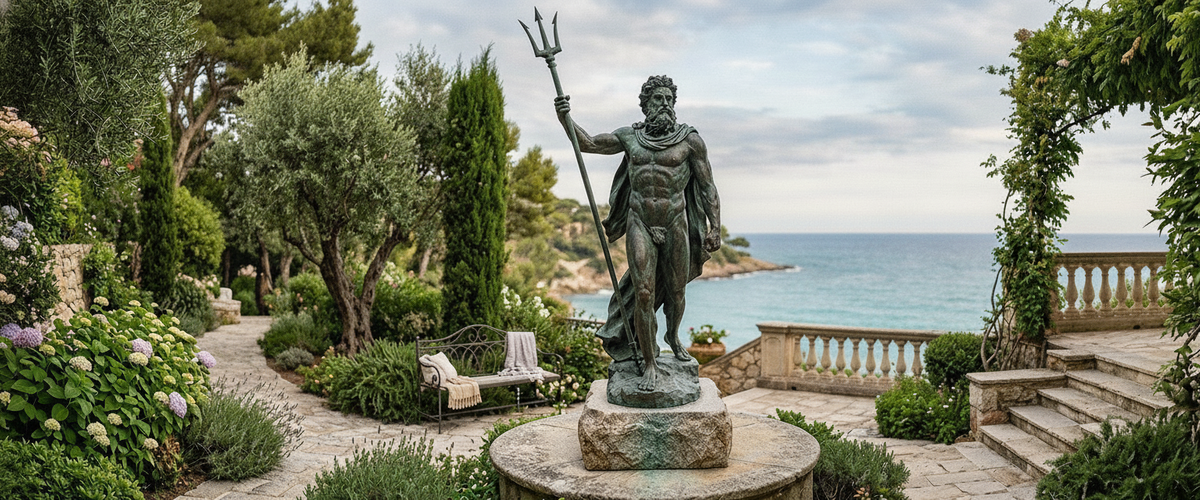

Three gods, three different browns. That is how most collections of bronze Greek god statues quietly come apart, and it never happens on day one. It happens in year four, when the third figure arrives from a different foundry, sits eight inches lower than the others, and glows a warm chocolate next to two cool green-black neighbors. The sculptures are fine. The set is not.
Looking for the full range in this category? Browse our Bronze Sculptures collection for every available finish, size, and configuration.
A pantheon grouping is an act of composition before it is an act of buying. Bronze Greek god statues acquired one at a time still have to behave like a single commission, and that only happens if the rules are written down early. Get the planning right and a set assembled slowly looks deliberate. Get it wrong and it looks like a garden center clearance line arranged by height.

Key Takeaways
Choose your anchor god first and scale every other figure against that one, not against the space.
Patina is the hardest thing to match across two foundries. Record the recipe, not just the color name.
Attributes (trident, thunderbolt, lyre) must stay legible from about twenty paces or the group turns into anonymous nudes.
Space gods so they face each other at slight angles rather than lining up along a path.
Plinth material, cap profile, and height increments do more for the coherence of bronze Greek god statues than the castings themselves.
Decide the Hierarchy Before You Buy a Single Figure
Greek mythology already gives you a chain of command, and the best groupings of bronze Greek god statues respect it. One god anchors the composition; the others answer to it. Zeus, Athena, or Poseidon usually takes the anchor role because each carries enough visual mass and enough recognizable attribute to hold a sightline on its own. Apollo, Artemis, Hermes, and Hebe read beautifully as supporting figures and awkwardly as leads.
Write the hierarchy down before you spend anything. Anchor figure, two secondary figures, optional tertiary pieces. That single page controls every later decision: which sculpture gets the tallest plinth, which one faces the approach, which one you can afford to place in half shade. A courtyard we worked on in Napa started with a striding Poseidon as anchor and added Apollo and Artemis eighteen months later at deliberately reduced scale. It reads as one commission because the client refused to buy anything that competed with the anchor.

Why Zeus at Life Size and Apollo at Seven-Eighths Wrecks a Courtyard Line
Foundry catalogs rarely use consistent scale language, and bronze Greek god statues are sold under wildly different definitions of the same words. "Life-size" from one maker might mean 5 feet 10 inches (178 cm); from another it means a heroic 7 feet (213 cm). Buy a Zeus at true life size and an Apollo at seven-eighths and the eye does not read "hierarchy." It reads "error," because Apollo is supposed to be a tall, athletic god and now he is shorter than his father by an odd, unresolved amount.
Scale differences work when they are decisive. A 10 to 20 percent step down is a mistake; a 30 to 40 percent step is a compositional choice. Set the anchor at a monumental 9 feet 10 inches (300 cm), the working height of a figure like the Life-Size Classical Greek Warrior Bronze Statue, 300cm, then put the secondary figures at roughly 8 feet 2 inches (250 cm) and the gap is close enough to feel like a mistake rather than a decision. Drop those secondary figures to a clearly subordinate height, or lift the anchor on a taller plinth, and the group snaps into order. Always confirm actual figure height and plinth height as separate numbers before ordering, because the combined figure quoted in a listing can hide a foot of stone.
An anchor figure with clearly subordinate secondary deities keeps the hierarchy readable from the approach.
Matching Patina Across Two Foundries Is Harder Than Matching Two Castings
Patina is where bronze Greek god statues most often betray a piecemeal purchase history. Two skilled foundries will produce very similar castings from the same model. They will almost never produce the same patina. Patination is a chemical process using heat and applied solutions, and the outcome shifts with alloy composition, surface texture, ambient humidity, and the individual hand doing the work. The National Center for Preservation Technology and Training has documented how much outdoor bronze surfaces continue to change once installed, with coatings and exposure driving the rate of that change.
Practical protections: keep a physical sample coupon from your first figure and send it with every later order. Record the patina name, the foundry, the alloy, and the protective coating system used. Photograph the finished piece in daylight against a gray card. When we take on staged commissions for Greek gods bronze statues, we hold the recipe on file specifically so figure four still matches figure one. If your first piece came from elsewhere, expect to blend the new casting toward the old, not the other way round, and budget time for on-site adjustment.
Attributes That Must Stay Legible at Twenty Paces
A bronze god without a readable attribute is just a figure. Legibility is the second thing anyone notices about bronze Greek god statues, right after sheer size. From close range you can see the detail; from across a lawn you cannot. Poseidon needs a trident with enough tine length and shaft diameter to break the silhouette. Zeus needs a thunderbolt held clear of the body, not tucked against the thigh. Apollo needs a lyre turned outward so the strings catch light rather than disappearing edge-on.
Ask for silhouette checks during modeling. We print the profile at scale and view it from the intended approach distance. Armored deities are the safest bet at distance: on a figure such as the Monumental Classical Armoured Goddess Bronze Statue, 250cm, the helmet crest and aegis carry identity long before facial modeling becomes readable. Thin, delicate attributes need thickening for outdoor work anyway, both for legibility and for structural sense in wind.

Spacing So the Gods Converse Rather Than Queue
The default instinct is to line figures along a path at even intervals. That produces a queue. Rotate each figure 15 to 20 degrees toward a shared point and place them on an implied arc or triangle instead, and the group starts to feel like an assembly. Uneven spacing helps too: two figures closer together with the anchor set apart creates tension worth walking toward.
Interior and terrace groupings follow the same logic at smaller scale. Where the surface is a console or a loggia table rather than a lawn, a set cast as one batch, such as the Classical Four Seasons Goddesses Bronze Sculpture Set, 40cm at around 16 inches (40 cm) each, holds together because the figures were modeled, proportioned, and patinated together. That is exactly the coherence you are trying to reproduce at monumental scale.
An implied arc and matched plinths turn a row of separate purchases into one composition.
Buying One Bronze Greek God Statue a Year: The Checklist
Fix the master scale in writing before the first purchase, including plinth heights for every planned position.
Lock one foundry and one alloy where possible; mixed suppliers are the main source of patina drift.
Keep a patina reference sample and daylight photographs of every completed figure.
Specify the same coating system and put every figure on the same waxing schedule, usually one or two cycles a year outdoors.
Pour all footings at once, even if the sculptures arrive years apart. Retrofitting foundations into a mature garden is disruptive and rarely lines up.
Confirm fixing method early: internal armature, threaded rod locations, and drainage at the base.
Plan the last figure first, so the composition still resolves if the final purchase is delayed.
Plinth Consistency Is What Sells the Illusion
Visitors do not audit patina; they read plinths, and the stonework does more visible work than the bronze Greek god statues standing on it. Same stone, same cap profile, same chamfer, same bolt pattern. Height varies by hierarchy in clean increments rather than by whatever the mason had left. Granite and limestone both age well outdoors; mixing them across one group is the fastest way to expose a piecemeal purchase history.
Have the stone cut in one batch from one block if you can, then store the unused plinths. Stone quarried three years apart from the same quarry can differ noticeably in tone and vein. It is a small logistical annoyance that buys you a group that looks commissioned rather than collected.

Commissioning the Set Rather Than Assembling It
The alternative to all of this is to commission the group as one project. You still take delivery in phases, but hierarchy, scale, patina, attributes, and plinths are resolved once at the drawing stage. Giant Sculptures works this way regularly with landscape designers and estate clients, developing bronze Greek god statues as a coordinated set with staged casting and a single specification. Budget depends on material, scale, complexity, engineering, installation, and finishing, so the sensible first step is a tailored quote against your site plan rather than a figure-by-figure comparison.
If you are still shaping the cast list, our bronze mythology and goddess statues and wider Greek and Roman statues ranges show how Greek gods bronze statues behave at different heights and help you test which deity holds the anchor role in your space. Decide the composition first. The castings are the easy part.
For wider placement ideas, Bronze Greek Gods Statues: Placing Zeus, Apollo and Poseidon Well is useful companion reading before finalising the setting and sightlines.