













































































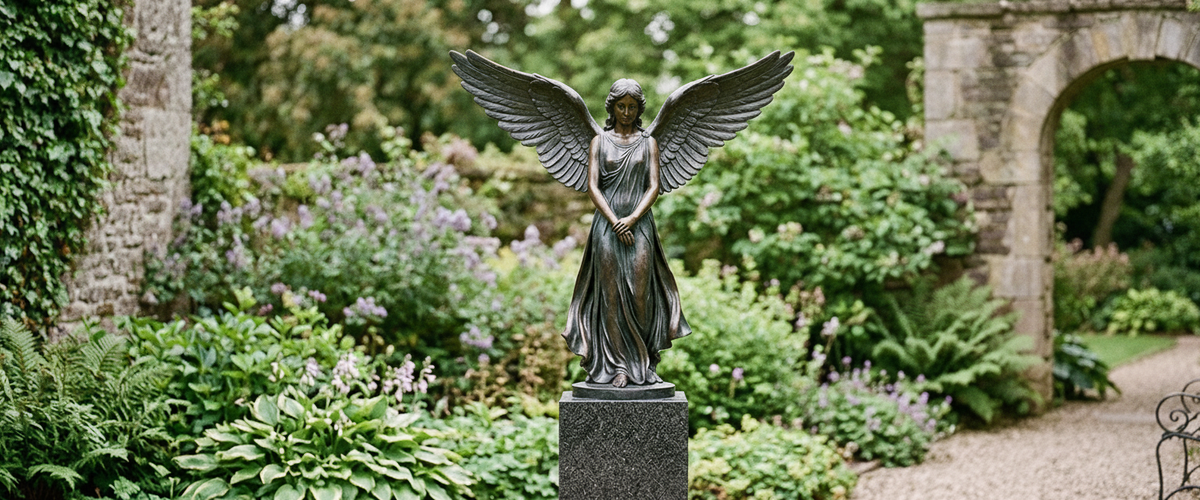

Most catalog photography for a church supply angel statue is a lie of omission. The camera sits at chest height, four feet away, with soft even light raking across the face. Nobody in your building will ever see the piece that way. They will see it from the back pew, sixty feet off, lit by a clerestory window that moves through the day, or from a gravel path in a memorial garden at four in the afternoon in January. Buy for the catalog photo and you get a church supply angel statue that looks beautiful in a crate and flat on a plinth.
Key Takeaways Before You Order
Scale is set by viewing distance, not by budget. A church supply angel statue that works at 12 feet can vanish at 60.
Interior materials and exterior materials are not interchangeable. Plaster and soft indoor marble fail fast outside; bronze and dense stone do not.
Light does half the carving. Uplighting a pale angel from below flattens the face and turns the eye sockets into hollows.
Catalog casts suit repeat memorial use; commissions suit a specific person, patron saint or dedication.
Clearance matters as much as the statue. Most memorial angels are crowded by the things placed around them within two years.
Ask for a quote based on your site. Cost for a church supply angel statue tracks material, scale, complexity, engineering, finishing and installation, so there is no useful shelf price.

Nave, Narthex or Memorial Garden: One Statue, Three Different Lights
The same church supply angel statue behaves like three separate sculptures depending on where it lands. In a narthex it is seen close, at walking pace, usually from the side as people move past. Detail earns its keep here: feather edges, the fall of drapery, a hand that holds something. In the nave it is seen head-on and far away, often against a bright window, which means the silhouette carries everything and the face carries almost nothing. Outside in a memorial garden it gets daylight from every angle, weather, and a background of hedging or sky rather than plaster.
Parishes that shop a church supply angel statue by thumbnail tend to pick one designed for the first condition and install it in the second or third. We had a congregation in North Texas send us phone photos from the altar steps, which looked promising, then a second set taken from the last row once the piece was in. Same statue, unrecognizable presence. The fix was a taller plinth and a repositioning of about eight feet forward, which cost them nothing but a Saturday.
Reading Distance: Why Pew-Back Sightlines Beat Plinth Photography
Before you shortlist anything, walk to the furthest seat a congregant will use and measure back to the intended position. That number decides the height range for your church supply angel statue. As rough working guidance from installations we have handled: under 20 feet, a figure around 4 to 5 feet (120 to 150 cm) holds its own. From 30 to 50 feet, you want something close to life size or above, in the region of 6 to 7 feet (180 to 210 cm). Beyond 60 feet, or in a garden with open sky behind it, you are into monumental territory from around 7 ft 10 in (240 cm) upward, because sky eats mass.
Silhouette does the long-distance work. Where the sightline runs the full length of a nave, an open-winged form such as the Life-Size Classical Standing Angel Bronze Sculpture (Wings Spread Wide) - 220cm, stays legible in a way a compact figure will not, because the wing spread breaks the vertical column of the body and creates a shape the eye recognizes instantly. A kneeling figure with folded wings reads as a single mass at that range and needs to sit much closer to the congregation, or on a raised base, to keep its meaning.
Wing spread keeps the silhouette of a church supply angel statue readable at sixty feet, where facial detail disappears.

Catalog Casts Versus Commissioned Work, and Where the Difference Shows
Families often arrive having found a church supply warehouse listing for a "With You" memorial angel statue, that familiar kneeling figure with folded wings and a downcast face. A stock church supply angel statue exists for good reason. These casts are consistent, recognizable, and a parish can add matching pieces to a columbarium wall over ten years without a mismatch. If your memorial program is ongoing and you want visual continuity across many dedications, a catalog cast is the sensible answer.
A commissioned church supply angel statue earns its money when the piece has to say something specific. A dedication to a named parishioner, a patron saint with a particular attribute, an angel holding an object that means something to one family, a figure sized to an existing niche that no standard cast will fit. It also matters when the piece must sit against existing sculpture and match its scale conventions. Our studio spends a surprising amount of time adjusting head-to-body proportion for pieces destined to be seen from below, since a figure modeled to look correct at eye level goes slightly wrong once it sits on a high plinth and the viewer is looking up at it.
The honest middle ground: many buyers start from a catalog church supply angel statue in our bronze angel and cherub statues range and commission changes to pose, patina, base and inscription plate. That keeps the cost structure sane while making the piece specific to your building.
Indoor Plaster and Marble Against Outdoor Stone: The Swap That Ruins Pieces
This is the single most expensive mistake we see. A parish buys a plaster or composite interior church supply angel statue, loves it, then moves it into the memorial garden five years later when the church is reordered. Plaster takes on water, freezes, and spalls. Softer decorative marbles suffer from salt crystallization and acid rain, and once the polished surface sugars, the detail is gone permanently. The Getty Conservation Institute's work on stone deterioration is clear about how quickly salts and freeze-thaw cycling do structural damage in exposed conditions.
Cast bronze handles freeze-thaw and coastal salt in ways plaster and soft marble never will.
For anything permanently outdoors, cast bronze is the safest long-term choice, followed by dense weather-tested stone such as granite. Bronze does not spall or sugar; it develops a patina, and with an annual wax and wash it holds its color for generations. Historic England's guidance on caring for outdoor monuments is worth reading before you commit to any exterior material. If a church supply angel statue is going into a coastal garden with salt air, or somewhere with hard freeze-thaw winters, tell your supplier at the quoting stage rather than after casting. Patina choice and base detailing both change.
Candlelight, Clerestory Light and Uplighting on a Pale Angel Figure
Pale surfaces are unforgiving. Uplight a white marble or light-toned church supply angel statue from ground level and you invert every shadow the sculptor intended: the brow ridge throws a shadow upward, the eye sockets go black, the underside of the jaw glows. The face stops looking peaceful and starts looking severe. Light from above and slightly to the side instead, at roughly 30 to 45 degrees, and let a low secondary source lift the shadow side without erasing it.
Candlelight is the opposite problem: warm, low, flickering, and beautiful on modeled surfaces but hopeless for legibility. If a votive stand sits near your church supply angel statue, treat the candles as atmosphere and add a discreet fixed source for the figure itself. Clerestory light moves. A statue that looks superb at 10am can silhouette into a dark shape by 3pm if it stands directly in front of the window. Stand in the space at three different hours before you fix the position. It takes a day and saves a reinstallation.
Darker patinas behave differently again. Against pale plaster or limestone walls, a dark-bronze figure such as the Large Classical Kneeling Angel Bronze Sculpture (Dark Patina) - 200cm asks for more light than a marble piece, not less, but it rewards it: the highlights on the wing edges and shoulders do the drawing, and the figure gains a gravity that pale stone rarely manages indoors.

Placement Habits That Crowd a Memorial Angel Out of Its Own Space
For wider placement ideas, Resin Garden Angel Statues: Placement, Scale, and When to Buy Something That Lasts Longer is useful companion reading before finalizing the setting and sightlines.
An angel memorial statue arrives with clear ground around it, and within two years it is fenced in. Planters creep forward. Bench dedications go in at the flanks. Cut flowers, laminated photographs, weatherproof boxes of prayer cards, a low chain rail, seasonal wreaths. Every one of these is well meant and every one shrinks the piece.
Set the rule the day your church supply angel statue goes onto its base, and write it into the memorial policy. A useful working figure: keep clear floor or ground within a radius equal to the height of the statue on its primary viewing side, and at least half that on the other three. For memorial garden angel statues that means the planting scheme has to be designed around the figure rather than grown into it. Hedging behind is fine and often helps by giving a plain backdrop. Hedging beside is how a 7-foot angel becomes a 4-foot angel.
The other habit worth breaking is centering everything. A church supply angel statue placed dead center at the end of an axis is formal but static. Offset it slightly, angle it maybe 15 degrees off the path line, and it starts to feel like a presence rather than a marker. Figures with an extended arm gain most from this, which is why something like the Monumental Classical Angel with Flower Basket Bronze Sculpture - 240cm is better set at an angle to the approach than square to it: the basket arm then reads as gesture rather than as a flat frontal pose.
Pet Memorials: Angel Cat and Angel Dog Statues in Church Grounds
More parishes and private memorial gardens are setting aside a corner for animal remembrance, often near a columbarium wall or a quiet side path. An angel cat memorial statue or angel dog memorial statues generally work best at a smaller scale than the human memorial pieces, placed low, and kept visually separate from the main dedication so neither reads as an afterthought. Bronze is again the practical material here; small pale composite pieces in an exposed corner tend to look tired within a few seasons.
Keep the sculptural language consistent. If the main garden angel is classical, a cartoonish pet piece will fight it. Our studio has produced companion animal figures in the same patina family as an existing church supply angel statue so that the two areas read as one commission, which is the kind of detail that only shows up years later when everything has weathered together.

Your Pre-Order Checklist
Measure the furthest viewing distance and choose the height of your church supply angel statue from that, not from the photograph.
Confirm indoor or outdoor placement before selecting material, and say so in writing.
Check the piece at three times of day if a window is in play.
Confirm plinth height, foundation depth and fixing method with your installer.
Measure doorways, gate widths and turning circles for the crate, not just the statue.
Agree the wing-tip clearance; wings are the first thing damaged in transit and installation.
Decide patina or finish with the surrounding stone and metalwork in front of you.
Write a clearance rule into the memorial policy so the piece keeps its space.
Plan annual care: wash and wax for bronze, gentle cleaning for stone, no pressure washing.
Request a tailored quote for your church supply angel statue covering material, scale, complexity, engineering, finishing and installation.
Commissioning a Church Supply Angel Statue with Giant Sculptures
We work with parishes, memorial committees, landscape designers and families on large-scale angel and religious commissions, from single dedications to multi-piece garden schemes. Send us the room or the site: photographs from the actual viewing positions, ceiling or canopy heights, the sightlines that matter, and any existing sculpture the new piece has to live beside. That is more useful than a wish list of dimensions.
From there we can advise on form, scale and material, adapt an existing model from our angel statues collection or develop a new one, and handle crating and delivery worldwide. Congregations looking at broader schemes, including saints and figurative groups, will find related work in our religious statues range. Whichever route you take, choose your church supply angel statue for the light you have and the distance people will stand at. The rest follows.