





































































































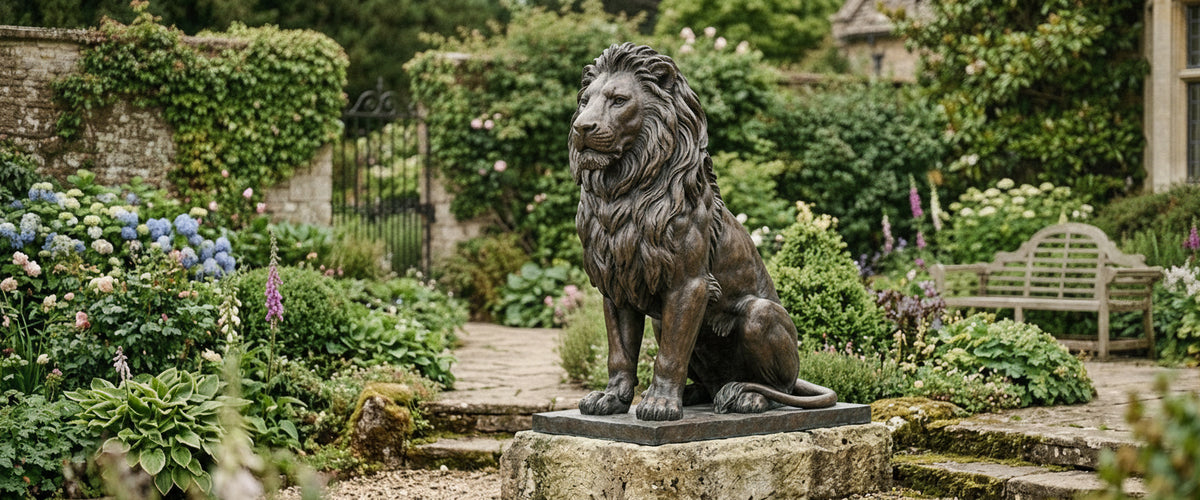

A bronze lion tells visitors where they stand before a word is spoken. Get the pose and scale right and the piece reads as calm authority; get them wrong and a proud animal shrinks into an ornament stranded on a step. That gap between statement and afterthought is what this guide is about. A bronze lion statue is one of the most requested subjects we handle, and the buyers who get it right tend to think about proportion and site first, aesthetics second.
A matched pair frames an entrance and signals guardianship the moment guests arrive.

Bronze Lion Statue at a Glance
Best for: entrances, driveways, formal gardens, hotels, and civic or commercial thresholds that need presence.
Material: cast bronze is the durable choice for outdoor lions; it ages gracefully and lasts generations.
Poses: seated (guardian), recumbent (calm and classical), crouching or roaring (tension and drama).
Scale: read it against your building, not the showroom. Most freestanding lions look right between roughly 4 and 7 feet tall (1.2 to 2.1 m) on a plinth.
Cost: depends on size, casting complexity, finish, and installation, so ask for a tailored commission quote.

What a Bronze Lion Statue Means, and Who It Suits
The lion has stood for guardianship and rank for thousands of years, from Assyrian palace reliefs to the guardian lions flanking temple gates across East Asia. That symbolism is exactly why buyers keep returning to it. A lion at a threshold signals protection and confidence without needing explanation.
In practice, we see three buyer types. Homeowners want a pair to frame a driveway or a grand entrance, often on estates where the approach matters as much as the house. Hospitality and commercial clients want a single dominant piece for a lobby forecourt or hotel arrival court. Collectors and designers want something specific in pose and patina that suits an existing scheme. If any of those describe you, a cast lion earns its place. If your space is small and informal, the animal can overpower it, and a smaller bronze figure may serve you better.

Materials, Finishes, and Scale Decisions
Bronze is the material of choice here for a simple reason: it survives outdoors for generations with modest care. Cast bronze develops a patina, a thin protective surface layer, rather than corroding away. That is the same principle behind the lions in London's Trafalgar Square, cast from bronze and still standing after more than a century and a half of weather and city grime. The four Landseer lions were unveiled in 1867 and, as Royal Museums Greenwich records, were cast from bronze in the studio of animal painter Sir Edwin Landseer.
Finish is where the sculpture gains character. A traditional dark brown or near-black patina reads formal and classical. Warmer brown tones with highlighted edges show the muscle and mane more clearly in sunlight. A verdigris (green) patina gives an aged, antique-monument look that suits mature gardens. All of these are applied by hand at the foundry using heat and chemistry, so no two pieces are identical, which is part of the appeal.
Getting the Scale Right
Scale is the single most common mistake. A lion that looks imposing in a photograph can look modest once it sits beside a two-story facade or at the mouth of a long drive. Our rule of thumb: measure the architecture the piece will sit against, then choose a form that holds its own from the point where visitors first see it, not from three feet away.
On a long sightline, a taller seated form carries across the distance far better than a low figure.
For a pair flanking a gate or steps, symmetry usually wins, and a matched set such as the Large Classical Seated Lions Bronze Sculpture - 130cm gives that balanced, guarded look. On a longer sightline where a single hero piece has to carry across distance, a taller seated form like the Large Classical Seated Lion Bronze Sculpture - 220cm reads far better than a low recumbent figure would.

Poses, and What Each One Says
Pose changes the whole message, so choose it against the mood you want at the threshold.
Seated guardian: upright, alert, watchful. The classic choice for entrances and the East Asian guardian-lion tradition. Where the threshold calls for ceremony and protection, a form like the Large Traditional Chinese Guardian Lion on a tiered Greek key plinth is closer to the right design language than a bare recumbent figure.
Recumbent: lying down, composed, regal. Reads calm and confident rather than defensive. A long recumbent form stretches along a lawn edge or terrace wall without demanding a tall plinth.
Crouching: coiled, low, ready. Adds tension and works well where you want energy rather than stillness.
Roaring: the most dramatic reading, best where the sculpture is the focal point and has room to be seen from the front.
Guardian lions are traditionally placed as a male and female pair, one with a paw on a ball, the other with a cub, so think about whether you want a matched set or a single statement before you commit.
Where to Place a Bronze Lion Statue for Impact
For wider placement ideas, Bronze Tabletop Sculptures: How Scale and Placement Decide the Whole Effect is useful companion reading before finalising the setting and sightlines.
Placement decides whether the piece commands the space or just occupies it. A few principles hold across projects:
Entrances and gates: pairs work best here, set back far enough that a car or guests pass between them comfortably. Give each figure a plinth so the head sits near eye level or above.
Driveways and approaches: a large bronze sculpture placed at the turn or the crest of a drive rewards the long view. Point the lions to face arrivals, not the house. Bronze lion statues outdoor look their best where the approach gives them room to be seen.
Formal gardens and terraces: recumbent lions along a balustrade or at the head of steps feel classical without blocking sightlines.
Commercial forecourts: a single dominant piece in a hotel or corporate arrival court sets tone instantly. Allow clear circulation around it.
One lesson from the studio: buyers almost always underestimate the plinth. A lion sitting directly on paving loses its authority. Lifting it onto a stone or bronze base of the right height changes the whole read, and it protects the metal from ground splash and mower damage.
Budget, Commissioning, and Delivery
There is no honest flat price for a cast lion, because the figure moves with size, wall thickness, casting complexity, the finish, the plinth, and how it gets installed. A pair of large lions with bespoke patina is a different proposition from a single stock-size piece. The sensible approach is to tell us the site, the pose, and the scale you have in mind, and we will return a tailored quote rather than a guess.
Large bronzes are heavy. A freestanding lion of six or seven feet can weigh several hundred pounds (well over 150 kg), so delivery and placement need planning: access for the truck, equipment to lift and set the piece, and a base that can carry the load. We handle worldwide shipping and will talk through crating, access, and installation before anything is cast. It is worth raising site access at the enquiry stage, not after the piece is finished.
Commissioning Checklist
Confirm the viewing distance and the architecture the piece sits against.
Decide single piece or matched pair, and lock the pose.
Choose the patina and whether you want a bronze or stone plinth.
Check delivery access: gates, driveways, ground level, and lifting equipment.
Agree the base fixing so the sculpture is stable and level for the long term.
Ask about aftercare so the patina stays sound outdoors.
How Giant Sculptures Helps With Bespoke Lions
Giant Sculptures is a bespoke supplier of large-scale sculpture, and lions are a subject we handle often. Beyond the pieces in our bronze lion statues collection, we commission to a client's site: adjusting scale to suit a facade, matching a pair for symmetry, specifying a patina to sit with existing stonework, and engineering the base so a heavy bronze stands safely for decades. A large bronze lion statue can also double as a water feature; we produce bronze fountains where the sculpture and the waterwork are designed together rather than bolted on afterward.
A good lion is a fifty-year decision, not a seasonal buy. Spend the time on pose, scale, and placement up front, get the plinth and the fixing right, and the piece will still be holding its ground long after the surrounding planting has grown in around it.