






































































































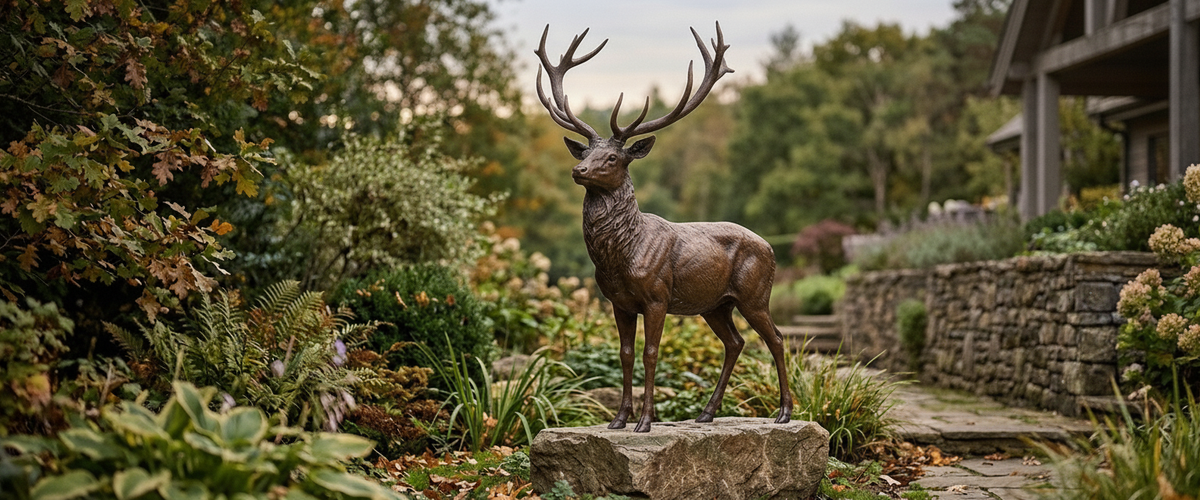

Most bronze deer statue sales lean on a pose: the stag mid-bellow, the doe with her head turned, the fawn curled in long grass. Pose is the easiest thing to copy. If you are scrolling bronze deer statues for sale, the question that protects your money is how old the piece is and how it was made. That decides what it weighs, how it ages outdoors and where it can safely live.
We field these questions weekly at Giant Sculptures, usually from buyers holding a screenshot of an auction lot or a bronze deer statues sale page. Here is how we read them.
At a Glance
Age first: a genuine 19th-century cast and a modern lost-wax cast belong in different places and need different care.
Test the metal: weight, tap and a discreet scratch will expose spelter and resin in under a minute, before you pay for anything in a bronze deer statue sale.
Read patina in daylight: earned color settles into the recesses; sprayed color sits on top.
Place by condition: antique stags suit a hallway or library, while new bronze can take the open lawn.

Why Age Tells You More Than Pose on Bronze Deer Statues for Sale
Two stags can share an identical silhouette and be 150 years apart. The 19th-century French animaliers made small bronze deer a drawing-room staple, and their models were copied, recast and reissued for decades afterward. Browsing the Met's holdings of Barye bronzes is a quick education in what period modeling looks like. When bronze deer statues on sale are described as "after Barye", the piece could be a period cast, a 1920s foundry reissue or last year's import, and each has a different value and a different tolerance for weather.
So we ask about age before anything else, whatever the bronze deer statues sale listing promises. A period piece is a conservation object. A modern cast is a working sculpture. Price, placement and maintenance all follow from that split.
Sand-Cast Grit, Hand-Chased Fur and Foundry Stamps: Signs of a True 19th-Century Cast
Turn the piece over, or ask the bronze deer statues sale seller for clear underside photos. Many period bronzes were sand cast, and the underside or interior often keeps a fine granular texture where mold sand met molten metal. Look for iron core pins or their plugged holes. Check for legs or antlers cast separately and joined with threaded sections.
The underside often tells you more than the pose: sand-cast texture and plugged core pins point to a period cast.
Then study the coat. On a good antique, a chaser worked the cooled metal by hand with punches and gravers, so the fur across the shoulder has direction, depth and slight irregularity. Mass-produced copies tend to show soft, rounded hair that looks half melted. Last, check the base for a foundry stamp or signature. Stamps help, but they get copied too, and bronze deer statue sales are full of borrowed marks. A crisp mark on a crude casting is a warning, never a credential.

Spelter and Resin Dressed as Antique Bronze: The Weight, Tap and Scratch Tests
Spelter, a zinc alloy, was the Victorian stand-in for bronze, and cold-cast resin is its modern successor. Both can be painted to pass in a photograph, which is exactly how they slip into bronze deer statue sales.
Weight: bronze is dense, so a tabletop stag should feel heavier than it looks. Spelter of the same size is noticeably lighter, and resin lighter still. Ask for the weight before you buy and compare it with a known bronze of similar size; a seller who cannot give you one is telling you something.
Tap: knock a knuckle on the flank. Bronze rings with a long, bell-like note. Spelter gives a dull clack; resin a hollow thud.
Scratch: on a hidden spot under the base, a light scratch on bronze shows warm gold. Spelter shows silvery gray. Resin shows pale filler.
Resin is fine when it is honest about itself. Where an interior wants the stag silhouette as a contemporary statement rather than a period object, a clear-resin piece such as the Clear Stag with Bronze Antlers on Black Marble wears its material openly, with bronze reserved for the antlers, and nobody mistakes it for a foundry cast. The trouble starts when painted resin turns up among bronze deer statues on sale at antique-bronze prices.
What a Modern Lost-Wax Cast Wins Back in Antler Tips and Hidden Fixings
Antlers are where old deer break, and where most antique bronze deer statues for sale show their repairs. Thin tines snap and get brazed back on, or are replaced in mismatched metal. A modern lost-wax cast captures the tips in full, holding fine branching that sand casting struggles with, and wall thickness can be specified for outdoor duty.
The bigger gain is hidden. Early in our outdoor work, we saw a stag's antlers loosen after one winter of freeze and thaw because water had pooled inside the joint. Now we design antler joints around internal stainless steel pins with drainage, and set fixings into the hooves so anchor bolts disappear into the plinth or footing. For a stag of 5 feet (1.5 m) or more on an exposed site, those details matter more than any surface finish. When you commission through Giant Sculptures instead of gambling on a bronze deer statues sale, scale, pose, base and fixing method are agreed before metal is poured.

Earned Patina Versus Sprayed Patina, Read in Plain Daylight
Carry the piece to a window or outside. Patina built over decades varies: deeper brown or green in the recesses of the fur and around the eyes, lighter and warmer on high points that hands have touched. It reads as layered. A sprayed "antique" finish, common across bronze deer statue sales, tends to be uniform, a flat chocolate or even verdigris that ignores the anatomy, and under raking light it sits on the surface like paint.
Bright green on a piece that has always lived indoors is a red flag in any bronze deer statues sale, since true green corrosion needs moisture and time. The American Institute for Conservation steers owners of historic metalwork toward trained conservators, and that advice holds here: never polish or chemically strip a suspected antique before it has been assessed. On a new cast, patina is applied hot at the foundry and sealed with wax that you renew once or twice a year.
Why an Antique Stag Wants a Hallway While a New Cast Can Hold the Open Lawn
If a bronze deer statues sale turns up a genuine 19th-century bronze, remember it carries old repairs, thinner walls and a patina that is part of its value. Rain, sprinklers and freeze cycles will change it in ways you cannot undo. Give it a hallway console, a library mantel or a covered loggia, where it reads at eye level and gets dusted rather than weathered.
A new bronze is built for exposure, and that is what the best garden-focused bronze deer statue sales should be offering. A pair of standing deer at the edge of a Hamptons meadow, a stag on a stone plinth framing a Napa vineyard view, a grazing doe in an aspen grove in the Colorado Rockies: these are jobs for modern casts with engineered footings. Our bronze deer statues cover outdoor-scale poses, and bronze garden statues widen the field. If you want the deer form indoors without the weight or the conservation worries, a clear-resin head such as the Clear Deer Head with Leafed Branch Antlers - 170cm holds a room at statement scale and makes no claim to age.
A modern cast with hidden hoof fixings can stand on open ground year-round.

A Buyer's Checklist Before You Commit
Ask the seller for age, foundry and casting method in writing before any bronze deer statue sale closes.
Request the weight plus photos of the underside and base.
Run the tap and scratch tests in person where you can.
Check antler tips for brazed repairs or color mismatch.
Judge patina in daylight, never under studio lights.
Decide placement first: protected interior for antiques, open ground for modern casts.
For outdoor work, confirm fixing method, plinth design and installation access.
For bespoke sizing, request a tailored quote, since budget depends on scale, pose complexity, engineering, finishing and installation.
If a listing cannot answer those points, it is telling you something. Plenty of bronze deer statues for sale are exactly what they claim; the checklist simply sorts them faster. Our team will gladly look over a find from a bronze deer statues sale you are weighing up or scope a new cast for your site, and our bronze animal sculptures are a good place to judge scale before you call.
For wider placement ideas, What Three Winters Under Trees Do to a Bronze Deer Garden Statue is useful companion reading before finalizing the setting and sightlines.