





































































































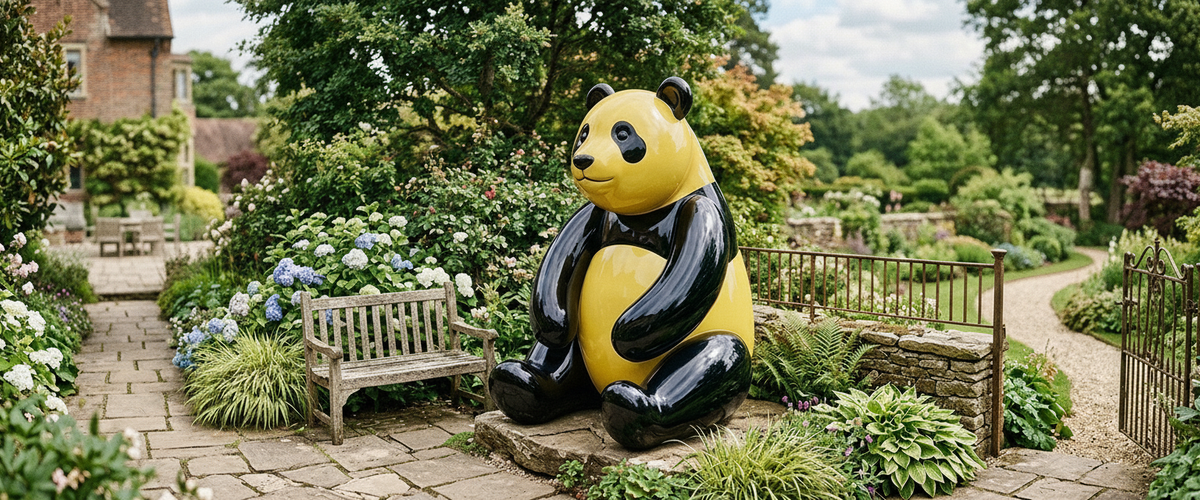

Most pop art sculptures fail on the same schedule. Around eighteen months in, the high gloss has gone slightly chalky on the south-facing side, a cleaning trolley has clipped one corner, and the visual gag that felt clever at handover now reads as dated. That is a subject-and-material problem, not a taste problem. The pop pieces that hold a lobby or a garden for a decade were chosen with a shelf life in mind, built in a finish that can be maintained, and given a backdrop plain enough to let them speak. Everything below comes from that gap between what looks great in a render and what still looks great in year three.

Pop Art Sculptures at a Glance
Subject beats novelty. Animals, balloons, candy and everyday objects age well. Anything tied to a current meme or product launch has a two-year window.
Gloss is a commitment. High-gloss color shows every ripple and every scuff. Mirror-polished stainless steel and cast bronze forgive far more.
Scale needs a reason. Oversizing works when the object gains presence, not just square footage.
Plan the repaint at purchase. Ask about touch-up systems and refinishing before delivery, not after the first chip.
Backdrop decides the read. A busy wall or planted hedge will swallow a pop piece within a week.
Bespoke keeps it art. A commission in your own palette avoids the signage trap that kills branded installs.

Subjects With a Shelf Life: Why Bears and Balloons Outlive Meme Pieces
Pop art has always borrowed from consumer culture, and Tate's summary of the movement traces that logic back to the 1950s: mass-produced imagery pulled into the gallery and treated with total seriousness (Tate). The pop works that lasted chose durable subjects. A soup can, a comic panel, a spoon, a cherry. None of them depended on a trend that expired.
The same test applies now. A bear sculpture pop art piece works because a bear is legible to a five-year-old and a collector at the same time; the pop treatment supplies the wit, and the animal supplies the permanence. Balloon forms carry the same advantage. Where an atrium needs mass and humor rather than a topical reference, something like the Black & Yellow Panda Pop Balloon Sculpture - 210cm (about 6 ft 11 in) will still be holding the focal point long after a novelty character has started to feel like last season's marketing. When clients bring us pop art sculpture ideas built around a specific mascot or viral image, we usually ask a blunt question: will you still want to explain this to visitors in four years?
Balloon and animal forms keep reading clearly years after a topical subject would have expired.
Scale Inflation and the Oversized Doughnut Problem
Enlargement is the oldest move in the pop playbook, and it can tip over. A doughnut at three feet is witty. The same doughnut at fifteen feet in a low-ceilinged reception becomes furniture you have to walk around. Scale earns its keep when the object gains a new quality on the way up, usually monumentality, absurdity or a change in how you read the surface.
Our rule of thumb for interiors: the piece should occupy roughly a third to a half of the visual height of its wall or void, with clear floor around it. Outdoors you can go much larger, because sky and planting absorb mass. Pop art food sculptures in particular need airspace above them; crowd the head height and the humor turns into obstruction. If the plan is to test an idea at a smaller size first, an ex-display piece such as the Pop Art Gorilla Sculpture - 50cm is enough to see how saturated gloss behaves in your actual light before you commit to a large commission.

Gloss Fiberglass, Mirror Steel and Cast Resin After Three Years of Daylight
This is where pop art sculptures separate into keepers and regrets.
Finishers flat off and polish in stages under raking light, because gloss hides nothing.
Gloss color coatings
Automotive-grade gloss over a composite or metal substrate gives you the flat, printed intensity pop demands. It is also the least forgiving surface in sculpture. Every ripple in the substrate shows, which is why our finishers flat off and polish in stages under raking light rather than spraying to a schedule. Outdoors, specify a UV-stable clear coat and expect to plan maintenance.
Mirror-polished stainless steel
Reflective steel gives you pop language without pigment. It cannot fade, it can be re-polished, and marine-grade alloys handle coastal and pool-side sites well. For a Hamptons garden or a Miami courtyard, this is usually the honest answer.
Cast resin and composites
For wider placement ideas, Why Your Art Collectible Figurines Read as Clutter, Not a Collection is useful companion reading before finalising the setting and sightlines.
Excellent for complex forms and interior work, and often the only practical route for a shape with deep undercuts. Keep resin indoors or in shade where you can, and treat it as a finish-dependent material rather than a structural one.
Cardboard and paper
A pop art cardboard sculpture is a genuinely useful tool at the maquette stage. We build card and foam mock-ups to test silhouette and sightlines on site. Just do not confuse a prototype with a purchase; cardboard has no outdoor life and very little indoor life once cleaners get near it.
The Repaint Conversation Nobody Has Before Delivery
Painted public sculpture gets repainted. That is normal practice, not a defect. The Walker Art Center has repainted Spoonbridge and Cherry more than once during its life in the Minneapolis Sculpture Garden, and the piece is better for it (Walker Art Center). Treat a gloss pop piece the way you would treat a car in a collection: it needs washing, occasional correction and eventual refinishing.
Before delivery, get three things in writing: the coating system used, whether matched touch-up material ships with the crate, and what a full refinish involves. We shipped a pair of balloon-form pieces to a mixed-use atrium in Houston where the facilities manager asked for touch-up lacquer and a written cleaning method in the crate. Two years later they had used it twice and the pieces still photographed as new. That request has since become standard advice from us.
Retail Atrium, Reception Floor or Living Room: One Piece, Three Lifespans
The same sculpture ages at three different rates depending on the traffic it sits in. A retail atrium means contact: strollers, luggage, hands, cleaning trolleys. Specify a plinth or a clear perimeter you can keep circulation out of, and choose a finish that can be corrected locally. A corporate reception floor is calmer but often has intense glazing, so UV exposure and heat gain matter more than impact. A private living room is the gentlest environment, which is where a delicate cast resin or a fine-finished gloss piece genuinely makes sense.
Site the piece with the sun in mind. West-facing glass in Texas or Arizona will punish saturated reds and oranges faster than any other condition we see. If a strong color has to live in that light, we push clients toward pigmented gel-coat systems or metal with an anodized or polished surface instead.
Brand-Palette Commissions That Read as Art, Not Signage
Hospitality and retail clients often want a pop piece in company colors. It can work beautifully, and it can also produce a very expensive logo. The difference is usually restraint: use one brand color as an accent rather than across the whole body, keep your own logotype and marketing copy off the sculpture, and let the form carry the identity. Where the brief calls for a consumer object quoted with affection rather than reproduced as packaging, the Coca-Cola Can Pop-Up Labubu Sculpture - 160cm (roughly 5 ft 3 in) sits on the right side of that line: a borrowed icon the eye enjoys, not a billboard for the room it stands in.
For 3D pop art sculpture commissions with a brand brief, we start with a card maquette and a color-drawdown panel in the actual light of the space. That single step has saved more projects than any other part of our process, because color on a screen and color under 4000K downlights are barely related.

Plain Walls Win: Backdrops for Pop Art Sculptures
A pop piece is a graphic object. It needs a quiet field behind it or the silhouette dissolves. Patterned wallpaper, exposed brick, dense mixed planting and glazed curtain walls with strong mullion rhythms all compete for the same attention. White, warm gray, board-formed concrete, a single-species hedge or a still water surface all let the form read cleanly.
Outdoors, plant behind rather than around. Give the piece its own footprint in gravel, lawn or paving so the outline stays intact through the growing season. A Napa client of ours moved a large gloss animal piece twelve feet forward of an olive hedge after one summer, and it stopped looking apologetic overnight.
Buyer Checklist Before You Commission
Subject test: will this still make sense in five years without explanation?
Scale test: mock the footprint and height in tape on site, then walk the approach.
Light audit: note orientation, glazing and artificial color temperature.
Material match: gloss coating, mirror steel, bronze or composite chosen for traffic and exposure, not just look.
Contact risk: plinth height, edge protection, and whether public hands will reach it.
Maintenance pack: cleaning method, touch-up material, refinish route.
Backdrop: confirm the wall or planting behind is quiet enough.
Logistics: door and elevator dimensions, crane or gantry access, floor loading, fixing method.
Budget clarity: ask for a tailored quote, since cost moves with material, scale, complexity, engineering, finishing and installation.
Where to Start Looking
Browse the pop art sculptures collection to see how subject and finish pair up at different sizes, and the character figurines and collectible figures range if you want a smaller piece to test a palette before committing. Giant Sculptures works as a bespoke supplier as well as a stockist, so if the piece you want does not exist at the size, color or pose you need, send us the space and the intent and we will build to it. Pop art rewards commitment; it punishes hesitation. Choose a subject with legs, a finish you can maintain, and a wall that stays out of the way.