

























































































Most Greek goddess statues sold today are the same handful of molds wearing different names. Change the plinth label from Aphrodite to Hera and nobody blinks, because the figure carries no attribute, no weight shift and no story. That is the whole problem with the category, and it is fixable in about three seconds of looking, once you know which details the ancient sculptors actually used to tell one goddess from another.

At a Glance: What Separates a Good Goddess From a Garden-Center Cast
Attributes first. An aegis and helmet mean Athena. A bow and short hunting tunic mean Artemis. A bared shoulder and loosened drapery point to Aphrodite.
Proportion second. Classical figures were fuller through the hip and thigh than most modern casts. Slimming her flattens the pose.
Contrapposto third. One hip should carry the weight. If both knees look locked, the mold has been copied from a copy.
Material sets the mood. Marble reads cool and archaeological, bronze reads warm and commanding, cast stone reads soft and quickly dated outdoors.
Scale decides everything. A 3 ft (0.9 m) figure in a 60 ft (18 m) lawn disappears. Measure the space before you fall for the piece.
Aegis, Bow, or Bared Shoulder: The Attributes That Name Her
Ancient viewers identified goddesses the way we identify logos. Athena wears the aegis, the goatskin collar edged with a gorgon head, and usually a helmet pushed back on the brow; an armored Athena Greek goddess statue should also have a spear hand or a shield resting at the calf, not empty air. Artemis carries the bow, the quiver strap crossing the chest, hem cut at the knee for running. Aphrodite is defined by what slips: drapery caught at the hip, a shoulder bared, hair being gathered or released. Hera holds the scepter and the diadem sits high. Demeter carries sheaves.
Crisp attribute modeling, not the label on the plinth, is what identifies the goddess.
When you shop Greek goddess statues, check whether these attributes are modeled or merely suggested. A gorgon head reduced to a lumpy oval is the fastest tell of a worn mold. The Getty Museum's antiquities collection is a useful reference library for what crisp attribute modeling looks like at close range.
One footnote for the question everyone asks: the Statue of Liberty is not Greek. She derives from Libertas, the Roman personification of freedom, with the radiate crown borrowed from ancient sun imagery. Interesting lineage, wrong pantheon.

The Classical Canon Was Fuller Than the Modern Cast
Buyers looking for a curvy Greek goddess statue, or typing "Greek goddess statues chubby" into a search bar, are usually reacting against something they have already seen: a mass-produced figure narrowed at the waist and thigh until she looks like a mannequin in a bedsheet. The classical originals were not built that way. The Knidian Aphrodite and the Venus de Milo both carry real volume through the abdomen, hip and upper thigh, and that volume is structural. It gives the standing leg something to support and the free leg something to release.
Take that volume out and the pose collapses. The torsion between the shoulders and the pelvis stops reading, the drapery loses the flesh it is meant to compress against, and you end up with a figure that looks thin rather than alive. When our studio reworks a classical female figure for a client who wants a fuller form, the correction is almost always in the thigh and the ribcage, not the waist.
Contrapposto and Drapery: Two Details That Expose a Tired Mold
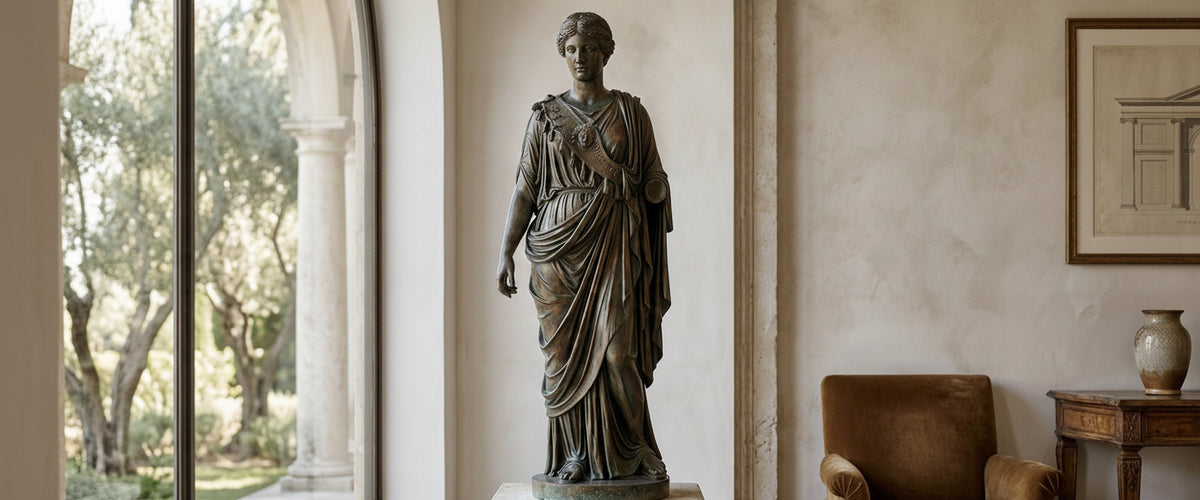
Stand in front of any candidate and look at the hips from the front. In real contrapposto, the weight-bearing hip rides higher, the opposite shoulder drops, and the spine makes a shallow S. Then look at the drapery. Good carving or modeling shows fabric doing two jobs at once: clinging where it touches the body, falling free where it does not. Cheap Greek goddess statues give you evenly spaced grooves, like corduroy, because a fifth-generation mold has lost every undercut.
Check the back too. Vendors photograph the front. The back of the calf, the base of the neck and the trailing edge of the himation are where mold fatigue and lazy chasing show up first, and where an original wax model shows its quality.

What Marble, Bronze, and Cast Stone Do to the Same Goddess
Marble gives you the museum reading: cool, matte, faintly translucent, at its best in shade where strong sun does not blow the surface out. It is also the least forgiving outdoors in freeze-thaw climates. Colorado clients almost always end up in bronze for that reason.
Patina choice moves the same figure from severe and archaeological to warm and honeyed.
Bronze holds fine detail through casting and takes patination, so the same goddess can read dark and severe or warm and honeyed. For a driveway turning circle or a formal terrace, a piece at the scale of the Monumental Classical Armoured Goddess Bronze Statue, 250cm (roughly 8 ft 2 in) is the classic solution, because the metal keeps the aegis and helmet crisp at viewing distances where marble would go soft. Where the setting needs narrative warmth rather than command, the Life-Size Classical Nude Goddess with Greyhound Bronze Sculpture, 180cm sits closer to the right register, giving an Artemis-adjacent reading without the theatrical armor.
Cast stone has its place on a budget-conscious interior scheme, but outdoors it chalks, greens unevenly and rarely survives a decade of Northeastern winters looking like the piece you bought. Budget for Greek goddess statues varies with material, scale, complexity of the pose, engineering, finishing and installation, so ask for a quote against your actual site rather than a category price.
Where She Commands a Garden and Where She Reads as Filler
Goddesses want an axis. Terminate a hedge walk, close a pool vista, anchor the far end of a reflecting rill, sit her in a niche where the wall does the framing. Those placements work because classical figures were designed to be approached, not circled at random.
They fail when scattered into planting beds with no sightline, parked beside a barbecue island, or placed on a plinth so short that the viewer looks down at her face. We shipped a life-size bronze Aphrodite to a Napa property last year where the landscape designer raised the plinth by 18 inches (46 cm) after mockup, purely so the gaze met the viewer at the top of the steps. Small change, completely different piece.
For sheer arrival drama, a monumental group such as the Monumental Classical Chariot with Goddess and Horses Bronze Sculpture, 600cm belongs at estate or civic scale, where you have 100 ft (30 m) of approach to let it build. Put it in a courtyard and it fights the architecture.
Groupings: Why Two Goddesses Compete for the Same Gaze
Placing Athena and Aphrodite in one garden room rarely works. Both are figurative, both are frontal, both demand the primary sightline; the eye ping-pongs and settles on neither. If you want multiple figures, separate them by garden room, by axis, or by hierarchy. Pair one goddess with something non-competing instead: an urn, a classical warrior figure set at a lower level, or an animal group that reads as supporting cast. Symmetrical pairs of the same figure flanking an entrance are the exception, because repetition becomes architecture.

Commissioning at Your Own Scale, Pose and Finish
The iconography is fixed; almost nothing else is. Commissioning through Giant Sculptures lets you set height to your sightlines, adjust the body proportions toward the fuller classical canon, specify a Greek goddess Aphrodite statue with the drapery falling to your preferred side, choose patina from near-black to verdigris, and engineer the base for wind load and anchoring on your actual substrate.
Checklist Before You Approve a Commission
Confirm the attribute set matches the goddess you actually want named.
Ask for photos of the clay or wax from four sides, including the back.
Agree the plinth height against a full-size mockup on site, not on a drawing.
Specify patina and any wax or lacquer system, and who reapplies it.
Check anchoring, fixing bolts and drainage at the base for freeze-thaw sites.
Confirm crating, lifting points and access width for delivery day.
Browse the wider Greek and Roman statues range to compare poses at scale, or the bronze mythology and goddess statues collection if you already know you want metal. Either way, judge the hips before you judge the face.
For wider placement ideas, Large Life Size Statues: How Scale and Placement Decide Whether a Piece Lands is useful companion reading before finalising the setting and sightlines.