






































































































A four-foot bear reads as garden decor. A seven-foot bear reads as an animal, and people slow down when they walk past it. That single jump is the whole decision behind a large bear sculpture, and it catches out more buyers than material choice, patina or budget ever do. Get the height wrong and you have bought a very heavy accessory. Get it right and the piece rearranges how the entire space is read.

Quick Answer: What Actually Decides the Piece
Height threshold: most bears start reading as wildlife somewhere past 5 ft (152 cm) standing on all fours, and past 6 ft 6 in (198 cm) rearing.
Pose: standing bears stop a sightline, seated bears anchor a corner, ambling bears pull the eye sideways along a path.
Material: marble reads heavier and stiller, bronze reads alive at distance, carved oak reads warm and softer up close.
Setback: viewing distance should be roughly two to three times the sculpture's height for a full read.
Indoors: measure door widths, elevator cars and ceiling clearance before you fall in love with a size.
The Height Where a Large Bear Sculpture Stops Being an Ornament
Bears are one of the few animal subjects where the viewer already has a mental yardstick. Everyone has a sense of how big a bear should be, so the eye checks your sculpture against that memory instantly. Undersize it and the brain files it as a toy. Hit or exceed the reference and the piece holds authority even from a hundred feet away.
On open ground, that means a large bear sculpture in the 5 ft to 7 ft (152 cm to 213 cm) range earns its keep on a lawn, while anything smaller wants a tighter setting: a courtyard, a terrace edge, a planted bed where the surrounding scale is compressed. A 90 cm (roughly 3 ft) bear on a wide Napa lawn disappears. The same piece on a Manhattan terrace, framed by planters, reads confidently. Scale is always relative to what surrounds it, never absolute.
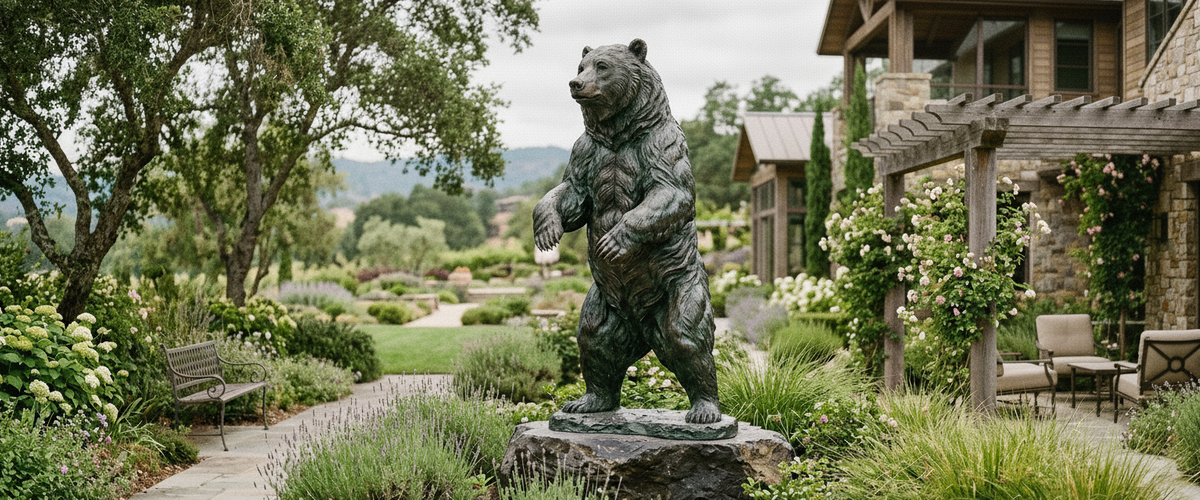
On open ground, height and setback decide whether the animal reads as wildlife or as ornament.

Standing, Seated or Ambling: What Each Pose Does to a Sightline
Height gets a large bear sculpture noticed; pose decides what it actually does to the space. A rearing bear is a wall. Place one at the end of an avenue of limes or across the axis of a drive and it terminates the view; the eye stops there and does not continue. That is a deliberate move, and it works beautifully at the head of a lawn or facing the approach to a house.
A seated bear behaves differently. It settles into a corner or the base of a slope and reads as resident rather than sentry, which is why seated forms work so well beside steps, pool copings and terrace walls. An ambling bear on all fours does the opposite job again: it introduces direction. Set one broadside to a gravel path and it drags the eye along the walk, which is useful when you want visitors to keep moving toward a pavilion or a gate.
Groups change the arithmetic entirely. A stacked composition such as the Gacko Black Marble Triple Bear Sculpture - 200cm holds one tall silhouette from distance and then resolves into three animals as you approach. That two-stage read is a genuinely useful property in a long garden, where the piece has to earn attention twice.
Why the Same Bear Feels Heavier in Marble and Lighter in Oak
At this scale, material does not just change the durability of a large bear sculpture, it changes perceived mass. A large marble bear sculpture reads dense and still, because stone absorbs light rather than throwing it back. The form looks planted. Carve the same silhouette in oak and it lightens; the grain runs through the body, the surface warms in low sun, and the animal feels closer to something living than something monumental.
Stone absorbs light rather than reflecting it, which is why marble holds its weight at close range.
That density is also why marble tolerates a shorter setback than bronze. Where the site is a walled courtyard or a terrace rather than open lawn, a compressed marble format such as the Gacko Black Marble Triple Bear Sculpture - 90cm keeps its weight at close range without needing the fifteen or twenty feet of clear ground a lawn-scale piece demands.
A large wooden bear sculpture asks more of you over time. Timber moves with moisture, checks along the grain and needs a finishing regime, and the USDA Forest Products Laboratory has published extensively on how species selection and end-grain sealing govern outdoor service life. For clients in dry-summer, freeze-winter climates like Aspen or Jackson Hole, we usually steer the conversation toward metal or stone unless the wooden character is the whole point.
A large bronze bear sculpture is the workhorse choice for open ground. Bronze holds fine fur texture that survives at distance, takes patina in browns, greens and near-blacks, and outlasts almost everything else placed outdoors; the Smithsonian's outdoor sculpture inventory work catalogues cast bronzes that have stood in public places for well over a century. Browse the bronze bear statues if longevity outdoors is the deciding factor.

Bronze at Scale: How Texture Carries Across a Lawn
Here is the detail most buyers never think about. Fur texture that looks superb in a studio at arm's length can flatten into a gray blur at 60 ft (18 m). Our sculptors deliberately exaggerate the depth of the coat on a large bear sculpture, cutting deeper channels and broader locks than anatomy strictly requires, so shadow does the work the detail cannot. The same logic applies to patina: a flat mid-brown dies at distance, while a patina with tonal variation between the shoulder mass and the flank keeps the animal legible.
Ask any supplier how a finish behaves at your actual viewing distance, not in a photograph. It is the single most useful question you can put to a foundry.
Setback Math for Hedges, Courts and Paths
Placement rules for a large bear sculpture are simple enough to check on site with a tape measure and a pair of stakes.
Full-figure read: allow two to three times the sculpture's height as clear viewing distance.
Hedge lines: keep the bear at least 3 ft (91 cm) off the face of the hedge so the silhouette does not merge into the green.
Gravel courts: center the piece on the geometry, then step back and check it from the car door, not just from the front step.
Daily paths: leave shoulder clearance people will not resent in the dark; 4 ft (122 cm) of clear walkway is a sensible floor.
Foundations: anything above roughly 5 ft wants an engineered pad or pinned base, sized to soil and wind exposure.

Atrium and Lobby Bears: The Clearance Nobody Measures
Interior installations fail on logistics, not aesthetics. We shipped a group to a Texas hotel lobby where the ceiling was generous, the floor loading was signed off, and the service corridor door was two inches too narrow. The piece went in through the loading bay on its side with the base detached, which was solvable, but only because we asked for a door schedule early.
Interior placements live or die on door widths, turning radius and floor loading.
Before you commit to a large bear sculpture indoors, get four numbers: finished ceiling height, narrowest door or elevator opening on the route, floor loading in the final position, and turning radius at the tightest corner. A rearing bear that clears the ceiling by a foot still needs to travel upright or be craned. Where the interior calls for a contemporary register rather than classical weight, a 160 cm format like the Gacko Banksy Love Bear Sculpture - 160cm moves through standard commercial buildings without drama, which is why that height suits boutique hotels and showrooms.
Scaling Up from Maquette: What Gets Lost
A maquette is not a small version of the final piece, and a large bear sculpture is never a maquette simply blown up. Enlarge a 12 in (30 cm) model to 7 ft and three things break. Fine surface detail becomes invisible. Slender limbs and paws that read fine in miniature become structurally marginal and need internal armature or thickened sections. And proportions that charmed you at desk scale can turn heavy in the shoulders, because the eye judges mass differently once the form is larger than a person.
Good bespoke work re-sculpts at full size rather than simply pointing up. When we commission a bear for a client, the enlargement stage is where the muzzle gets re-cut, the paw pads get redefined and the coat rhythm gets rebuilt for distance viewing. That is what buyers usually mean by a bear largo sculpture: an oversized, presence-driven format rather than a shelf piece.

Commissioning Checklist
Photograph the site from every approach, including the driveway and the main interior window.
Mark the footprint with stakes and string at the intended height before ordering.
Confirm material against climate: freeze-thaw, salt air, irrigation overspray and UV exposure all change the answer.
Agree the patina or finish sample at viewing distance, outdoors, in daylight.
Check access route dimensions end to end, including gates, bridges and soft ground.
Specify the fixing method and who is responsible for the base.
Ask for the long-term care schedule in writing: waxing intervals for bronze, sealing for stone, refinishing for timber.
Budget for a large bear sculpture depends on material, finished height, casting or carving complexity, engineering, installation and finish, so the honest route is a tailored quote rather than a guessed range. Giant Sculptures works on bespoke commissions and stocked pieces alike; start with the large bear sculptures range to calibrate scale, then talk to us about what the site actually needs.
For wider placement ideas, How to Place a Large Bronze Mermaid Statue so It Reads Like Art is useful companion reading before finalising the setting and sightlines.