































































































A forged piece can take weeks of hammer work and disappear in one afternoon, all because someone set it in front of a hedge. That is the hard truth about wrought iron garden sculptures: they are drawings made in mid-air, and a drawing only exists if there is something behind it to read the line against. Bronze can survive a bad background because it has mass. Forged iron has almost none. What it has is silhouette, and silhouette is fragile.

At a Glance: Placing Forged Iron Well
Open sky is the best backdrop you will ever give wrought iron garden sculptures, and it costs nothing.
Dark evergreen is the worst. Yew, holly and mature boxwood swallow black metalwork whole.
Fine scrollwork reads at about six feet (1.8 m) and turns to mush past twenty-five feet (7.6 m). Match detail density to viewing distance.
Pale render, light gravel and still water are the surfaces that flatter iron most reliably.
Plan for July, not April. Borders grow six to eighteen inches taller than you expect and crop the base of a wrought iron garden sculpture.
Finish is a contrast decision first and a corrosion decision second. Both matter; only one gets discussed.
Backlight Beats Backdrop: Let the Open Sky Do the Drawing
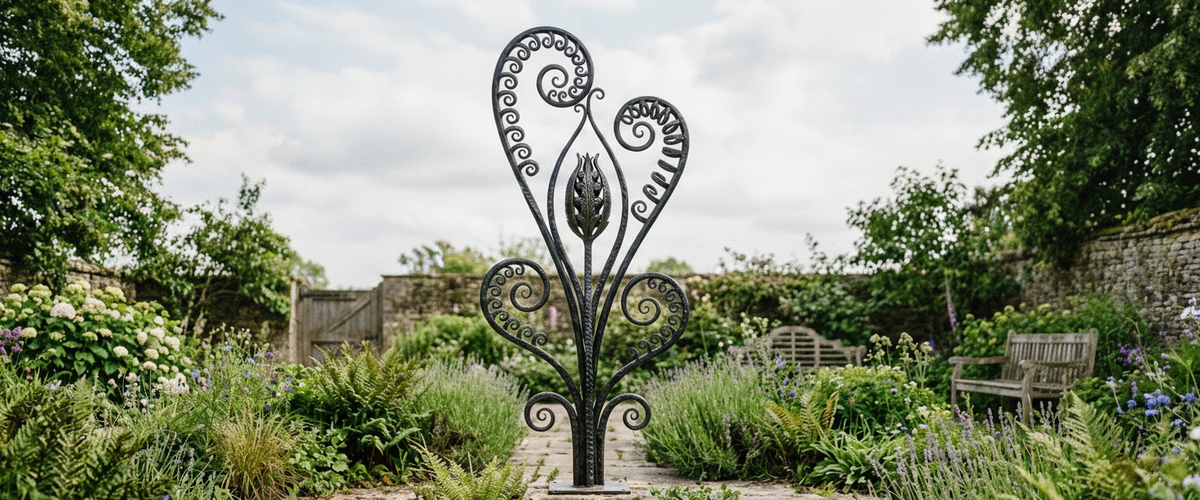
The single best position for a wrought iron garden sculpture is one where you can see daylight through it. A ridge line, the crest of a lawn, the end of a gravel walk with nothing behind it but air. When sky sits behind the metal, every curl, taper and hammer mark turns into a clean black graphic. Late afternoon does this best, when low sun rakes across the bars and the edges pick up a thin bright line.
Designers working on Napa hillside properties and Hamptons lawns get this almost by accident, because those gardens have horizon to spare. Walled city gardens in Brooklyn or Georgetown have to work harder. If you have no sky, fake one: a pale wall, a light-toned fence panel or a sheet of still water will stand in for it behind wrought iron garden sculptures.
Set Against Yew, Forged Detail Collapses Into One Black Smudge
We shipped a forged fern-and-seed-pod installation to a client outside Dallas who had chosen the position before the crate landed: dead center of a clipped evergreen hedge. From ten feet away it looked like a shadow on a wall. We moved it eleven feet to the left, onto the gravel turning circle with sky behind, and the same object suddenly had a hundred separate lines in it. Nothing changed but the background, and that is the most common placement error we see with wrought iron garden sculptures.
Dark green and black iron sit at nearly the same tonal value. Your eye cannot separate them, especially in the flat light of an overcast day. If a hedge is non-negotiable, either raise the piece above the hedge line so the top two thirds break into sky, or choose a lighter finish. Scale is part of the same calculation: at 88 cm (about 35 inches), something like the Butterfly Egg & Fern Garden Wrought Iron Installation will never clear a mature yew line, so it belongs on gravel, low planting or a pale courtyard surround rather than in front of dark mass.

Scrollwork That Sings at Six Feet and Vanishes at Twenty-Five
Detail density has a viewing distance, and most buyers of wrought iron garden sculptures pick the wrong one. Fine filigree, tight scrolls, leaf veining and hammered texture all read beautifully from conversational range, near a bench, a doorway or the turn of a path. From across a lawn they merge into a gray haze.
The fix is not more detail. It is bolder members: heavier bar stock, wider gaps, fewer repeats. When we quote a long-view commission for wrought iron garden sculptures we usually push the section thickness up and cut the ornament count by half. If your sightline is genuinely long, consider whether forged iron is the right family at all; stainless steel or Corten will hold a distant read better. Browse our iron sculptures with your actual viewing distance in mind rather than the photograph.
Pale Render, Gravel and Still Water: The Three Best Surfaces for Iron
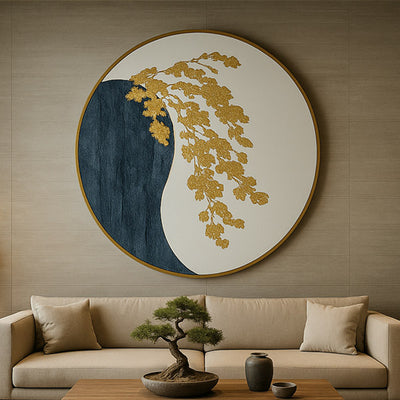
Pale render and limewashed masonry give wrought iron garden sculptures the cleanest contrast available at ground level, which is why wall-mounted forged work belongs there. On a light stucco courtyard wall in Santa Barbara or Scottsdale, a gilded piece such as the Gold Filigree Lotus Disc Wrought Iron Wall Art at 120 cm (roughly 47 inches) has a bright ground to sit against, so the warm metal reads as pattern instead of sinking into shadow.
Light gravel does the same job horizontally: it throws bounce light up into the underside of the piece and stops the base from sinking into shadow. Still water is the showiest of the three. A dark reflecting pool doubles the silhouette and adds movement whenever wind touches the surface. Avoid busy planting, variegated foliage and patterned paving directly behind wrought iron garden sculptures; competing pattern is the quickest way to kill a line.
The July Problem: Borders That Swallow the Base
Gardens are specified in spring and photographed in July. Perennial borders put on serious height between those two moments, and the first casualty is the bottom third of wrought iron garden sculptures. Once the base disappears, the piece stops standing on the ground and starts floating awkwardly in leaves.
Two practical answers. Raise the work on a plinth of stone, steel or brick so the visual base sits above peak border height. Or hold a clear apron of gravel, mown grass or paving around it, at least a foot wider than the footprint on every side. We build plinth height into commission drawings for wrought iron garden sculptures for exactly this reason, and we ask clients for the mature height of their planting, not the current height.

Gates, Arches and Boundary Walls: Where Forged Work Was Always Meant to Sit
Blacksmithing grew up on thresholds. Gates, overthrows, arches, railings and boundary walls are where forged iron has been structurally and decoratively at home for centuries, and where wrought iron garden sculptures still look most natural today. Historic English and American ironwork used real wrought iron, a fibrous, slag-streaked material almost nobody produces commercially now; contemporary smiths work in mild steel using identical forge techniques, which is what the trade still calls wrought. Historic England's guidance on metals is a good primer on that distinction if you are matching new work to an old gate.
Practically, a threshold gives a wrought iron garden sculpture a frame and usually a sightline through to sky. An arch over a path turns the piece into something you walk under rather than look at. A decorative panel set into a boundary wall reads as architecture. Where the masonry is dark brick or weathered stone that would flatten a black silhouette, color does the separating instead, and the Multi-Colour Disc & Filigree Wrought Iron Wall Art at 141 cm (about 55 inches) is closer to the right approach than an unpainted forged panel.
Rust, Paint or Galvanizing: Judging Finish by How the Line Reads
Most finish advice is written by corrosion engineers. Useful, but incomplete. Judge the finish on wrought iron garden sculptures first on how the line reads against green.
Left to rust: warm orange-brown separates well from foliage and gravel, and the color deepens over years. It needs a stabilized patina or regular oiling, and it will stain pale stone beneath it. Never site untreated rusting iron over white marble paving.
Painted or powder coated black: the classic, and the riskiest against dark planting. Superb against sky, render and water.
Painted in a pale or metallic tone: the underused answer for hedge-backed wrought iron garden sculptures. Gilded, bronze-toned and off-white finishes hold their drawing where black does not.
Hot-dip galvanized, then coated: the longest-lived route for coastal and freeze-thaw sites. The American Galvanizers Association sets out how the zinc-iron alloy layers form and why they outlast paint alone.

Buyer Checklist Before You Commit a Position
Run this list before you fix the position of wrought iron garden sculptures. For wider placement ideas, Bird Statues for Garden Spaces: Why Height Beats Size Every Time is useful companion reading before finalizing the setting and sightlines.
Stand at the main viewing point and photograph the empty spot on a gray day. Flat light is the honest test.
Check what sits behind at eye level: sky, pale surface, water, or dark mass?
Measure the distance from viewer to piece and match detail density to it.
Add mature border height to your plinth calculation.
Confirm drainage and anchoring. Wrought iron garden sculptures have a small footprint and catch wind.
Decide finish on contrast first, then on your climate and salt exposure.
Agree a care rhythm: inspect fixings and touch up coatings annually, more often within a mile of the ocean.
Commissioning Bespoke Wrought Iron Garden Sculptures
Bespoke work solves the problems a catalog piece cannot: exact height to clear your planting, bar thickness tuned to your sightline, a finish chosen against your actual wall color. At Giant Sculptures we ask for site photographs, viewing distances and background material before we draw anything, because those three things shape the forging more than the subject does. Cost for bespoke wrought iron garden sculptures depends on scale, section size, ornament complexity, engineering, foundation work and finishing, so the sensible next step is a tailored quote rather than a guess. If you are still comparing families, our wider metal sculptures collection shows how forged iron sits alongside cast and fabricated alternatives.
Get the background right and a modest wrought iron garden sculpture will outperform something three times its size. Get it wrong and the best smithing in the country turns into a smudge.