





































































































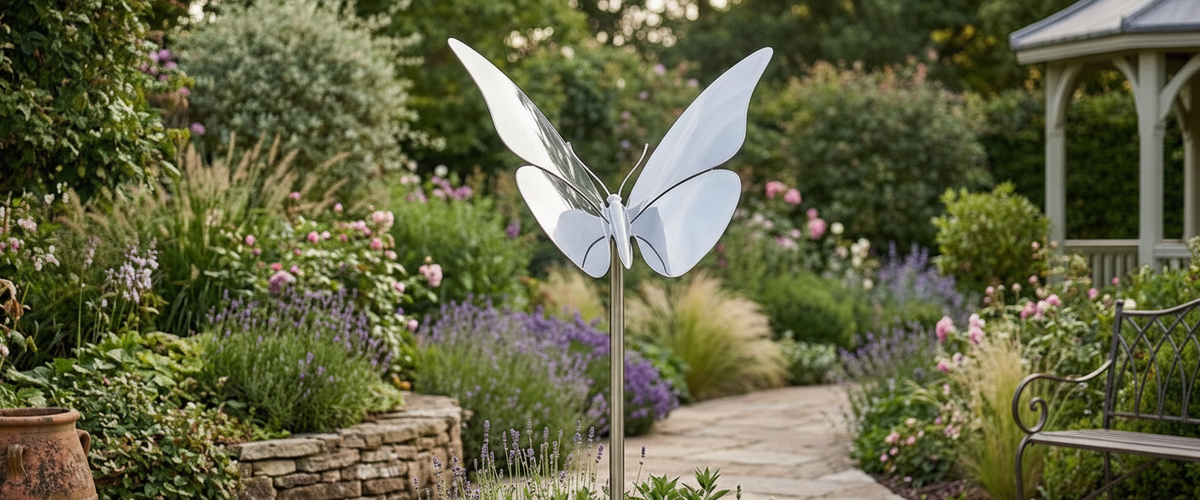

A large outdoor butterfly sculpture is, structurally speaking, a sail on a stick. Two broad wing panels sit at the top of a slender stem, and every gust that hits those panels gets multiplied by the height of the stem before it reaches the ground. That is why so many butterfly pieces in American gardens end up leaning, and why the ones that still look sharp after a decade were specified backwards from the footing, not forwards from the wings.

At a Glance
Wind, not weight, sets the spec for a large outdoor butterfly sculpture. Wing area multiplied by stem height gives you the bending moment at the base.
Three honest footings: a poured pad, a helical ground screw, or a socket sleeve set below grade. Each suits a different site and a different level of permanence.
Mount it above the planting. Wings read against sky or a dark hedge, never flat on a lawn.
Finish choice is a maintenance choice. Powder-coated aluminum is light and colorful; 316 stainless is the low-intervention option near salt air.
Groups work in odd numbers at staggered heights, composed from your real daily viewpoint.
Budget follows material, scale, engineering and installation. Ask for a tailored quote rather than guessing from a catalog photo.
Wing Area Times Stem Height: The Lever Arm That Decides Your Footing Spec
Think of the stem as a crowbar working against you. A wing set that catches, say, 8 square feet (0.74 sq m) of wind at 4 feet (1.2 m) off the ground generates a given bending moment at the base plate. Raise that same wing set to 8 feet (2.4 m) and the moment at the base roughly doubles. Nothing about the wings changed. The lever arm did.
So when you are comparing a large outdoor butterfly sculpture from two makers, ask for four numbers: total wing area presented to the wind, overall stem height, base plate size and thickness, and the bolt pattern. If a supplier cannot give you those, they have not engineered the piece; they have styled it. Coastal and open-prairie sites need more; a courtyard in central Austin ringed by walls needs less. A Napa hillside we shipped to had a thermal draft coming up the slope every afternoon, which the client had never registered as wind until a sculpture sat in it.
Concrete Pad, Ground Screw, or Planted Socket, and When Each One Is Honest
A poured concrete pad with cast-in anchor bolts is the default for a tall, permanent large outdoor butterfly sculpture on exposed ground. It spreads the load, resists overturning, and lets you level precisely with shim nuts. Take it below your local frost depth, which is a very different number in Aspen than it is in Dallas, and slope the top surface so water sheds away from the base plate.
Helical ground screws are excellent in consistent soil and leave no scar if the piece ever moves. They fail in fill. On a Hamptons garden with a rubble-and-gravel subgrade, the installers hit resistance at barely a foot down and we switched to a pad the same afternoon. Probe before you promise a client a no-concrete install.
A planted socket (a sleeve set in concrete below grade, with the stem dropping in and locking with set screws) is the quiet favorite for lawns that get mowed and for owners who want seasonal removal. It hides the hardware, keeps mower decks away from the coating, and lets you lift the piece for storm season. Drainage matters: a socket that holds water becomes a corrosion cell at the exact point you cannot inspect.
A cast-in bolt pattern and a leveled pad do more for longevity than any amount of wing detail.

Powder-Coated Aluminum, Stainless, and Glass Infill After Two Exposed Winters
Two winters is the honest test for any finish on a large outdoor butterfly sculpture. Powder-coated aluminum is the lightest option, which means smaller footings and easier handling, and it carries saturated color better than anything else. Its weakness is the coating itself: south and west faces chalk and fade first, and architectural-grade specifications such as those published by the American Architectural Manufacturers Association exist precisely because not all powder is equal. Specify the higher-durability class, AAMA 2605 rather than 2604, if the piece sits in full sun.
Stainless is the low-intervention route. Grade 316 holds up far better than 304 within a mile or two of salt air, and a brushed or satin finish hides water spotting that a mirror polish will show every morning. Where an exposed site calls for wings that carry sky color rather than applied pigment, a tall single-stem piece such as the Flutter Silver Butterfly Steel Sculpture, 200cm holds its appearance longer than a coated aluminum equivalent at the same height, with the stem reading as a line rather than a post. The trade-off is an occasional wash to keep the reflection clean.
Glass or acrylic infill panels give you translucency and a piece that changes through the day. Use laminated glass, never annealed, and accept that the interlayer is the component with a service life. Wrought iron and steel armature pieces sidestep the coating question entirely by treating the wing as drawing rather than surface, which is why a ground-level cluster like the Butterfly Egg & Fern Garden Wrought Iron Installation, 88cm sits comfortably among ferns and grasses without ever needing a fade-management plan.
Mounting Height: Butterflies Belong Above the Planting
The single most common mistake we see is a large outdoor butterfly sculpture installed at lawn height, where the wings disappear against green and the whole silhouette flattens. Butterflies read as things in flight. Lift them.
Set the lowest wing tip above the mature height of the planting in front of it, not the height on the day of install. Perennials will gain a foot in two seasons and swallow a low piece. In borders, a wing plane somewhere between chest and slightly above eye level from the main path gives you the best silhouette against sky, a dark yew hedge, or a pale stucco wall. Figurative work follows different rules: where the placement is narrative rather than a silhouette read from a distance, a plinth-mounted carving such as Playing With Butterfly Cupid Angel Marble Outdoor Sculpture, 80cm belongs at knee-to-waist height, because the story sits in the pose and needs to be looked down into.
One more placement note worth taking seriously: sculptural butterflies look best where real ones gather. Nectar planting guidance from the Xerces Society is worth reading alongside your siting plan, because a good pollinator border and a good sculpture backdrop are usually the same border.
Wing planes lifted clear of mature planting keep the silhouette legible from the house.

One Tall Stem or a Staggered Group of Three
Decide this from the kitchen window, not from the lawn. Almost every client looks at a large outdoor butterfly sculpture from one habitual interior viewpoint far more often than they walk past it.
A single tall stem is the stronger move where you want a focal point at the end of an axis, on a terrace corner, or breaking the horizontal of a long hedge. Groups of three work when you want movement, but only with real variation: different stem heights, different wing angles, and spacing that lets the silhouettes overlap slightly from the primary sightline. Three matched pieces at matched heights in a line look like fence posts. Push one forward, drop one lower into the planting, and angle the third away.
Where Flex Cracks the Coating First, and How to Touch In Without a Color Patch
Coatings do not fail in the middle of a panel. They fail where metal moves: the weld collar at the stem-to-wing junction, thin-gauge wing edges, tab joints, and the base plate where the wrench went on. A large outdoor butterfly sculpture flexes slightly in wind by design, and that repeated micro-movement opens hairline cracks at stress points long before the broad surfaces look tired.
Inspect those points once a year with your hand as much as your eyes. Touch-in is where owners create the patchy look they were trying to avoid: dabbing fresh paint into a faded field leaves a bright spot that shows from twenty feet. Feather the repair, blend outward, and if the fade is noticeable, recoat the whole panel rather than the wound. Record the color reference and coating batch at handover so a repair three years out is a real match instead of a guess.
Buyer Checklist Before You Commission a Large Outdoor Butterfly Sculpture
Site exposure: open ground, coastal, or sheltered courtyard? This drives stainless grade and footing size.
Subgrade probe: confirm soil versus fill before choosing a ground screw over a pad.
Primary viewpoint: photograph the spot from your most-used window and work back from that frame.
Mature planting height: specify mounting height against it, not against current growth.
Finish records: get color code, coating class and batch details in writing.
Access: gate widths, turning circles and whether a crane or two installers will do it.
Removability: if you may move house or re-landscape, socket-mount it.
Commissioning a Bespoke Butterfly at Scale
A commissioned large outdoor butterfly sculpture usually changes in three ways from the catalog version: stem height to suit a specific sightline, wing gauge and bracing to suit the local wind, and finish to match an existing palette of railings, stone or joinery. Wing span, plinth detail and mounting method all get drawn before anything is cut. Cost depends on material, scale, complexity, engineering, finishing and installation, so a tailored quote is the only honest number.
If you are weighing options, our stainless steel sculptures cover the durability-led end of the range, the wider garden sculptures collection is useful for scale comparisons, and the photograph from your kitchen window tells us more about the right height and grouping than a page of measurements.
For wider placement ideas, How to Place a Large Angel Statue in a Garden so It Reads From the House is useful companion reading before finalising the setting and sightlines.