






































































































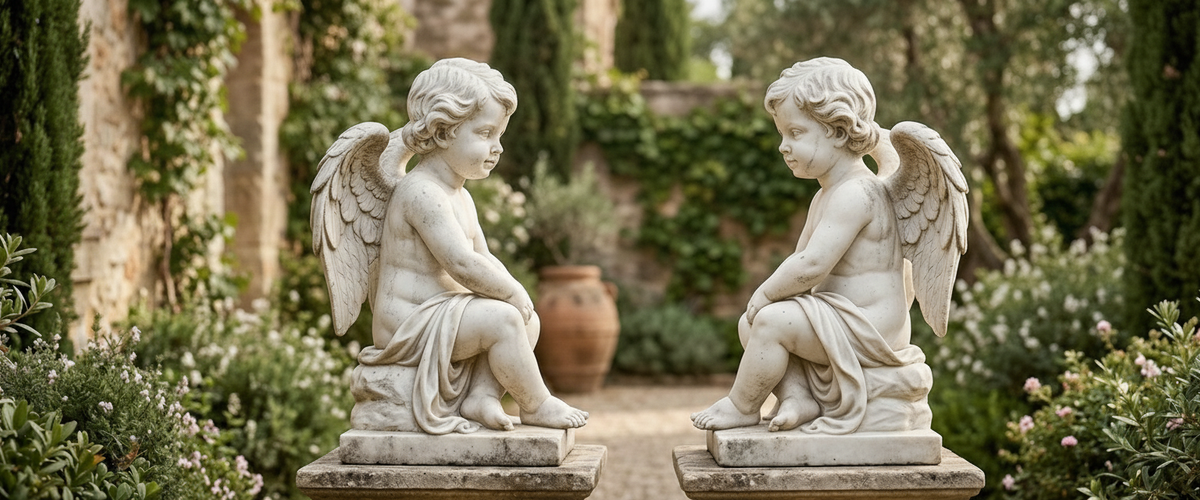

Most cherubs fail outdoors for a simple reason. Someone sets one in the middle of a lawn and asks a figure the size of a toddler to carry an entire view. A cherub garden statue works best when it has a job to do: marking a step, finishing a wall, or catching the eye at the edge of water. Get the placement right and the piece reads as considered design. Get it wrong and it reads as an impulse buy from a garden center, however good the carving.

Key Takeaways
Treat putti as accents at edges and transitions. Save the focal point for a fountain, a specimen tree or a larger figure.
Pairs and mirrored poses look intentional. A single cherub on open grass rarely does.
Fountain rims, balustrade ends and bench backs are the most reliable placements.
Size a cherub garden statue by measuring what sits nearby: hedge height, urn height and step depth.
Winged pieces need extra frost protection at the wing tips.
Choose a material for how you want it to age, whether that means stone that takes moss, the soft gray of lead, or the patina of bronze.
Putti in Baroque Gardens Worked as Punctuation
Walk the parterres of a seventeenth-century French or Italian garden and you will find putti everywhere, though rarely in charge. They ride dolphins on fountain basins, cling to the corners of balustrades and hold garlands over gateways. The big statements belonged to river gods, mythological groups and long axial views. The putti acted as commas and full stops, slowing the eye at junctions. The Victoria and Albert Museum's sculpture collection includes garden putti that show how small, lively and decorative these figures were meant to be.
That history is still the best brief. If you want one dominant piece, commission something at true statement scale. If you want cherubs, plan them as a rhythm.

Why One Cherub Garden Statue on Open Grass Looks Twee
A lone cherub garden statue on a lawn has nothing to measure itself against. The grass flattens it and the sky dwarfs it, so the eye reads sentiment rather than structure. Place two mirrored figures on either side of a path or doorway and the effect changes. The pair frames a view, implies symmetry, and suddenly the garden looks planned.
It is one of the most common fixes we make. A client orders a single cherub for the center of a lawn, then calls back a week later to say it looks like a lost child. The answer is usually a matching figure in a reversed pose, with both moved to flank the steps down to a terrace or the start of a path. The same carving that looked twee on the grass becomes the corner every guest photographs.
Fountain Rims, Balustrade Ends and Bench Backs
Fountain rims. Water gives a cherub a reason to be there. A figure perched on a basin edge, or set on a low pedestal in the pool, reads as part of the fountain rather than an add-on. Where the basin is large enough to need a centerpiece rather than an edge accent, a group composition such as the Large Classical Cherubs Under Parasol in bronze, at 170cm (about 67 inches), can hold the middle of the water on its own, because the figures play off each other and the parasol gives the group real height.
Balustrade ends. The newel post at the top or bottom of a stair or terrace wall is the classic spot. Because it is raised, the figure sits closer to eye level. Because it is structural, the cherub looks anchored.
Bench backs. A seated figure behind or beside a stone bench, whether in a Hamptons garden or a shaded Texas courtyard, gives the seat a sense of occasion. A compact seated cherub of around 60cm (about 24 inches) suits that scale without crowding whoever sits there.
Sizing Putti Against Box Hedging, Urns and Stone Steps
Size is relative, so before you choose a cherub garden statue, measure its neighbors.
Box hedging: the figure should clear a low clipped hedge by roughly a head's height. If it doesn't, summer growth will make it look half-buried.
Urns: when a cherub and an urn share a terrace, let one of them dominate. Matching heights look like indecision.
Stone steps: at the end of a stair, the figure and its plinth together should roughly match the height of the balustrade it finishes. That way the line continues instead of stopping short.
As a working rule, paired figures around 100cm (39 inches) suit most residential terraces and stair ends. At that height, a standing marble figure such as the Blossom Crown Cherub, set on a modest plinth and commissioned as a mirrored pair, will finish a balustrade without overpowering the steps it marks. Smaller 60 to 70cm (24 to 28 inch) pieces belong on fountain rims, low walls and seating areas, where people see them from a few feet away.

Cherub Angel Garden Statues With Wings: Protecting the Thinnest Edges
Wings are where cherub angel garden statues get damaged. The feathered tips are the thinnest part of the carving, they project away from the core of the stone, and they hold water. In freeze-thaw climates, from Aspen to upstate New York, water that seeps into fine surface cracks expands as it freezes and can lift flakes off an edge over a few winters. In our studio, wing tips and fingers are the first details we check on every piece before crating, because that is where any weakness shows.
Protection is mostly common sense. Set winged figures on a plinth so they sit clear of splash and standing snow. Avoid spots under dripping eaves. In the hardest months, use a breathable cover rather than plastic sheeting, which traps condensation. If your winters are long, look closely at how far the wings project before you commit: on a larger seated figure such as the Winged Sitting Cherub Angel at 120cm (about 47 inches), wings that stay close to the body will weather far better than feathers fanned out into open air. For sealing and cleaning exterior stone, the Natural Stone Institute publishes sensible care guidance.
Which Material Ages Best Outdoors?
Lead was the baroque and Georgian favorite for garden putti. It weathers to a soft silvery gray and holds fine detail. It is also very heavy, can slump over decades without good internal support, and raises toxicity concerns that many buyers now prefer to avoid.
Cast stone is the choice for anyone who loves moss. Its porous surface invites lichen and algae, and after a few seasons in a damp, shady garden, a cherub garden statue in cast stone can look a century old. The trade-off is softer detail and greater vulnerability to frost.
Resin is light and easy to move, but it gains little character over time. Sun fades the surface instead of aging it, and resin never develops the depth of real stone or metal.
For buyers who care about longevity, we usually recommend carved marble or bronze. Marble is denser than cast stone, so it gathers moss more slowly and holds sharper carving, though in hard winters it still needs the plinth and cover described above. Bronze develops a living patina and copes easily with frost. You can compare poses and finishes across our bronze angel and cherub statues.

Buyer Checklist Before You Order
Decide what job the cherub garden statue will do: fountain rim, stair end, bench companion or flanking pair.
Measure the nearest hedge, urn, wall or step before choosing a size.
Plan for a pair or mirrored poses if the figures will stand in open space.
Check your winter conditions, and favor compact wings in freeze-thaw areas.
Confirm the plinth, the footing and access for delivery and installation.
Choose the material by how it ages: softening under moss, or developing patina and lasting for decades.
Budget depends on material, scale, carving complexity, engineering, installation and finishing, so a tailored quote is the only accurate guide. Giant Sculptures can adapt pose, size or material as a bespoke commission. That includes mirrored pairs made to suit an existing balustrade, or a single cherub garden statue scaled to sit on a particular fountain rim.
For wider placement ideas, Garden Bronze Keeps a Calendar: How to Clean Outdoor Bronze Sculptures is useful companion reading before finalising the setting and sightlines.