






































































































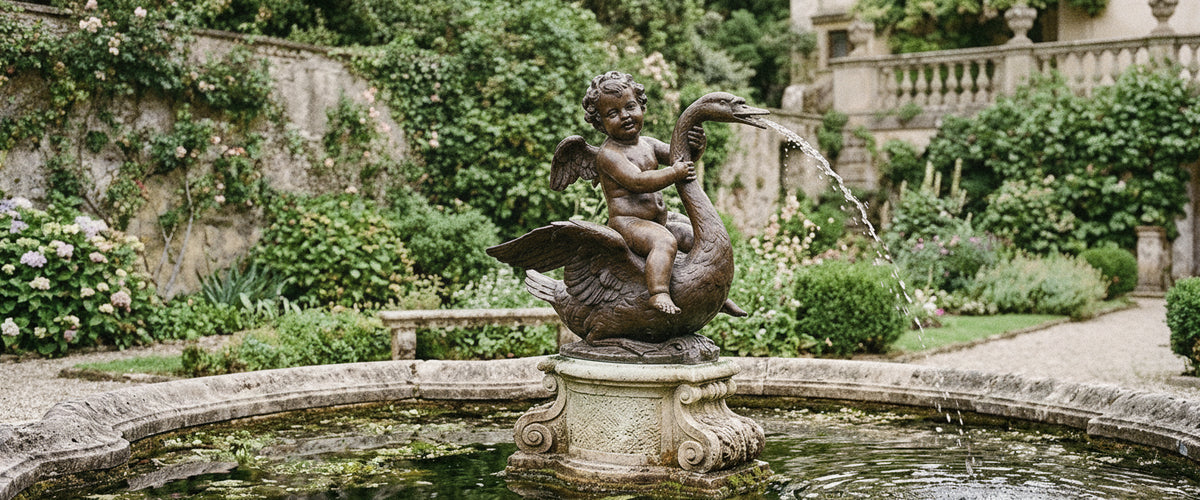

Most cherub fountains fail at the plumbing long before the bronze shows its age. A cherub fountain statue is a sculpture with a pipe running through it. The owners who stay happy with theirs asked about that pipe before they asked about the face: where the water leaves the figure, what carries it there, and whether the basin below can catch it.

At a Glance
Pose follows the water. Spouting, pouring and shell-holding figures each throw water differently, so the pose sets the noise, the reach and the splash.
Pipework should be built in. Metal tube cast or brazed into bronze, or a bore drilled through stone, outlasts a plastic tube bonded into a resin shell.
Hard water narrows small spouts. Plan for outlet access from day one.
Cold climates need a drain point. Water trapped in the line can crack stone and stress a casting.
Size the basin before the figure. Splash that lands outside the pool empties the reservoir and stains the paving.
From Renaissance Putti to the Brussels Spout
The chubby winged child in your garden descends from the erotes of Greek and Roman art, revived as the putto in 15th-century Florence. Verrocchio's Putto with a Dolphin, made for a Medici villa, is the template most fountain designers still borrow from: a small figure wrestling an animal, with water forced out through the animal's mouth. The pose exists because of the plumbing.
Brussels pushed the idea further. Jérôme Duquesnoy the Elder's Manneken Pis, made in 1619, put the outlet in the most literal place possible, and nearly every cherub peeing fountain statue sold today owes something to that small bronze. It still reads as charming in a private garden in Napa or a walled courtyard in Austin. In a hotel forecourt or on a restaurant terrace, check that the joke suits the brand before you commit.
Spouting, Pouring or Holding a Shell: Where the Water Exits Decides the Pose
A spouting cherub fountain statue, whether the water leaves from the mouth, a horn or that famous low outlet, throws a narrow jet that arcs and travels. It is lively, but it is also the outlet most sensitive to wind and to scale build-up.
A pouring figure tipping an urn or jar gives a heavier, softer fall. It is quieter, more forgiving of hard water, and better beside a bedroom window or a dining terrace where conversation matters.
A held outlet, whether a shell, a fish or a swan's beak, moves the water away from the body and lets the sculptor set the angle precisely. If you want the child to stay dry and its patina to weather evenly, send the water from the bird rather than the figure. The Monumental Classical Cherub on Swan Bronze Fountain, 220cm, roughly 7 ft 3 in tall, takes exactly this approach. Multi-figure tiered pieces combine all three: a jet at the top, sheets spilling between bowls, and a final fall into the pool.
Sending the water from the swan keeps the cherub dry and its patina even.

Why Cast-In Pipework Outlasts a Tube Glued Into Resin
In a bronze cherub fountain statue, the water line is a metal tube set into the wax or brazed into the casting before patination, so it becomes part of the sculpture. In stone and marble, the carver drills a continuous bore through the block. Either way, the passage lasts as long as the figure does.
Cheaper cherub water fountain statues are often a resin shell with a plastic tube bonded inside. Sunlight and temperature swings work on that bond year after year. When it lets go, the leak sits inside a sealed hollow you cannot reach without cutting the statue open. For long-term ownership, that is the single biggest difference between a fountain and a garden ornament with a hose in it.
When Giant Sculptures takes on a bespoke commission, we agree the pump flow, the inlet position at the base and the internal bore with the client and their landscape contractor before casting begins. Changing any of those after the bronze is poured is slow and costly.
Limescale in a Narrow Bore: What Hard Water Does to a Small Spout
Hard water is rich in dissolved calcium and magnesium, and the USGS rates much of Texas, Southern California and the desert Southwest among the hardest supplies in the country. Recirculating fountains concentrate those minerals as water evaporates. The crust forms first at the outlet, where the bore is narrowest.
The pattern is familiar in places like the Texas Hill Country: a year or two after installation, the jet from the mouth of a cherub fountain statue has shrunk to a wobbling dribble. The bore inside is usually clean; a ring of scale at the lip is doing all the damage. The cure is a slightly wider bore and a threaded, removable nozzle that can be unscrewed and soaked clean away from the statue. Simple fixes like these belong in the spec, not the service call. Top up with rainwater or softened water where you can, and keep strong acid descalers away from bronze patina.
Frost in a Trapped Line: Draining the Figure Before Winter
Water expands as it freezes, and a line that dips inside the base of a cherub fountain statue acts like a trap that never empties. In stone, that ice can split a bore from the inside; in bronze, it stresses joints and fittings. Owners in the UK, Aspen or upstate New York should insist on a drain valve at the lowest point of the run, then pull the pump, drain the basin and blow the line through each autumn. A breathable cover is fine; a tight plastic wrap traps condensation against the surface.

Basin First, Cherub Second: Sizing the Pool so the Splash Lands Inside
A useful rule of thumb: the basin should reach out from the outlet at least as far as the water drops, and further on an exposed site. A tall cherub fountain statue on a windy Hamptons lawn needs a wider pool than the same piece in a sheltered courtyard. With a tiered group around 8 ft 6 in (260 cm), such as the Monumental Classical Three Cherubs Fountain Bronze Fountain, 260cm, size the pool to the reach of the highest fall rather than the lowest bowl. For tighter spaces, a figure group near 5 ft (150 cm), like the Large Classical Woman and Cherubs Bronze Fountain, 150cm, keeps the fall short and the splash contained. The reservoir also needs enough volume to ride out a hot week of evaporation without starving the pump.
On a tiered group, size the pool to the highest fall, not the lowest bowl.
A Buyer's Checklist for Any Cherub Fountain Statue
Where does the water exit, and is that pose right for the setting?
Is the pipework cast, brazed or drilled in, or bonded into a shell?
Can the nozzle be removed for descaling?
Is there a drain point at the lowest part of the line?
Has the basin been sized to the fall height and site exposure?
Who will connect the pump, and do they have the inlet details before casting?
Budget depends on material, scale, complexity, engineering, installation and finishing, so the most useful next step is a tailored quote. Explore our bronze angel and cherub statues or the wider bronze garden statues collection, then talk to us about the water path before you fall for the face.
For wider placement ideas, Where Should a Crane Bird Statue Stand? Start at the Water's Edge is useful companion reading before finalising the setting and sightlines.