







































































































Most crane statues look wrong for one simple reason: they stand where no real crane ever would. A crane bird statue dropped into the middle of a lawn, flanked by roses, reads as an ornament. Move the same bird to the edge of a pond, ankle-deep in real or implied water, and it suddenly makes sense. That one placement decision matters more than the finish, the maker or the size of the bird.

At a Glance
Cranes symbolize longevity in Chinese and Japanese art, and both traditions show them beside water.
Standing poses suit still ponds, preening poses suit streams, and dancing poses need open ground.
No water? Raked gravel, slate or blue-gray planting can suggest it.
Bronze darkens slowly near water; stainless steel doubles itself in a reflection.
Keep to one or two birds, and make sure the head clears the planting at its tallest.
Why a Crane Bird Statue Belongs Near Water
In Chinese painting the red-crowned crane is shorthand for long life, often shown with pines and rocky shores. Japanese screens and kimono textiles carry the same bird, usually wading or calling across a marsh. In both traditions the water is part of the meaning, so a crane set far from any shoreline loses half its story.
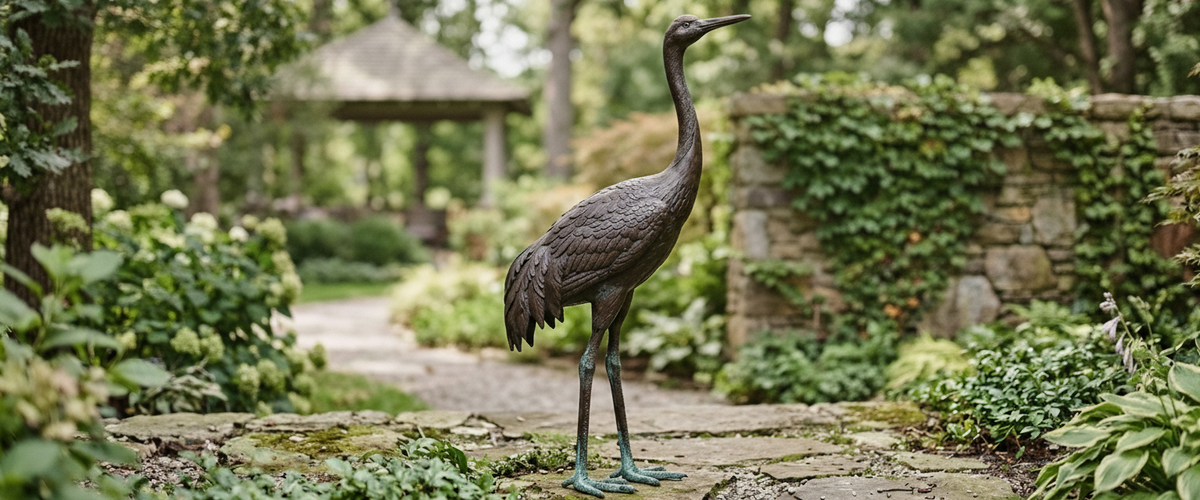
A standing crane at the pond margin, where the vertical line catches a clean reflection.
The living birds are wetland specialists, as the International Crane Foundation documents, and a mature red-crowned crane stands close to 5 feet (1.5 m) tall. That height is a useful benchmark. A crane bird statue sized near life reads as a presence rather than a trinket, and it can hold a pond margin on its own without needing companions.
Standing, Preening or Dancing: Matching Pose to Site
For wider placement ideas, Put Your Bronze Bird Garden Statue Where the Real Bird Would Stand is useful companion reading before finalising the setting and sightlines.
Match the pose of a crane bird statue to the movement of the water. Calm water wants a calm bird.
Standing, neck extended: the classic choice for a still pond edge. The vertical line catches a clean reflection, and the bird reads from across the garden.
Preening, head turned into the wing: a quieter, closer pose. It suits a stream or rill viewed from a path or footbridge, where people pass within a few feet.
Dancing, wings raised: the most theatrical pose, and the hungriest for space. Give it a gravel bed or an open lawn sweep where the silhouette can play against the sky.

No Pond? Let Gravel, Slate and Planting Suggest Water
Japanese dry gardens have used raked gravel to stand in for water for centuries, and the trick works just as well in a Scottsdale courtyard as in Kyoto. Set a crane bird statue at the edge of the raked area and the eye reads that edge as shore.
Slate chippings in blue-gray, laid in a curving band, make a convincing dry stream. Blue fescue, blue oat grass or low sedges along a shallow swale do the same job with planting. One client in Austin had water restrictions that ruled out a pond entirely; a single standing crane beside a ribbon of dark slate gave her the waterside scene she wanted without a drop of irrigation.
Bronze or Stainless Steel Beside Water
Bronze changes slowly near water. Humidity and splash speed up the patina, deepening brown toward black with greens gathering at the feet. Many owners love that drift, and an annual wax coat keeps it even; the Canadian Conservation Institute publishes sound guidance on caring for outdoor metals. Our bronze animal sculptures show how different patinas settle on feather detail.
Stainless steel plays a different game. A mirror finish beside still water doubles the bird, giving you two cranes for the price of one silhouette. Specify marine-grade 316 near pools or the coast, and choose a brushed finish if glare toward the house is a concern. Where you want that reflective, contemporary note at close to life size without starting from a blank commission, a silver-finished fibreglass bird such as the Langthorpe Silver Crane Sculpture - 150cm, at 59 inches (150 cm), is tall enough to stand alone at a pond margin. At Giant Sculptures we also cast bronze and fabricate stainless cranes as bespoke commissions, so the pose, scale and finish can be tuned to a specific pond rather than chosen off a shelf.
Polished steel beside still water gives you two silhouettes for one bird.

The Crane Bird Porcelain Statue Indoors
A crane bird porcelain statue belongs indoors. Freeze-thaw cycles will craze the glaze and crack the body, even in mild winters. Inside, you can still hint at a shoreline: paint the back of an alcove gray-green, set the bird on a slate tile or shallow stone tray, and add a few dried reeds.
If porcelain feels too fragile for a busy hallway, a gold-finished bird at console scale gives the same cue with less worry. For a niche or sideboard, a 24-inch (60 cm) piece like the Gold Crane Bird on Resin Base Sculpture makes more sense than a full garden crane, which would overwhelm the room.
Two Cranes Make a Conversation; Three Make a Crowd
A pair at the water reads as a dialogue. Set one standing and one bowing, angled so their sightlines meet. Clients often ask us for three, and we usually talk them down. Three birds on one bank produce competing silhouettes and the scene tips into clutter. If you want a third, put it on the opposite bank or on a different level, so it reads as a separate moment.
Neck Height Against Reeds and Grasses
Planting grows; sculpture does not. A crane bird statue that looks right in May can vanish by August. We learned this on a Hamptons project where a standing crane disappeared into miscanthus by late summer; the fix was moving it to a gravel spit with low sedges around it. Measure the planting at its mature height, then make sure the head and upper neck clear it. Japanese forest grass, Siberian iris and low rushes keep the shoreline feel without swallowing the bird.

Buyer Checklist for a Crane Bird Garden Statue
Locate the water, real or implied, before choosing the bird.
Match the pose to the water: still pond, moving stream or open ground.
Check that the neck clears planting at its tallest, not at planting time.
Pick material for exposure: bronze or 316 stainless outdoors, porcelain indoors only.
Plan the fixing: ground anchors or a plinth for wind and soft pond margins.
Decide on one or two birds, never three on one bank.
Stand where the bird will most often be seen and judge scale from there.
Budget for a crane bird statue depends on material, scale, complexity, engineering, installation and finishing, so the most useful next step is a tailored quote built around your site. Explore our bird sculptures and wider wildlife sculptures for reference, then talk to us about a commission sized to your water's edge.