





































































































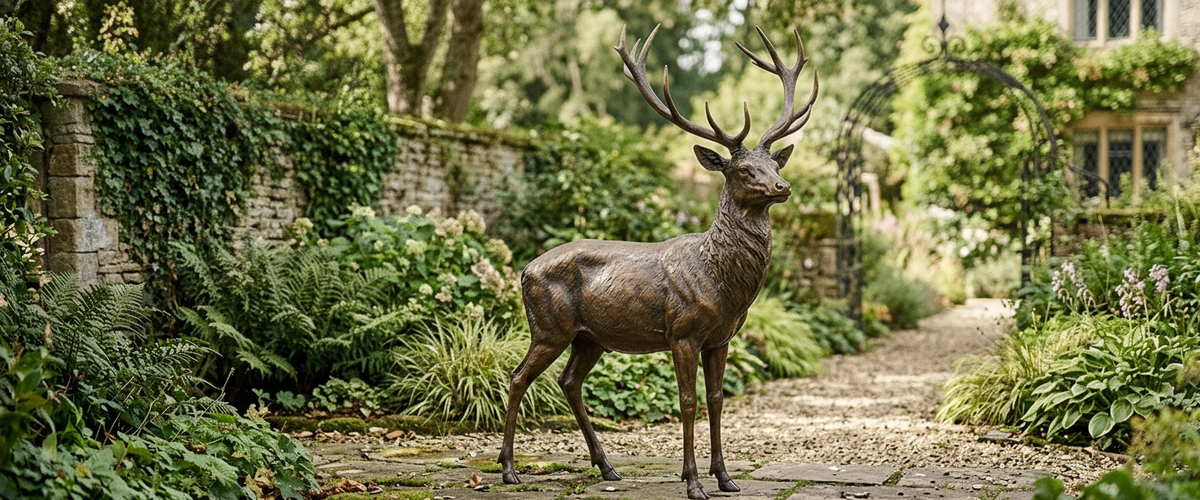

Antlers are the first thing to go. Nearly every repair question we field about bronze deer garden statues starts with a broken tine, and almost none of them involve vandalism. A ladder leaned against a stag during gutter work. A hedge trimmer swung a little wide. A storm-thrown branch catching the highest point of a rack. Bronze is not fragile, but a tine cast too thin at the joint will shear where the metal was starved, and once you know what to look for you can spot that weakness before you buy.

Key Takeaways Before You Buy
Five checks separate well-made bronze deer garden statues from the ones that end up back with a welder.
Antler tines and lower legs are the two hardest parts of the pour. Ask how both are cast and joined.
Look at the flank in low, raking sunlight. Good chasing restores fur texture; a rushed grind leaves flat scars that patina will only exaggerate.
Warm brown, verdigris and near-black patinas age very differently after five wet winters. Choose for your climate, not just for the showroom photo.
Hollow casting is standard and desirable. What matters is the internal armature, the base plate and where the fixing studs land.
Approve the maquette carefully. Once the mould is cut, pose changes mean starting the sculpt again.
Tines Snap First, and the Wall Thickness That Stops It
A full rack with eight or ten points is a nightmare of thin, branching sections. Most quality foundries cast antlers separately from the head, then TIG weld them in and chase the join until it reads as continuous bone. That is the right approach. The risk sits at the base of each tine, where wax thickness in the lost-wax process determines whether you get a solid, well-fed section or a hollow whisker of metal that snaps under a knock.
When you are comparing bronze deer garden statues, ask two direct questions: are the antlers cast separately, and does a pin or armature carry the load from the beam back into the skull? The heavier the rack, the more that answer matters. On a piece carrying the antler mass of the Monumental Bugling Elk and Fallen Deer Bronze Sculpture at 290cm, internal reinforcement is the difference between a sculpture that survives a decade of garden maintenance and one that visits a welder every other spring.
A chased antler join should read as continuous bone, with no flat grind band at the base of the tine.

Legs Are the Hardest Pour in the Whole Piece
Antlers get the attention; legs cause the failures nobody sees coming. A walking or alert stag often carries its whole weight through two slender lower legs, and those are exactly the sections where molten bronze cools fastest. Starve the gating and you get a cold shut, a seam where two flows of metal met but never properly fused. It looks like a hairline wrinkle. It behaves like a crack.
Good foundry practice means generous feeders into the legs, chills where needed, and a stainless steel pin running from the hoof into the base plate so the bronze is not the only thing resisting a side load. Scale multiplies the problem: a standing pair at the height of the Life-Size Traditional Stag and Doe Deer Bronze Sculpture - 260cm, 260cm or roughly 8 ft 6 in, puts real use through those ankles in high wind. Ask to see the fixing detail drawing, not just a photograph.
Seam Lines Along the Flank: Chasing Versus a Rushed Grind
Large bronze deer garden statues are cast in sections and welded back together, usually along the flank, the neck and behind the shoulder. That is normal. What separates a fine piece from a mediocre one is what happens after the welding. Chasing means a metalworker re-cuts the fur direction, the muscle break and the hair whorls across the weld so the seam disappears into the modeling. A rushed grind just flattens the weld bead, leaving a smooth band where the texture stops dead.
Test it in the sun. Walk around the sculpture with light hitting the flank at a shallow angle and look for any strip that reflects differently from the surrounding surface. Patina sits on smooth metal differently than it does on tooled metal, so a hidden seam at delivery can appear as a pale scar two winters later.

Warm Brown, Verdigris or Near-Black After Five Wet Winters
Patina is a controlled chemical layer, not paint, and it keeps moving once the sculpture is outside. Warm brown patinas from ferric nitrate tend to darken and deepen where rain washes them and lighten on sheltered undersides. Verdigris greens look best on pieces with deep texture, since the green settles into the recesses and the high points burnish back to bronze. Near-black finishes read strongly as silhouette but show water spotting from hard-water sprinklers faster than anything else.
The single most useful habit for bronze deer garden statues is an annual wax. Conservation guidance from the Getty Conservation Institute and other conservation bodies points to a maintained microcrystalline wax barrier as the practical defense for outdoor bronze, and it is far cheaper than repatination. One client in Napa lost the even brown on a doe within three seasons purely because an irrigation head was hitting the same shoulder twice a day. We moved the head, rewaxed, and the surface recovered.
Hollow Casting, Internal Armature, Bolting Down and Freight
Cast bronze deer garden statues are hollow shells, which is why a life-size stag weighs a fraction of what a solid one would. That shell needs an internal armature and a welded base plate with threaded stainless studs or bolt holes in known positions. Get those positions before you pour a plinth. We have seen more than one beautiful piece arrive to find the concrete pad drilled for the wrong bolt spread.
Stud positions and plate dimensions should be confirmed in writing before any groundwork is poured.
Freight deserves the same planning. Antlers travel in separate foam-lined saddles inside the crate on every stag we ship, and water features need their plumbing route confirmed before the piece leaves the studio. A multi-figure water feature such as the Large Traditional Running Deer Herd Bronze Fountain - 250cm stacks a pump and pipework on top of the fixing question, so the site survey has to cover power and lift access as well as the pad.
Maquette Approvals You Cannot Revisit
On a bespoke commission, the maquette stage is where the sculpture is genuinely decided. Head angle, ear set, antler spread, gait, the ground line where hooves meet the base, and the patina sample all get signed off before a mould is cut. After that, a change of pose means re-sculpting from scratch. Our advice is to view the maquette at the same eye level you will see the finished piece from, then photograph it from the exact approach path in your garden. A stag that looks proud head-on can read stiff from a driveway approach three-quarters behind.

Red Flags in a Quote for Bronze Deer Garden Statues for Sale
Anyone browsing bronze deer garden statues for sale will meet a wide spread of quality behind similar-looking photographs. These are the details that separate a real foundry quote from a listing:
No alloy named. Silicon bronze and other cast bronze alloys behave differently. Silence usually means nobody asked the foundry.
"Bronze finish" or "bronze effect" wording. That is often cold-cast resin with bronze powder, not cast metal.
No bare weight and no crated weight. You cannot plan lifting or a plinth without both.
No bolt placement drawing. Ask for stud positions and base plate dimensions in writing.
No explanation of how antlers join the head. Welded, brazed, pinned, or simply hoped for.
No patina sample and no wax specification. Colors shift in daylight; approve a physical swatch.
No maquette approval stage on a commission. Skipping it transfers all the risk to you.
Delivery quoted without an access survey. Narrow gates and soft lawns decide whether a crane is needed.
On budget, be wary of any figure quoted before scale and engineering are settled. Cost on a cast piece depends on size, alloy, casting complexity, internal armature, patina work, fixings, crating and installation. The honest answer is a tailored quote against your site, and any supplier who cannot explain what drives their number is guessing.
Commissioning a Deer That Suits the Site
For wider placement ideas, Where a Bronze Deer Statue Looks Wild, Not Staged is useful companion reading before finalising the setting and sightlines.
Deer work well in numbers and in dialogue. A single alert stag anchors a lawn edge; a doe placed thirty feet away and turned slightly toward him creates a scene the eye completes on its own, which is why a life-size pair often outperforms one larger figure. Giant Sculptures casts bespoke bronze deer garden statues to commission and holds a working range across the bronze deer statues collection, with broader options in bronze garden statues if you want to see how a herd sits alongside other outdoor pieces. Bring us the site photographs, the sight lines and the intended plinth, and we will tell you honestly which scale the setting can carry.