





































































































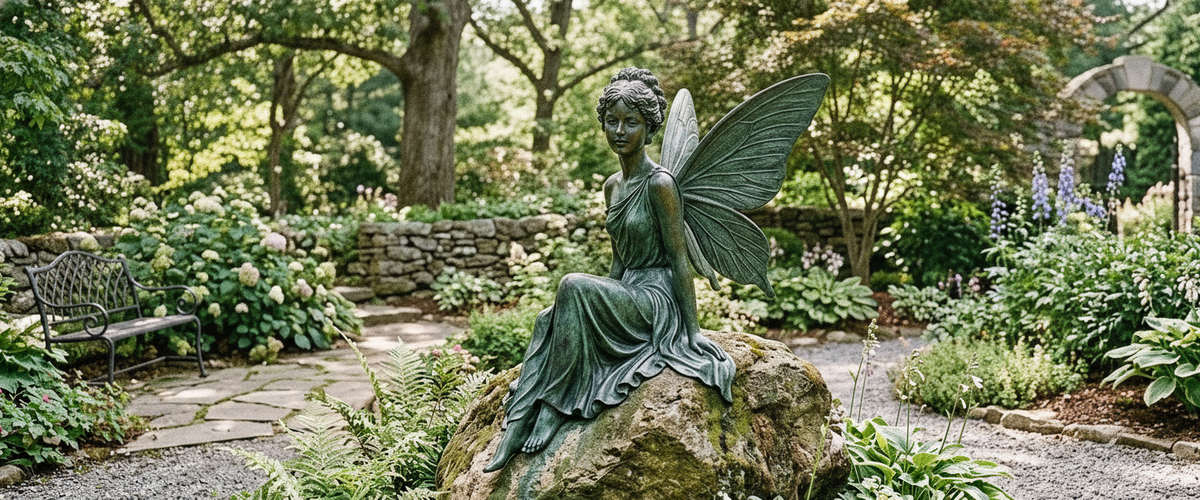

Scale is unkind to fairies. A 16 in (40 cm) resin figure gets away with paper-thin wings and a sugary face because nobody looks closely. Large garden fairy sculptures give the viewer nowhere to hide: at 5 ft (150 cm) the proportions, the joints and the surface are read from ten paces and then inspected from three. Two pieces of the same subject can sit in the same garden, and one reads as sculpture while the other reads as a gift-shop figure that someone photocopied at 400 percent.
The difference is rarely the subject. It is almost always the ratios, the engineering and the material.

Key Takeaways Before You Shop
Wing span is the tell. A span wider than the figure is tall usually tips a piece toward signage rather than sculpture.
Past 5 ft (150 cm), the sculpt has to change. Faces simplify, drapery deepens, bases grow.
Ankles and wing roots fail first. Ask what metal runs through them, not just what the surface is made of.
Bronze holds the finest detail; cast stone softens it and weathers beautifully; cast aluminum buys you lightness for terraces and roof gardens.
Planting sets the scale. Ferns and low mounding foliage flatter a figure; open lawn shrinks it.
Budget depends on material, height, complexity, engineering and installation. Ask for a tailored quote rather than working from a generic figure.
Wing Span to Body Ratio: The Number That Separates Sculpture from Kitsch
Look at any classical winged figure that has survived two centuries outdoors and you will see restraint in the wings. The span tends to stay close to the figure's own height, the feathers stack in controlled ranks, and the wings read as mass rather than as a flat cutout. The large garden fairy sculptures that still look right after twenty seasons borrow that restraint. Insect wings copied from a small ornament and blown up to 6 ft (183 cm) across do the opposite: they flatten into a silhouette that the eye reads as a sign, not a body.
Do the squint test on any listing photo. Step back, half-close your eyes and see what shape survives. If the wings swallow the figure, the piece will dominate your garden in a way that gets tiring by the second season. Where you want the classical register rather than the insect-winged one, Large Classical Winged Fairy Figure Bronze Sculpture, 150cm is the proportion to measure against: the wings sit tight to the back and follow the line of the spine, so the silhouette stays human first and winged second.
Wings that follow the spine keep the silhouette human first and winged second.

What Has to Change Once Large Garden Fairy Sculptures Pass 5 ft (1.5 m)
Enlarging a maquette is not a neutral act. Detail that charms at 20 in (50 cm) turns fussy at full height, and features that read as delicate in the hand read as weak from across a lawn. In our studio the sculpt gets reworked at scale: eyelids and lips are simplified so the face does not look over-modeled, drapery folds are cut deeper so they still catch shadow at midday, hands and feet are pushed very slightly larger because foreshortening from ground level eats them, and the base is widened so the figure looks planted rather than perched.
Hair is the other giveaway. Fine strand-by-strand hair enlarged wholesale turns into a wig. Good large garden fairy sculptures group hair into masses with a few crisp separations, the same way monumental figures have been handled since the Renaissance.
Slender Ankles and Cantilevered Wings: The Joint That Gives Up First
Fairy subjects love difficult poses: one foot raised, weight through a single narrow ankle, wings reaching out behind with nothing under them. Those are cantilevers, and outdoors they are loaded by wind, by freeze-thaw cycles, and occasionally by a visitor who decides to lean on a wing for a photograph.
Ask three questions before you commit to any of the large garden fairy sculptures on your shortlist. What runs through the ankles? (Stainless rod continuing into the base plate, ideally, not just thickened casting material.) How are the wings joined? (Mechanically fixed and keyed into the shoulder mass, not glued to a flat seam.) And how does the piece anchor to the ground? We shipped a seated figure to a hillside garden north of Napa where afternoon wind funnels straight up the slope, and the fix was simple: a seated pose with low wings and a stainless dowel set into a concrete pad. On an exposed site, a seated composition such as Contemporary Seated Fairy Girl with Dove Bronze Sculpture, 150cm settles half the structural question before engineering starts, because the load path goes straight down through the mass rather than out through an ankle.
Bronze, Cast Stone and Cast Aluminum, Judged on Detail
Material decides how much of the sculptor's hand survives the trip from clay to garden, and it is the biggest single cost driver in large garden fairy sculptures.

Bronze
Lost-wax bronze captures the finest detail of the three: feather edges, fingernails, the tension line where a wing meets the back. It also ages into a patina that deepens instead of degrading, which is why most of our bronze sculptures are specified for permanent outdoor placement. The Smithsonian's conservation specialists point to the same basics, protective waxing and routine washing, for keeping outdoor bronze stable over decades.
Cast stone
Cast stone gives up a step of fine detail against bronze, so it suits broader, calmer forms. What it gives back is texture and the way it takes moss and lichen, which many buyers want in a woodland setting. Marble, carved rather than cast, sits in a different category again and holds crisp edges superbly; for a shaded corner where a full-height figure would crowd the space, a smaller carved piece such as Fairy Sitting Angel Marble Outdoor Sculpture, 80cm is the more proportionate specification.
Cast aluminum
Aluminum is the pragmatic choice for large garden fairy sculptures on roof terraces, balconies and anywhere with a load limit, since it weighs roughly a third of bronze for the same volume. Detail is good but slightly softer, and the finish does the heavy lifting, so specify a marine-grade coating system and expect to refresh it on a longer cycle than you would wax bronze.
Ferns and Low Planting Set the Scale That Open Lawn Destroys
A 5 ft figure stranded in the middle of a mown lawn looks smaller than the same figure half-emerging from a bank of ferns. Large garden fairy sculptures need something of known size beside them, and low mounding foliage supplies it: ferns, hostas, hellebores, low grasses at knee height. Set the figure at a woodland edge, on the turn of a path, or where a sightline from a kitchen window lands, and let planting overlap the base by a few inches so the piece looks like it grew there.
Low planting over the base gives the eye a scale reference that open lawn removes.
Playful pieces want a different setting. A graphic, contemporary figure holds its own against gravel, clipped hedge or a pool surround, where a traditional woodland fairy would look stranded. Match the register of the piece to the register of the garden.
Moss on Drapery Flatters the Piece, Staining Across the Face Ruins It
Biological growth is not automatically the enemy on large garden fairy sculptures. Moss in the recesses of drapery reads as age and depth. Green film across cheekbones, eyes and the flats of a wing reads as neglect. Historic England's technical guidance on biological growth on masonry draws a similar line: control it where it does damage, tolerate it where it does none.

Seasonal Care Checklist
Wash twice a year with clean water and a soft brush. Skip pressure washers; they drive water into joints and strip patina.
Clear leaf litter and standing debris from the base, where trapped moisture starts most stone staining.
Wax bronze annually with a microcrystalline wax, working around the face and upward-facing surfaces first.
Spot-clean the face, hands and wing upper surfaces; leave recesses and drapery folds alone.
Check fixings and the wing-to-shoulder joint after the first winter, then yearly.
In freeze-thaw climates, keep drainage away from the base so water is not sitting against cast stone through a hard freeze.
Commissioning Large Garden Fairy Sculptures to Fit the Site
For wider placement ideas, How to Place a Large Angel Statue in a Garden so It Reads From the House is useful companion reading before finalising the setting and sightlines.
Catalog pieces solve most briefs. A commission earns its keep when the site dictates something the catalog cannot: a specific height to clear a wall, a pose that turns toward an approach path, a portrait element, or wings reworked for a wind-exposed coastal site. Bring photographs from the viewing position, the approximate viewing distance, and a note on prevailing wind and shade. Those three inputs change the sculpt more than any style preference.
As a bespoke sculpture supplier, Giant Sculptures works through maquette, scale-up, material selection and finishing on commissioned large garden fairy sculptures before anything ships, and buyers who send site photographs early almost always end up with a better-sited piece. Cost tracks material, finished height, pose complexity, structural engineering, base work and installation access, so the honest answer on budget is to ask for a tailored quote against your actual site.
Get the wing ratio right, put stainless through the ankles, choose the material that suits the detail you want to keep, and plant around the base. Do that and large garden fairy sculptures stop being whimsy and start behaving like the figurative work they descend from.