





































































































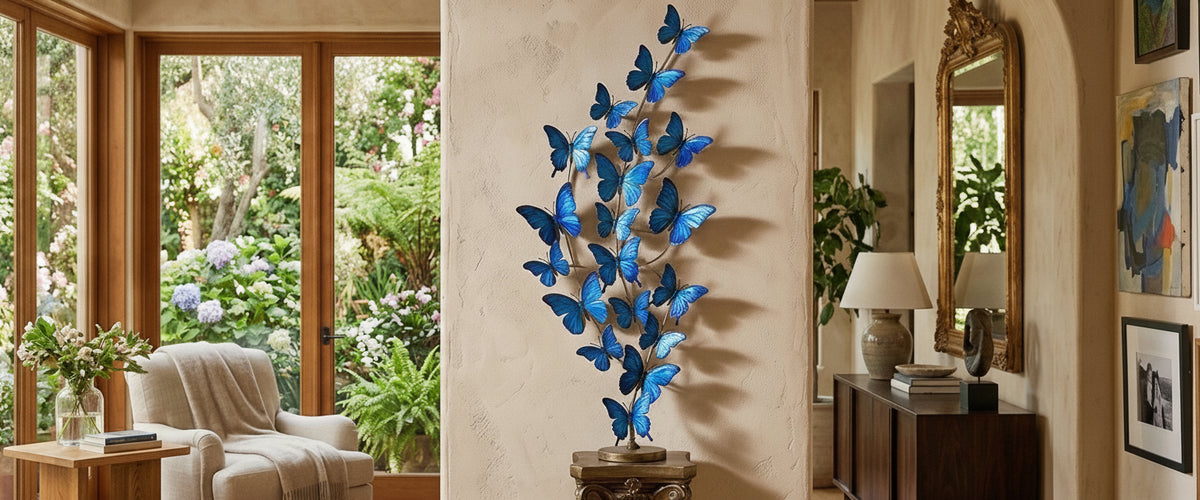

Most 3D butterfly wall art looks great in a product photo and disappointing on the wall. The reason is almost always the same: the piece was designed for the camera, not for the room, the distance, or the way daylight moves across it. A cluster of flat butterflies stamped from thin sheet can read as clutter at ten feet and vanish at thirty. Get the wing pitch, spacing and metal right, and the same idea holds the eye across a double-height stairwell.
Looking for the full range in this category? Browse our Wall Art and Wall Decor collection for every available finish, size, and configuration.
We build wall pieces at architectural scale, so this is a subject we argue about in the studio more than you might expect. Here is what actually goes into a butterfly wall installation before anyone reaches for the plasma cutter.

Key Takeaways for 3D Butterfly Wall Art Buyers
- Viewing distance drives everything. A 6-inch (15 cm) butterfly and a 3-foot (0.9 m) one solve different rooms.
- Wing pitch is the whole trick. Angled wings catch light and cast shadow; flat wings look like stickers.
- Material decides lifespan. Stainless steel, brass, and Corten age very differently from painted composite.
- Spacing is a design decision, not an afterthought. The gaps between butterflies matter as much as the butterflies.
- Budget depends on material, scale, complexity, mounting and finish. Ask for a tailored quote rather than trusting a flat sticker price.

What Sculptors Think About Before Taking on a 3D Butterfly Wall Art Commission
The first question is never "how many butterflies?" It is "where is this going and how far back will people stand?" A powder room and a 25-foot lobby wall need different answers, even if the client shows us the same reference image. Scale, count and wing depth all shift with distance.
The second question is orientation. A horizontal drift of butterflies reads calm and decorative; a rising vertical column reads like motion. Where a tall, narrow slice of wall would leave a landscape arrangement looking awkward, an upward-pulling piece such as Papilio Butterfly Vertical Blue holds the space better, and it flanks a doorway naturally.
Then comes the honest conversation about permanence. Is this a statement wall the client expects to live with for a decade, or a lighter decorative moment they may want to refresh? That single answer reshapes the whole material and mounting plan.

Craft Decisions That Change the Final Result (and the Price)
A butterfly is deceptively simple. The design work hides in four choices.
Metal and finish. Stainless steel gives you a crisp, modern edge and shrugs off weather, which matters if the wall is a covered outdoor terrace. Brass and bronze warm up over time and suit interiors with wood and stone. Corten develops a russet patina that reads beautifully against gray render or pale limestone. Painted composite keeps weight and cost down but will not carry the same longevity outdoors; the Smithsonian's conservation guidance on outdoor metal is a useful reminder that finish choice is really a maintenance decision in disguise (see Smithsonian's Museum Conservation Institute).
Wing geometry. This is where cheap and considered pieces separate. Flat wings sit dead against the wall. Wings folded at a slight dihedral, each butterfly set on its own standoff, catch raking light and throw shadows that shift through the day. Those shadows are half the artwork.
Layering and standoff depth. Mounting some butterflies flush and floating others 1 to 3 inches (2.5 to 7.5 cm) off the wall builds genuine dimension. It also builds cost, because every floated element needs its own fixing and alignment.
Color strategy. A single hue reads as a graphic; a graded palette reads as a swarm caught mid-flight. For a large arrangement that would otherwise flatten out, tonal shifts like those in Papilio Butterfly Cascade Blue keep depth alive across the wall. On a bright wall where strong pigment would overpower the space, the clear cascade version is closer to the right approach, leaning on transparency and shadow rather than colour.

Why Some 3D Butterfly Wall Art Reads Right at 10 ft and Wrong at 30
Distance is unforgiving. Up close, fine wing detail and edge texture do the work. Step back into a large room and those details collapse; now the silhouette, the spacing rhythm and the overall shape of the drift are all the eye can read.
We shipped a butterfly arrangement to a client with a tall entry wall who had first bought a small off-the-shelf set. It looked busy and lost from the stair landing where guests actually saw it. The fix was fewer, larger butterflies with more air between them and deeper standoffs so shadows carried across the plaster. Same concept, completely different result, purely because we designed for the real viewing distance rather than an arm's length photo.
The rule we work to: the farther back the primary viewpoint, the larger and sparser the elements should be. Detail is for corridors and powder rooms; bold silhouette is for lobbies and stairwells.
Studio Process: Maquette, Sample, Fabrication, Install
A bespoke butterfly wall goes through four stages, and skipping any of them shows.
- Maquette. We map the arrangement to scale, often on a printed wall elevation, so the client sees exactly how the drift sits against windows, switches and furniture lines.
- Sample. We produce a single butterfly in the chosen metal and finish. Seeing one real wing at true size, in the client's own light, settles more debates than any render.
- Fabrication. Wings are cut, formed, finished and fitted with their standoffs. Each fixing point is planned against the mounting surface, because a butterfly wall is only as good as the wall behind it.
- Install. For large arrangements we supply a drilling template so every butterfly lands where the maquette said it would. This is the step DIY buyers most often underestimate.
If you want to see the range of formats this process can produce, our 3D wall art collection shows how depth and standoff mounting change a piece, and the broader metal wall art collection covers the material options in more detail.
How to Hang 3D Butterfly Wall Art Without Regret
Whether you bought a set or commissioned an arrangement, the install rules are the same.
- Find your fixings. Into studs, masonry or a proper mounting rail, never into hollow drywall alone for anything with real weight.
- Use a template. Mark every hole before you drill a single one. Adjusting butterfly three after butterfly ten is drilled is how walls get scarred.
- Match the anchor to the wall. Metal butterflies on standoffs need anchors rated well above the actual weight; err heavy.
- Work from a center line. Establish the visual spine of the drift first, then build outward so the arrangement stays balanced.
- Check the light. Live with a taped mock-up for a day if you can, so you see how shadows fall before committing holes.
For 3D printed wall art specifically, weight is usually low but rigidity is the concern; support wide spans at more than one point so panels do not bow off the wall over time.
Honest Red Flags to Ask About Before You Commit
A specialist should welcome these questions. Be cautious if they dodge them.
- "What is the actual metal thickness?" Thin sheet dents and flexes. Ask for a gauge, not just "steel."
- "Is this rated for outdoors?" Painted composite marketed as "3D butterfly wall art" can fade and fail outside within a season or two.
- "How does it mount?" If the answer is adhesive pads for a heavy metal piece, walk away.
- "Will you supply a template?" No template on a large multi-piece drift means a fiddly, error-prone install.
- "Can I see a sample in my light?" Any bespoke maker should be able to.
Giant Sculptures builds decor 3D wall art at scale, in durable metals, with the engineering and install support that separates a piece that looks right for a decade from one that sags and dulls inside a year. Whether you want an existing Papilio design or a fully bespoke swarm sized to your wall, the process starts with the same question we always ask: where is it going, and how far back will people stand?
For wider placement ideas, 3d Printed Wall Art: What Sculptors Weigh up Before Saying Yes is useful companion reading before finalising the setting and sightlines.