










































At two in the afternoon, a white marble Buddha on an open lawn in Scottsdale is almost too bright to look at. Move the same figure under a Japanese maple in Napa and it turns calm, cool and resolved. Planning a marble Buddha statue garden comes down to light, ground and gesture. Buyers who get those right rarely regret the stone.

Quick Answer
Choose the gesture first. A meditating figure (dhyana) suits a secluded corner. A raised-palm figure (abhaya) suits an entrance or the end of a path.
Seated figures settle a space. A standing Buddha needs a hedge or wall behind it.
Shade flatters white marble. Dappled light keeps it soft. Full sun on a pale lawn creates glare.
Expect slow weathering. Frost and acidic rain roughen marble over decades, and moss collects in the robe folds.
Build the footing before delivery day. A level concrete base below ground stops a heavy seated figure from leaning.
What the Mudras Meant to Gandhara and Gupta Carvers
The hand gestures on a Buddha figure are a precise visual vocabulary. In Gandhara, the region spanning present-day Pakistan and Afghanistan, carvers working between roughly the first and fifth centuries CE blended Greco-Roman drapery and wavy hair with Indian iconography. The Gupta workshops at Sarnath and Mathura later smoothed the robes until they clung like wet cloth. Both schools relied on the mudras. Dhyana, with hands resting in the lap, signals meditation. Abhaya, the right palm raised outward, offers protection and reassurance. Dharmachakra, with the hands held at the chest, represents teaching.
Most of those early figures were cut in gray schist or red sandstone rather than white marble. A marble Buddha statue for the garden is a later interpretation, so the gesture carries much of the historical meaning. Traditionally the figure sits on a throne or lotus base rather than bare ground, and that custom also happens to be sound engineering outdoors.
Matching the Gesture to the Garden
In a marble Buddha statue garden, a dhyana figure belongs where people slow down: beside a still pool, at the end of a gravel walk, or facing a bench in a corner screened by bamboo. An abhaya figure works as a greeter. Put it at a gate, a courtyard threshold or the top of a flight of steps, where the raised palm meets visitors as they arrive.
When a garden has a strong boundary wall but no room for a freestanding figure, a carved panel is often the better choice. A relief such as the Crowned Buddha and Bodhi Tree Marble Relief, at 150cm (about 59 inches), sets the figure beneath the tree of enlightenment and asks nothing of the lawn. Mounted on a stucco courtyard wall in Santa Barbara, a panel of that kind reads as architecture rather than ornament.

Seated or Standing: Choosing a Marble Buddha Statue for the Garden
A seated Buddha forms a low pyramid, wide at the knees and narrowing to the head. It looks settled from every angle, which is why it can hold an open bed or a lawn junction alone. A standing figure is a vertical line, and without a backdrop it looks stranded. A clipped yew hedge, a limestone wall or a dark stand of cypress gives it something to stand against.
Scale matters more than most buyers expect. A small figure set too far from the main path disappears. If the viewing point is a terrace or kitchen window across the lawn, go larger or bring the piece closer. For tight spaces, a head can carry the same presence. A carved marble head such as the Buddha Head Marble Sculpture, 50cm (about 20 inches), set on a waist-high plinth among ferns, gives the face its full weight without crowding a small courtyard the way a full seated figure would.
Dappled Shade Versus Open Lawn: Where White Marble Glares
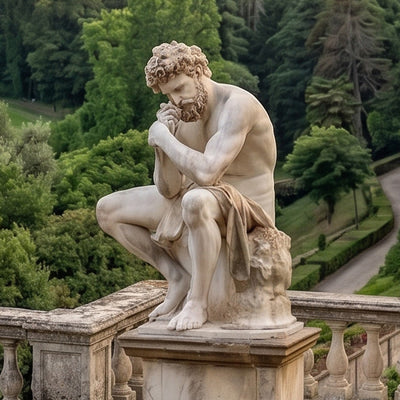
White marble reflects a great deal of light, which makes sun exposure the deciding factor in any marble Buddha statue garden. Under olive, birch or maple canopy, the moving shadows give the carving depth, so the eyelids, lips and robe folds stay legible. In full sun on a pale lawn in Texas or Arizona, those details flatten into a hot white silhouette.
Two fixes help. Ask for a honed finish rather than a high polish, especially on the robes; our carvers usually reserve the softest sheen for the face. Or reconsider the material for very exposed sites. On a sun-baked Hamptons lawn, a seated bronze at the scale of the Monumental Traditional Seated Buddha Bronze Sculpture, 250cm (about 8 feet 2 inches) is the better choice. A dark patina absorbs light, so the face and hands hold their definition where pale stone would turn to glare.
How Marble Buddhas Weather in US and UK Gardens
Most marble is calcite, and calcite responds to water. In frost belts such as New England, the Upper Midwest, Colorado and much of the UK, water enters the grain, freezes and expands. Over years the surface can loosen into a granular texture conservators call sugaring. Acidic rain slowly dissolves calcite too, a process the US Geological Survey has documented on marble monuments in Washington, DC.
A seated dhyana figure brings its own challenge, because the cupped hands and lap form a small basin. When we plan a marble Buddha statue garden for a cold climate, we discuss a discreet drainage channel so water cannot sit there and freeze. Moss and lichen will find the robe folds, and many owners like the softening. To slow it, brush gently with soft bristles and clean water. Avoid pressure washers, bleach and acidic cleaners, which harm marble faster than any winter will.
A Level Base Below Ground: Why Seated Buddhas Lean
Marble weighs roughly 170 pounds per cubic foot (about 2,700 kg per cubic meter), and a seated figure concentrates that load on a small footprint. The classic failure is a seated marble Buddha set on pavers laid over topsoil. In a Hudson Valley winter, frost heave can tip it several degrees by the first spring thaw. The fix is a compacted gravel bed and a concrete pad poured below the local frost line, with the plinth pinned to the slab.
Your contractor should confirm frost depth and soil type before delivery. Plan the access route too: a large marble figure arrives on a pallet and usually needs machine lifting, so check gate widths and protect any lawn or soft border between the driveway and the footing.

Buyer Checklist for a Marble Buddha Statue Garden
Gesture: meditation for retreat spaces, protection for thresholds.
Viewing distance: where you will see it from most often, and whether the scale reads from there.
Light: hours of direct sun on the chosen spot in midsummer.
Climate: freeze-thaw exposure and any need for drainage detailing.
Finish: honed, polished or a mix.
Footing: concrete pad, plinth height and fixing method.
Access: clear route for lifting equipment on installation day.
Commissioning Your Own Marble Buddha
Giant Sculptures carves and ships bespoke marble and bronze sculpture worldwide, and a garden Buddha is one of the commissions where early conversation pays off. We can adjust the mudra, scale, finish and plinth to suit the site, and advise when bronze is the wiser choice. Budget depends on material, scale, carving complexity, engineering, shipping, installation and finishing. If you are planning a marble Buddha statue garden, the most useful next step is a tailored quote with photos of the spot. Our Buddha statues and heads are a useful place to compare poses and proportions, and the wider garden statues collection helps if the Buddha will share the space with other pieces.
For wider placement ideas, Large Marble Garden Statues: What a Decade of Weather Reveals is useful companion reading before finalising the setting and sightlines.