



























































































Two white figures can leave the same workshop and carry the same word on the invoice. Ten winters later, they can look entirely different. One stays crisp at the nose and fingertips. The other turns soft, gray and faintly powdery, as if someone had gone over it with fine sandpaper. That gap is the real story behind large marble garden statues, and most product listings never mention it. How a piece ages depends far more on the stone, the veining, the joinery and the climate than on the carving.
Looking for the full range in this category? Browse our Marble Sculptures & Statues collection for every available finish, size, and configuration.

Key Takeaways
Ask which marble, not just whether it is marble. Grade and grain predict how long a piece will last outdoors.
Sugaring (a granular, crumbly surface) is a failure of the stone itself, and scrubbing makes it worse.
Veins are fault lines as well as decoration. Where they run through a thin limb matters.
Pinned joints are the first place a sectional figure shows stress.
Climate decides the stone. Freeze-thaw winters and damp maritime gardens need different choices.
What the Word Marble Leaves Out
Geologically, marble is limestone that has recrystallized under heat and pressure. That definition covers stones with very different grain sizes, porosity and impurities. A fine, tight white can shrug off decades of rain. A coarse, open stone of similar color can start shedding crystals within a few seasons. When we brief a commission for large marble garden statues, our first question to the quarry is about grade and block. A spec sheet that just says white marble is about as useful as a furniture listing that just says wood.
Carrara, Statuario and Denser Whites After a Decade of Rain
Standard Carrara, the gray-white Bianco grade most people picture, is fine-grained and carves beautifully. Outdoors, its soft gray veining and moderate porosity mean it weathers toward a mellow, slightly matte surface. Most owners like that. A few expect showroom gloss forever and end up disappointed.
Statuario is the brighter, scarcer grade from the same Apuan quarries. Sculptors have long prized it for its clean white body and even structure, and it tends to hold sharp detail longer. Its bolder veins still deserve a closer look (more on that below). Denser whites, including some dolomitic marbles, absorb less water and tend to resist surface erosion better. They are worth asking about for exposed, wind-driven sites.
Finish is the other variable. A high polish on an outdoor figure is temporary everywhere, because rain is mildly acidic and slowly dissolves calcite. A honed finish ages more evenly. That is why we usually recommend it for large marble garden statues set in open lawn rather than under a loggia or pergola.
A honed finish weathers evenly on exposed lawn sites.

Sugaring: The Failure That Looks Like Dirt
Conservators call it granular disintegration. It happens when the bonds between calcite crystals loosen. Calcite expands by different amounts along different axes as it heats and cools, so neighboring crystals pull against each other, and acidic rain etches the boundaries between them. Over time the surface turns into something like coarse sugar.
From a few feet away it reads as grime, so owners reach for a pressure washer. That is the worst thing you can do: it strips away the loose crystals and opens up the next layer. Run your hand across the stone. If it leaves fine white grit on your palm, stop cleaning and call a stone conservator. The US National Park Service Preservation Briefs are a sensible starting point for gentle cleaning principles.
Cracks That Started in the Quarry
On large marble garden statues, a hairline crack in year three is rarely bad luck. Veins are planes where other minerals settled as the stone formed, and some are weaker than the marble around them. Water finds them, freezes and pries them open.
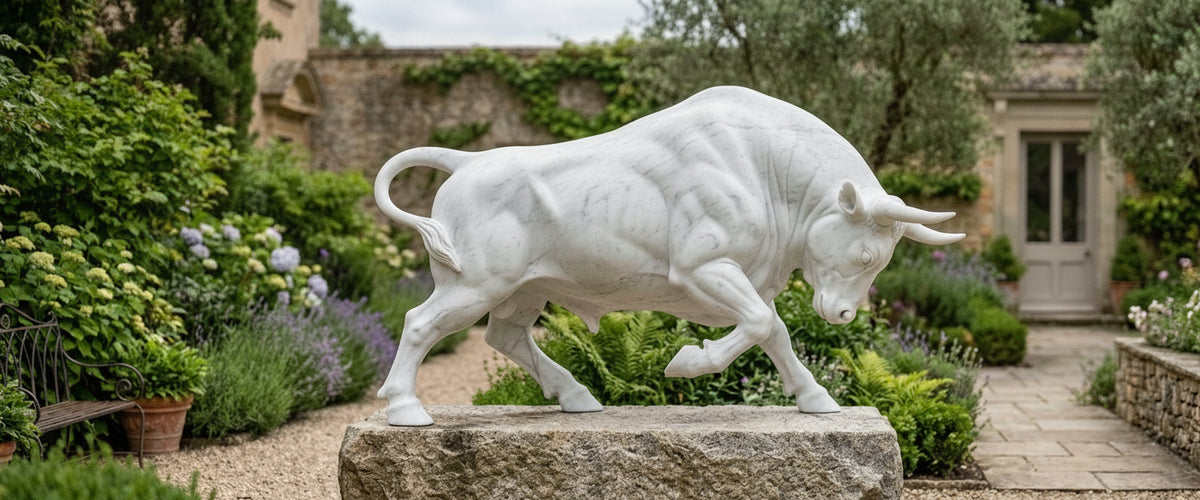
In the studio we turn blocks before carving to read the veins. We have rejected otherwise beautiful material because a dark seam would have run straight through an ankle. On animal subjects the stress points shift. A figure such as the Charging Bull in white marble, at about 5 feet (150 cm), carries a heavy body on slender legs, so vein direction through those supports matters far more than anything running across the hide. Ask any supplier how they chose the block. A vague reply tells you something.

One Block or Pinned Sections: Where Large Marble Garden Statues Fail First
Past a certain size, carving from a single block becomes impractical, or the block simply cannot be sourced. Instead, figures are made in sections joined with pins and structural adhesive. Done well, this is entirely sound, and plenty of classical statuary was assembled the same way.
The weak point is the pin. Mild steel rusts, swells and splits the stone from the inside, a failure conservators see constantly on older garden pieces. Insist on stainless steel pins and ask where the joints sit. On a tall subject like the Graceful Giraffe in white marble, at roughly 11.5 feet (350 cm), the neck and legs are exactly where you want to know how the piece is built and how it is anchored to its base.
Single-block pieces avoid joints entirely, but they demand flawless material and heavier lifting gear on delivery. Plan access early if your garden sits behind the house or up a slope.
UK Damp vs US Freeze-Thaw: Choosing Stone for Your Climate
A garden in Devon and a garden in Aspen want different stone for large marble garden statues, even when the design is identical. Mild, wet British gardens rarely see the deep, repeated freezes of a Rocky Mountain winter, but the stone stays damp for months. That invites algae, lichen and green staining in shaded corners. In that climate, a well-drained plinth and good airflow matter as much as grade.
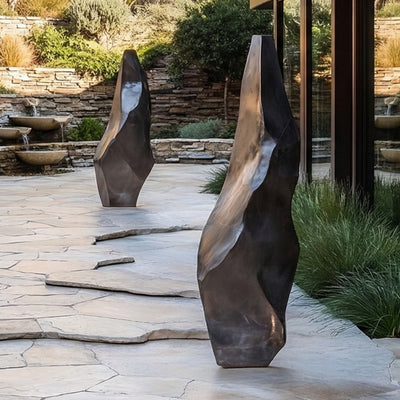
Across much of the northern US, water in veins and pores freezes and thaws repeatedly through the winter. The USDA Plant Hardiness Zone Map shows how cold your winters get, though not how often they cycle through freezing. For those sites we steer clients toward the densest stone available, honed finishes and fewer thin projections. Where frost is the main worry, a compact, flowing form such as the Abstract Flame Marble Sculpture - 55cm / 120cm gives ice far less thin detail to work into than a figure with outstretched wings or free-standing fingers. If you cover a piece for winter, use a breathable, ventilated cover rather than a tarp. Plastic traps condensation and can do more harm than the snow.
In freeze-thaw climates, dense stone and a breathable cover do most of the work.
Gardens in Napa and Southern California face a different stress. Strong sun and wide swings between day and night temperatures drive sugaring more than frost does, because the constant heating and cooling works the crystal boundaries loose. There, a dense, fine-grained stone and a honed surface remain the safest choices.

A Buyer's Checklist Before You Commission
Most problems with large marble garden statues can be avoided at the briefing stage.
Name the stone. Ask for the marble type and grade, not just the color.
Ask about absorption. Lower water absorption usually means a longer outdoor life.
Check the veins. Request photos showing how veins run through limbs, necks and supports.
Confirm the joinery. Find out whether the piece is single block or sectional. If sectional, insist on stainless steel pins.
Match the finish to exposure. Choose honed for open sites and save high polish for sheltered spots.
Plan the base. A drained, level plinth prevents wicking and tilt.
Agree an aftercare routine. Use a soft brush and clean water, with no pressure washers or acidic cleaners.
Budget depends on stone grade, scale, carving complexity, engineering, shipping and installation, so a tailored quote is the only honest number. Our large garden statues collection is a good place to judge scale before you brief a commission.
At Giant Sculptures we treat every bespoke commission as something that should still look right in thirty years. That means choosing the block, the joinery and the finish for your specific garden. If you would rather start with finished pieces, explore our wider garden statues and talk to us about adapting the stone to your climate.
For wider placement ideas, Large Metal Garden Sculpture: Pick the Finish Before the Form is useful companion reading before finalising the setting and sightlines.