



































A heron stands on two legs thinner than a broom handle, and that is exactly where a large outdoor bird sculpture gets into trouble. Scale a bird up past waist height and every pound of body, neck and wing has to pass through two slender points before it reaches the ground. Get the engineering and the siting right, and a big bird reads as weightless. Get them wrong, and you are watching it lean by the second spring.

At a glance
Long-legged birds (herons, cranes, ostriches) need a steel armature running through the legs and into the footing.
Above head height, a bronze or Corten skin over an internal steel frame is the most reliable cast build.
Open wings act like a sail; they need a deeper footing than a folded pose.
Site the bird against open sky, not a dark hedge, so the silhouette stays legible.
Choose a finish for your climate, not just your color preference.
Two Thin Points Carry the Whole Bird
Most animal sculptures spread their weight. A bear sits on its haunches, a horse stands on four hooves. Wading and flightless birds do the opposite. A crane balances its mass high on two stalks, which concentrates load at the ankle joint and at the point where the foot meets the base.
In the studio we treat the legs as structure first and anatomy second. The visible leg is shaped to look natural, but inside it sits a solid steel bar or heavy-wall steel tube that continues through the foot, through the plinth, and into concrete. If a supplier cannot tell you what is inside the legs of a large outdoor bird sculpture, ask again before you buy.
The visible legs are anatomy; the steel bar inside them is the structure.
Steel Inside, Bronze or Corten Outside
For a large outdoor bird sculpture that stands above head height, roughly 6 feet (1.8 meters) and up, we recommend an internal steel armature carrying a bronze or Corten skin. The armature takes the structural load; the skin carries the feathers, texture and patina. This keeps wall thickness sensible, keeps weight down, and stops the outer surface from being asked to do two jobs at once.
Fabricated stainless steel works differently. The bird is welded from sheet over an internal frame, so the shell and structure are designed together. That approach suits abstracted birds, where clean planes matter more than individual feathers. If you want a statement bird above head height without the feather-by-feather detail of cast bronze, a fabricated form such as the Gold Abstract Swooping Bird Stainless Steel Sculpture, at 236cm (about 7.7 feet), keeps its swept wing line crisp because frame and skin were engineered as one.

Open Wings Catch Wind Like a Sail
A folded heron presents a narrow profile to the wind. Spread those wings and you have added a large flat surface several feet off the ground, and wind pushes on it the way it pushes on a garden umbrella. The force acts as a lever through the legs, trying to tip the bird or snap it at the ankles.
The practical answer is a deeper and wider footing for any large outdoor bird sculpture in an open-wing pose, plus attention to exposure. A ridge-top garden in Malibu or an open lawn in the Hamptons sees far more wind than a walled courtyard in Napa. Tell your supplier where the sculpture is going; footing design should follow the site, not a standard drawing.
Worked Example: An Ostrich in the Yard
Take a life-size Corten ostrich with its head lowered to graze, set on an open lawn. A real adult ostrich can stand around 7 to 9 feet (2.1 to 2.7 meters) tall, so even a head-down pose has serious presence.
Three decisions shape a piece like this. First, scale: at true life size, the body needs a steel frame with both legs anchored deep into a concrete pad. Second, ground clearance: leave enough room around the legs and under the belly for a ride-on mower to work past without scraping, and talk to the lawn crew before the footing is poured. Third, grazing height: set the beak just above the grass, close enough to look convincing, high enough that rainwater and clippings do not collect around it. That last detail sounds small. It is the difference between a sculpture that looks alive and one that looks parked.
Set the Bird Against Sky, Not Hedge
A large outdoor bird sculpture is read by outline: the curve of a neck, the angle of a beak, the line of a wing. Put a dark bronze heron in front of a yew hedge and the outline disappears. Put the same bird on a slight rise with sky behind it, and the shape snaps into focus from across the garden.
A slight rise and open sky keep the neck and beak legible from across the lawn.
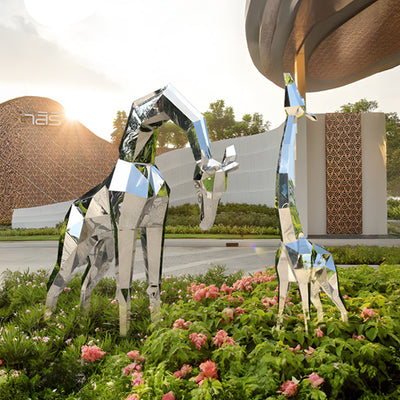
Reflective finishes change the rule slightly. A mirror-polished surface picks up its surroundings, so it can sit closer to planting and still read clearly. On a terrace wall or table-height plinth backed by foliage, a compact form like the Silver Mirror-Polished Abstract Bird at 83cm holds its outline where dark bronze would simply vanish. Smaller paired forms work best at eye level near seating, where people can see the detail; beside a bench or outdoor dining table, a piece such as the Brown Loop with Two Birds is closer to the right scale than a single tall bird competing with the view.

Finishes That Stay Crisp After Five British Winters
Our test bed is unglamorous: samples left outside at the studio through wet, gray UK winters. After five seasons the pattern is consistent. Corten develops a stable, even rust layer, provided water drains away and the surface dries between showers, a behavior well documented in weathering steel guidance. Bronze darkens and benefits from a yearly wax. Stainless steel holds its edge best, though grade matters: coastal and de-iced sites need 316 rather than 304, as the World Stainless Association sets out in its material guidance.
For a buyer in Florida or on the New England coast, salt is a bigger enemy than cold, so any stainless steel sculpture headed for those sites should be specified in 316. In Aspen, freeze-thaw cycles are the main concern, so drainage holes in the hollow body of a large outdoor bird sculpture are essential.
Buying a Large Outdoor Metal Bird Sculpture: A Checklist
Ask what is inside the legs. You want continuous steel into the footing.
Match pose to exposure. Open wings on windy sites need engineered foundations.
Check the backdrop. Walk the site and look for sky behind the proposed position.
Pick finish by climate. 316 stainless near salt, Corten where water drains freely, bronze where you will wax it.
Plan access. Mowers, irrigation and lighting cables should clear the base.
Budget realistically. Cost depends on material, scale, complexity, engineering, installation and finishing, so request a tailored quote.
A large outdoor metal bird sculpture is a long-term structure as much as an artwork. At Giant Sculptures we build bespoke birds around the site they will live on, from footing depth to finish. Send us photos of your garden or venue and we will tell you honestly which pose, scale and material will hold up.
For wider placement ideas, Why a Large Bird Sculpture Lives or Dies by Its Legs is useful companion reading before finalising the setting and sightlines.