






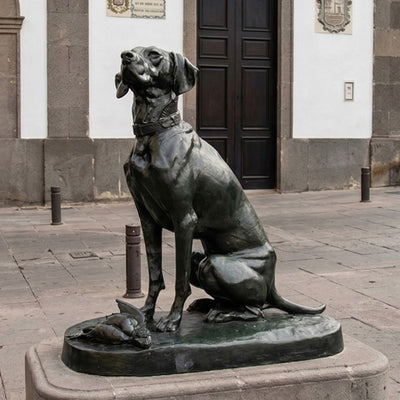





































Buyers study the face. They photograph the muzzle, the set of the ears, the tension in the shoulders. Then the piece goes outside, and the damage starts somewhere nobody looked: the bottom 8 inches (200mm). Almost every complaint we field about large outdoor dog statues traces back to the base, the joint under it, or the ground beneath that. Get those three right and the sculpture will outlive the house it guards.

At a Glance
Rain bouncing off hard paving attacks paws and plinth harder than anything falling from the sky.
In freeze-thaw climates, cast stone and concrete large outdoor dog statues fail at the plinth joint long before cast bronze does.
Green algae tidemarks make a new piece read as neglected within two seasons.
Foo dog pairs need setback and drainage planned before the gateway is paved, not after.
Doweled and bedded fixings outlast adhesive pads by decades.
A bespoke commission is often worth it purely for a better-engineered base.
Paw-Level Splashback: The First 8 Inches Take the Punishment
Set a sculpture on flagstone, gravel or a driveway apron and every downpour throws dirty water back up at it. That splash zone carries grit, de-icing salt, fertilizer runoff and whatever the mower flings. On stone it grinds a rough gray band around the feet. On bronze it interrupts the patina, leaving pale streaks where the protective wax has been abraded off and the metal is left bare to chloride attack.
The fix is boring and effective. Raise the piece. Even 4 to 6 inches (100 to 150mm) of plinth height moves the paws out of the worst of the splash arc. Large outdoor dog statues also do better with a gravel or planted margin around the base rather than solid paving, so water lands soft. A ground-level figurative group such as the Traditional Boy and Dog Bronze Sculpture, 150cm is a good example of why: sitting it straight onto a lawn edge puts the feet in the mud line, while a low stone plinth lifts the composition to eye level and keeps the splash arc off the bronze.

Freeze-Thaw at the Plinth Joint
Water does not need much of a gap. It gets into the seam between sculpture and plinth, freezes, expands roughly nine percent, and levers the two apart. Repeat that forty times a winter in Aspen or upstate New York and the joint opens.
This is where material choice stops being aesthetic. Cast stone, reconstituted marble and concrete large outdoor dog statues are porous and brittle at the edges, so the arris around the joint spalls first, then the crack walks upward. Cast bronze does not absorb water, so the same freeze cycle simply cannot get inside the metal. It can still lift a badly bedded bronze off its base, which is a fixing problem rather than a material one. The American Institute for Conservation's guidance on caring for outdoor sculpture is blunt about the same principle: keep water moving off and away, never let it sit in a detail.
Slope the top of the plinth by a degree or two so water runs off. Bed the sculpture on a full mortar or sealant bed with no voids. Leave no horizontal ledge where meltwater can pool against the metal or stone.
Moss, Algae and the Green Tidemark
Nothing ages large outdoor dog statues faster than a green band creeping up from the ground. Biological growth needs moisture and shade, so a dog statue tucked under a yew hedge on the north side of a Connecticut house will colonize far quicker than the same piece on an open Texas terrace. Historic England's guidance on biological growth on masonry makes the point that improving drainage and airflow does more than any cleaning product.
Practical version: clear vegetation back 12 inches (300mm) from the base, wash with water and a soft brush twice a year, and re-wax bronze annually. Skip pressure washers and wire brushes. On stone they open the pores and give the algae a better grip; on bronze they strip patina you cannot buy back.
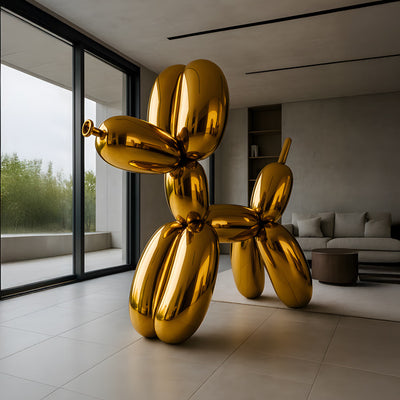
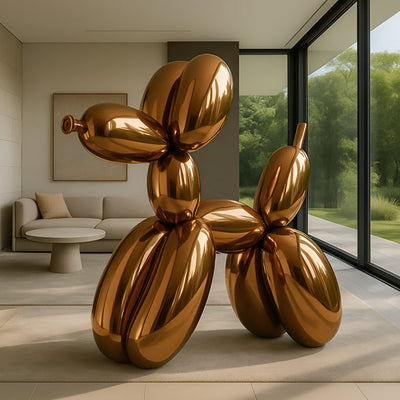
Mirror-polished stainless behaves differently again. Where a site is damp and shaded and annual waxing is unrealistic, a sealed high-gloss surface like the Mystic Chrome Balloon Dog Sculpture, 130cm is closer to the right specification than patinated bronze; it resists growth almost entirely, though it does show hard-water spotting. A rinse with deionized water and a microfiber cloth keeps the reflection clean. The wider range of large balloon dog sculptures is worth reading through if you want to see how much a high-gloss surface changes the way light works in a courtyard.

Outdoor Foo Dog Statues in Pairs: Setback, Gateway Width and Drainage
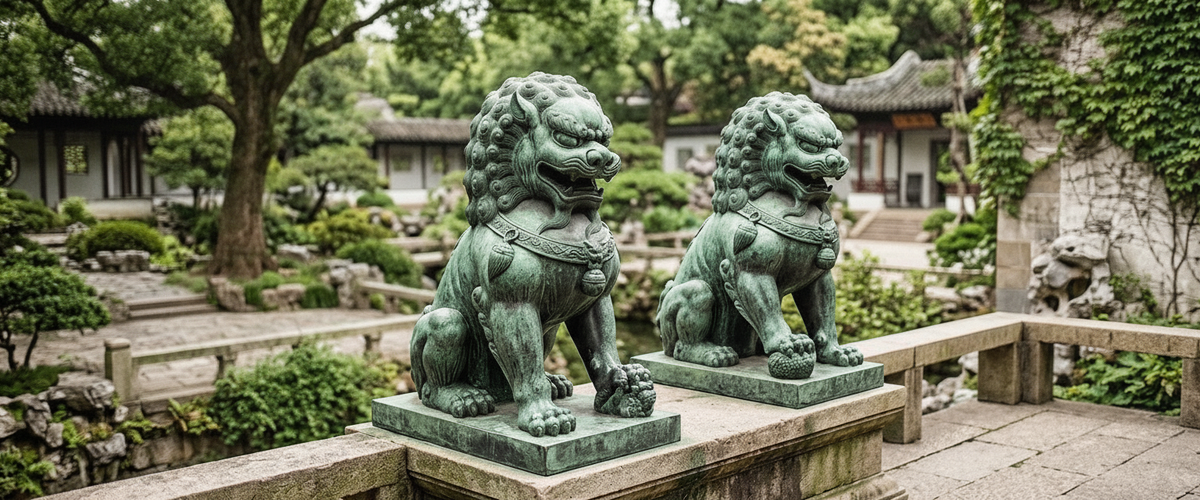
Large outdoor foo dog statues are a symmetry problem more than a sculpture problem. The guardian lion pair traditionally sits with the male and his ball on one side and the female with her cub on the other, flanking an entrance. Get the geometry wrong and the whole arrangement looks apologetic.
Three numbers to settle before anything is poured. First, setback: keep at least 18 inches (450mm) between the outer face of each plinth and the swept path of a vehicle or a swinging gate. Second, gateway width: for outdoor foo dog statues to read as guardians rather than obstacles, the clear opening between them should be roughly two and a half to three times the width of a single plinth. Third, drainage: a shared plinth spanning a driveway entrance becomes a dam if the ground falls toward it, so the falls need setting out with the paving contractor.
A shared plinth locks the pair permanently level, which matters because the eye catches a half-inch mismatch between two foo dogs statues outdoor at a gate instantly. Separate bases are more forgiving to install and easier to reposition, but they need identical footings or one will settle first. Few large outdoor dog statues are as unforgiving of a crooked install as a guardian pair.
Footings for a Statue a Winter Storm Will Lean On
A tall dog sculpture is a sail. Wind load acts on the whole silhouette and the use lands on the base, so large outdoor dog statues at or above life size want a reinforced concrete footing taken below the local frost line and sized to the piece rather than guessed. Clay soils shrink and swell seasonally; sandy soils scour. A striding group such as the Life-Size Hunting Dogs Bronze Sculpture, 220cm concentrates a lot of weight over a small contact area and carries most of its mass high and forward, which is exactly the case where a proper pad and dowel layout stops being optional.
We supply fixing details with large commissions for this reason. One client on a Hamptons dune site had a pair reset twice by a landscaper before the footings were engineered; after that, nothing has moved through several nor'easters.
Dowels, Resin and Lead: Fixings That Outlast Adhesive Pads
Adhesive pads and construction glue are quick, cheap and temporary. They fail in UV, they fail in frost, and they fail exactly when the wind is worst. What holds large outdoor dog statues down over decades is mechanical, corrosion-rated and reversible.
Stainless steel dowels cast or drilled into the sculpture base and set into the plinth. Use 316 grade near coastal air.
Chemical resin anchors for the dowel holes, injected so the annulus is fully filled and the excess is cleaned off before it cures.
Molten lead caulking in stone plinth pockets, the traditional method, still unbeaten for slight movement tolerance and reversibility.
Never rely on weight alone for anything a person could climb on or a vehicle could clip.
When a Commissioned Dog Is Worth It for the Base Alone
Plenty of buyers commission for breed accuracy or a specific pose, which is fair enough. The quieter argument is engineering. Commissioned large outdoor dog statues let us cast the dowel bosses into the base, thicken the wall where the load runs, size the plinth to the paving module you have already chosen, and match the patina to the stone rather than fighting it. Budget for a commission depends on scale, material, modeling complexity, engineering, finishing and installation, so the honest answer is a tailored quote rather than a headline figure.

Checklist Before You Order
Where does splashback land, and can you raise the piece out of it?
Does the plinth top shed water, or hold it?
Is the location shaded and damp enough to invite algae?
For a pair, are setback, opening width and falls agreed with the paving contractor?
Is the footing below frost line and sized for wind load?
Are the fixings mechanical, corrosion-rated and reversible?
Have you scheduled a wash and wax at least once a year?
Tell us the site conditions, the sight lines and the paving you are working with, and our studio will advise on material, scale and base detail before a single mold is made. That conversation is where good large outdoor dog statues become permanent ones.
For wider placement ideas, Extra Large Outdoor Sculpture: How Scale, Sightlines and Placement Decide the Whole Effect is useful companion reading before finalising the setting and sightlines.