

























































































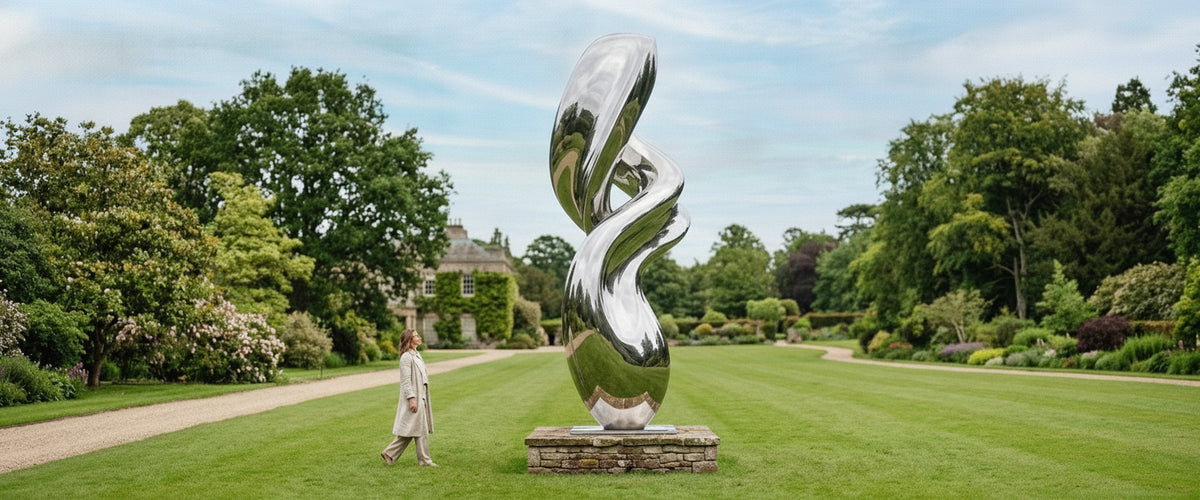

A big sculpture in the wrong spot looks smaller than a well-placed medium one. That sounds backward until you have watched it happen: a ten-foot piece parked flat against a busy hedge, swallowed whole, while a six-foot figure on a low plinth at the end of a lawn stops people mid-conversation. Extra large outdoor sculpture is a scale decision first and a shopping decision second, and the difference between a piece that commands a garden and one that quietly disappears usually comes down to sightlines, backdrop and height off the ground.
Looking for the full range in this category? Browse our Large Garden Statues collection for every available finish, size, and configuration. Extra large outdoor work is where these decisions matter most.
We ship large and bespoke work worldwide from our UK studio, and the questions that come up again and again are not about the sculpture itself. They are about where it goes. So let us treat placement as the real subject of any extra large outdoor commission.

Extra Large Outdoor Sculpture at a Glance
- Scale is relative to its surroundings. A piece reads as large when the space around it gives it room, not when it fills every gap.
- Sightline distance sets the minimum size. The farther the main viewing point, the bigger the piece needs to be to hold attention.
- Pedestal height changes everything. Raising a figure even 18 inches (about 46 cm) can shift it from ornamental to commanding.
- Backdrop contrast decides visibility. A dark bronze against dark yew is a common, expensive mistake.
- Material follows exposure. Coastal salt, hard frost and strong sun all argue for bronze, stainless steel, Corten or stone over anything less durable in an extra large outdoor setting.

What Extra Large Actually Looks Like in Real Settings
The word "large" means nothing without a room around it. In a double-height entrance hall, a seven-foot figure can feel proportionate, almost restrained. Set that same figure on an open back lawn with sky behind it and it can look modest, because the eye now measures it against acres, not walls. That is the trap most extra large outdoor buyers meet first.
Outdoors, the reference points get generous fast. Mature trees, a pool terrace, a wide gravel forecourt: all of these shrink a sculpture visually. This is why so many big garden commissions end up bigger than the client first imagined. When a client asked us about a centerpiece for a circular drive, the honest answer was that anything under about nine feet (roughly 2.7 m) would have looked like a garden ornament dropped in the middle of a runway.
Indoors, the opposite pressure applies. Ceiling height, door widths and the route from truck to final position all cap the practical maximum. We have turned pieces sideways through service elevators more than once, and it is always the doorway, not the room, that sets the ceiling on size.

Scale, Sightlines and Pedestal Height
Start with the primary sightline: the one spot where people will most often first see the piece. A terrace door, the top of a driveway, the far end of a formal lawn. Measure that distance honestly. As a rough working rule, the farther the viewer, the larger the sculpture and the higher the base needs to sit for the piece to hold the eye. This is the heart of any extra large outdoor placement.
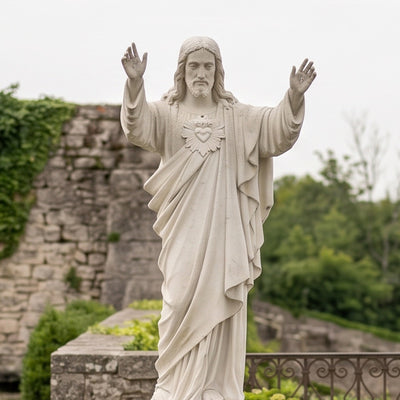
Pedestal height is the lever most buyers underuse. A figure at ground level invites you to look down at it, which flattens its presence. Lift it, and the silhouette meets the horizon or the sky, and it starts to read as a landmark. For a stainless steel abstract on a lawn, even a modest plinth can turn a pleasant object into the thing the whole garden points toward. If you are commissioning, ask for the base to be designed as part of the piece, not sourced afterward.
There is a limit, of course. Raise a piece too high above a close viewing point and you force everyone to crane their necks, which nobody enjoys for long. Match the base to the distance: close viewing, low or no plinth; long approach, taller base.

Indoor Versus Outdoor: When Each Wins
Outdoor placement wins when the sculpture needs breathing room and a sky or planting backdrop to sit against. Weather resistance becomes the deciding factor, which is why we steer these large commissions toward bronze, stainless steel, Corten weathering steel and natural stone. These materials are built for decades outside; bronze develops its patina, and Corten forms a stable rust layer that protects the metal beneath it. The Smithsonian's outdoor sculpture conservation work is a useful reminder that even durable metals reward planned care over the years. Any extra large outdoor piece earns its keep this way.
Indoor placement wins when you want the piece protected, closely lit and read at short range. Interior work can carry finer surface detail because it will never face frost or salt spray. It also lets you control light precisely, which matters for reflective finishes.
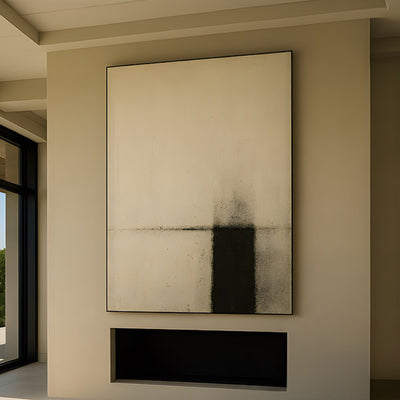
One practical note for exterior metal panels: an extra large outdoor metal wall art panel behaves differently from a freestanding piece. It has no plinth to give it height, so the wall itself becomes the pedestal. Fix it high enough that the composition reads from your main viewing distance, and make sure the wall can carry the weight. On rendered or single-skin garden walls we always ask about the substrate before we finalize fixings.

Light, Backdrop and Contrast
The single biggest visual mistake is contrast failure. A dark patinated bronze in front of a dark hedge, a brushed steel piece against a pale rendered wall in flat midday light: in both cases the sculpture loses its edges and the whole investment goes quiet. An extra large outdoor form deserves better staging than that.
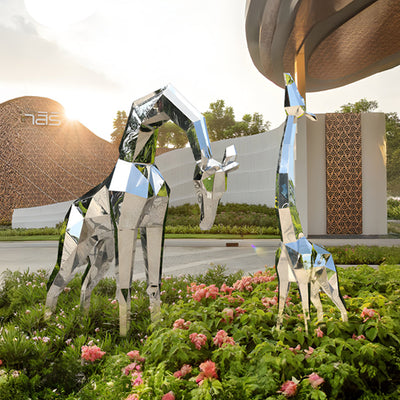
Think in silhouettes. What sits directly behind the piece from the main viewpoint? A polished stainless steel form comes alive against green planting or open sky because it catches and throws light; the same piece against bright white stone can dissolve into glare. A Corten piece, all warm rust tones, sings against silver birch trunks or gray stone and can vanish against autumn planting.
Track the sun. A sculpture read mainly at golden hour wants low, raking light across its surface to pull out form. A piece seen at noon needs contrast built into its setting because overhead sun flattens everything. If the main viewing time is evening, plan discreet uplighting from the start; retrofitting cable runs across a finished lawn is nobody's favorite job.

Placement Mistakes We See in Commissions
For wider placement ideas, Large Metal Garden Sculpture: How Scale and Placement Decide the Whole Effect is useful companion reading before finalising the setting and sightlines of an extra large outdoor piece.
Some of these come up so often they are almost predictable.
- Buying to fit the gap, not the sightline. The piece ends up correctly sized for an empty corner and undersized for the view that actually matters.
- Ignoring the backdrop. Beautiful sculpture, invisible against the planting behind it. Always check the piece against its real background, not a studio wall.
- Skipping the plinth conversation. Ground-level placement drains presence from figurative and abstract work alike.
- Underestimating access. Gateways, soft ground, low branches and turning circles decide whether a monumental piece can even reach its spot. We plan the route before we cast, not after.
- Forgetting foundations. A tall, heavy piece needs a proper footing. A stone or bronze figure weighing several hundred pounds (well over 150 kg) cannot sit on a paving slab and hope.
- Treating light as an afterthought. The setting looks fine by day and disappears by night.
A Short Placement Checklist Before You Commission
- Identify the single most important viewing point and measure the distance to it.
- Photograph the exact backdrop from that point, in the light you will most often see it in.
- Decide the plinth height against that distance, then confirm foundations.
- Match material to exposure: coastal, frost-prone or full-sun sites narrow the sensible options for extra large outdoor work.
- Walk the delivery route end to end and note every pinch point.
- Plan lighting now if the piece will be seen after dark.
Get these six right and the sculpture does its job. If you are weighing options, our team at Giant Sculptures works through exactly this list on bespoke extra large outdoor commissions before anything is cast or fabricated, because the placement decisions are far harder to change once a multi-hundred-pound piece is standing on a footing. Browse the stainless steel sculptures if you are drawn to reflective, contemporary forms that thrive against open planting; the material handles decades outdoors and rewards a considered backdrop.
Scale is a promise. Made well, an extra large outdoor piece becomes the fixed point a garden or forecourt organizes itself around for a generation. Made carelessly, it is simply a large object nobody quite looks at. The distance between the two is placement.