





































































































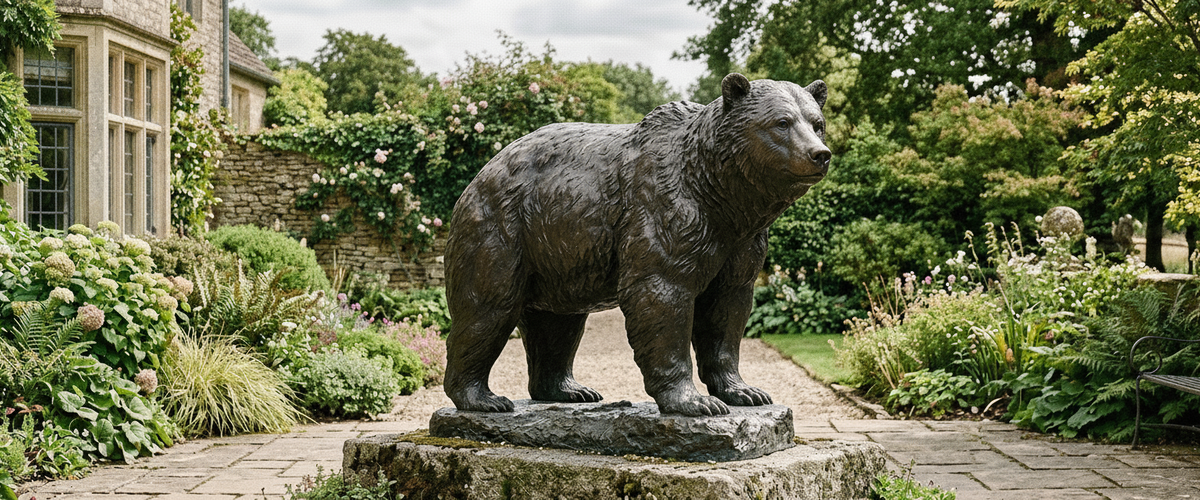

A tall bronze bear does not usually fail because someone picked the wrong pose. It fails because it was bedded on soft turf in late fall, settled a degree or two over one winter, and put every pound of its mass through a single rear paw weld. That is the unglamorous truth about large outdoor bear sculptures: the sculpture is the easy part, and the ground under it decides how the next thirty years go.
Looking for the full range in this category? Browse our Large Bear Sculptures collection for every available finish, size, and configuration.

Key Takeaways
Stance changes everything. A four-point walking bear spreads load; a seated or reared bear concentrates it.
Match the footing to the surface. Concrete pads for lawn, ballast trays for gravel, joist calculations for decking.
A reared bear behaves like a sail. Standing poses catch gusts that a walking pose shrugs off.
Bad bedding cracks the paw-to-base weld first. Full contact matters more than bolt count.
Sightline beats slab convenience. Place against a treeline or hedge mass, not stranded on a driveway turn.
Budget depends on material, scale, engineering, finish and installation access, so ask for a tailored quote rather than guessing.
The pad sits below the topsoil so grass grows back to the edge.
Weight per Paw: Why Stance Changes the Ground Prep
Two bears of identical height can load the ground in completely different ways. A walking grizzly on four paws distributes mass across four contact patches, each maybe the size of a dinner plate. A bear reared on hind legs pushes the same mass through two paws and a tail-line support, and it does it at the top of a lever arm several feet long. In gravel, that difference is the gap between a sculpture that settles evenly and one that sinks at the back corner by the second spring.
Large outdoor bear sculptures are usually specified by height first and contact area second, which is the wrong way round. Before you fall for a pose, work out the contact area. A naturalistic four-point form at 165 cm (roughly 5 ft 5 in), along the lines of the Fresh Grizz Bear Sculpture - 165cm, spreads its mass across four broad paws, and even then cast bronze at that scale is heavy enough that point loading matters. Fabricated stainless or Corten pieces at the same height weigh less overall, but they tend to carry more of that weight high in the form, which loads the base plate differently. We ask every client for the surface type before we talk about finishes, because the answer changes the base detail we fabricate.

Concrete Pads, Ballast Trays and Joist Math
Three surfaces, three answers.
Lawn and soft landscaping: a poured reinforced concrete pad, set below the topsoil so grass grows back to the edge and the pad disappears. Size the pad wider than the footprint on all sides, not flush with it.
Gravel and resin-bound drives: a steel ballast tray or buried plinth under the gravel layer, so the bear sits on engineered support while appearing to stand directly on stone. Loose gravel on its own will migrate under repeated load.
Timber decking and roof terraces: get the point load checked against joist spacing and span before delivery day. Deck framing is designed around distributed live loads, not a concentrated mass on four small pads, and American Wood Council span guidance is a sensible starting point for your contractor. Spreader plates or a load-bearing sleeper frame usually solve it.
For terraces and rooftops in places like NYC or coastal California, the structural check on large outdoor bear sculptures should happen before the commission is finalized, not after. We have redesigned base plates mid-project because a client's roof deck needed the load fanned across three joists instead of one.
A Reared Bear Is a Sail
Wind is the load buyers of large outdoor bear sculptures forget. A walking bear presents a low, dense profile. A reared bear, forelegs raised, presents a broad vertical face several feet off the ground, and gust pressure acts on that face like it would on a fence panel. In exposed sites, an Aspen ridge garden, a Hamptons dune edge, a Texas ranch with a mile of open pasture upwind, that overturning moment is real and it is cumulative.
The fix is not more weight at the top. It is a wider anchored base, deeper fixings, and honest conversation about exposure. If a client wants a standing pose in a windy spot, we design a concealed base extension into the footing rather than bolting a slim plate to a shallow pad and hoping.
An upright pose catches gusts a walking form shrugs off.

The Paw-to-Base Weld Is Where a Badly Bedded Bear Cracks First
In large outdoor metal bear sculptures, the highest stress concentration is almost always where a limb meets the base plate. If bedding is uneven, the sculpture rocks by fractions of a millimeter with every temperature swing and every gust, and that flex works the weld like a paperclip bent back and forth. A cracked coating, a rust weep line, or a hairline seam at the ankle usually means the footing was never truly flat.
Bed the base of large outdoor bear sculptures in a non-shrink grout or a full-contact mortar layer so there are no voids. Torque fixings evenly rather than tightening one corner down onto a high spot. On bronze, keep an eye on the wax and patina layer around the fixing points; the Getty Conservation Institute publishes solid material on how outdoor bronze surfaces degrade where moisture sits and pools.
Frost Heave, Drainage and What Goes Under the Footing
The detail buyers skip is the layer nobody sees. A footing poured straight onto clay in Colorado or upstate New York will lift when water in the soil freezes, and it rarely lifts evenly. Take the footing below the local frost line, sit it on a compacted free-draining stone base, and give trapped water somewhere to go. On sloped ground, add a drainage channel upslope so the pad is not sitting in a seasonal puddle.
Same principle for the sculpture itself: hollow forms need drain holes at the lowest point, kept clear of leaf litter and grit. A large outdoor bear sculpture that holds a pint of water in a paw through a hard freeze is being split open from the inside.
Sightline Before Slab: Where Large Outdoor Bear Sculptures Actually Belong
The easiest install spot is rarely the best one. Driveway turning circles are convenient for crane access and terrible for the sculpture, because the bear reads against parked cars and hard paving. Placed against a treeline, hedge mass or stone wall, the silhouette resolves and the animal gains scale.
Sit the piece so the head is angled toward the approach path rather than square to it. Walk the site at the times you actually use the garden, morning coffee, evening light, and mark the position with stakes before a single bag of cement is opened. Where the setting calls for a contemporary silhouette rather than naturalistic fur detail, the Inside Appears Outside Bear Sculpture - 165cm is closer to the right design language, and a form like that needs a clean backdrop so it is not fighting planting detail.
Soft Ground Sites: When Resin over Steel Is the Smarter Call
For wider placement ideas, Large Resin Bear Statues and the Rooftop Weight Problem Nobody Mentions is useful companion reading before finalising the setting and sightlines.
Sometimes the ground says no. Boggy paddocks, thin roof buildups, event terraces with load caps, seasonal installations that move twice a year. On those sites, large outdoor bear sculptures built in resin over an engineered steel armature are the sensible choice: far lighter for the same footprint, still weatherable with a UV-stable finish, and easier to relocate without a crane. Our resin sculptures and statues exist for exactly these conditions. For permanent, generational installs on solid ground, bronze, Corten or fabricated stainless remains the better long-term answer.

Pre-Install Checklist
Confirm pose and contact points, then calculate load per paw.
Identify surface type and specify pad, tray or spreader frame accordingly.
Check local frost depth and drainage fall across the site.
Assess wind exposure, especially for reared or upright poses.
Verify crane or lifting access, gate widths and turning space.
Agree base fixing detail, bedding method and drain hole positions with the studio.
Stake the sightline and view it across a full day before pouring.
Commissioning a Bear at the Right Scale
Height reads differently outdoors than it does on a spec sheet. A 135 cm bear (about 4 ft 5 in) works in a courtyard or beside a pool terrace; the same design at 165 cm holds a lawn that a smaller piece would get lost in. In an enclosed space where a taller form would crowd the sightline, stepping down to a 135 cm version of the same design, such as the Inside Appears Outside 3 Bear Sculpture - 135cm, keeps the proportions honest without shrinking the presence.
For bespoke work, Giant Sculptures engineers the base detail into its large outdoor bear sculptures from the first sketch rather than as an afterthought, so the structure and the artwork arrive as one system. Send site photos, surface details and a rough footprint, and we will come back with material options and a tailored quote. Cost tracks scale, material, complexity, structural engineering, finishing and access. Either way, a serious bear commission starts with the ground, not the catalog.