




































































































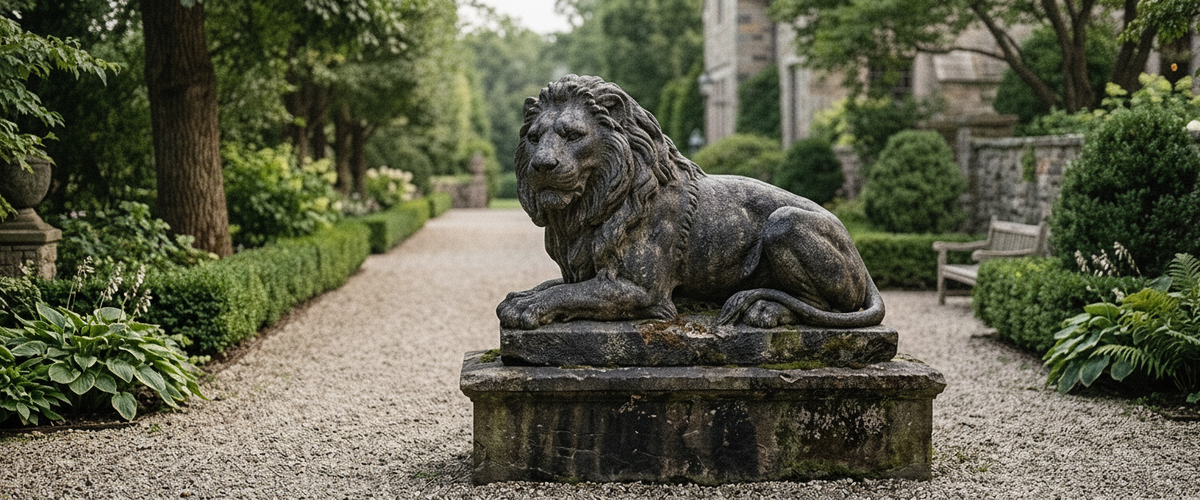

Walk twenty paces back from a granite figure and it either holds the garden or it disappears into the hedge. That single test settles more decisions than any material sample ever will. Granite garden statues are among the most physically permanent objects most people will ever place outdoors, and they are also the easiest to site badly, because the density and crystalline hardness that make granite outlast everything around it are the same properties that fight fine detail and eat shadow.
Looking for the full range in this category? Browse our Granite Headstones collection for every available finish, size, and configuration.
At a glance:
Granite gains mass and silhouette at distance; it loses crisp modeling up close.
Finish matters more than carving depth. Flamed, honed and polished each read differently at 30 feet (9 m).
Gray granite against gray masonry is a disappearing act. Dark evergreen is the reliable backdrop.
A plinth helps standing figures and ruins crouching animals.
Site for low winter sun, when the garden has no foliage left to help you.
Footing is decided by block weight, and granite is heavy in a way photographs never communicate.

Twenty Paces Is the Test for Granite Garden Statues
Stand a carved granite figure at arm's length and the crystal speckle in the stone competes with every tool mark. Feldspar, quartz and mica scatter light across the surface, so a delicate eyelid or a folded sleeve reads as noise. Back up to twenty or thirty paces and the same piece becomes what it was always meant to be: weight, outline, presence. Marble holds detail at close range. Bronze holds it at any range, because patina absorbs light rather than scattering it. Granite is a distance material, and that should drive where you put it.
The practical consequence is that granite garden statues belong at the far end of a lawn, at the turn of a long path, on an axis you approach slowly, or across water. They do not belong tucked beside a doorway where visitors read them from four feet away. We shipped a crouching animal piece to a client outside Austin who had planned it for a courtyard entry, then moved it to the end of a gravel walk after seeing it uncrated. Same sculpture, entirely different object.
Viewed from the far end of an axis, mass and outline do the work that surface detail cannot.
Flamed, Honed or Polished Decides How Much Carving Survives
Surface finish changes granite more than most buyers expect. A flamed (thermal) finish is created by passing a high-temperature torch over the stone so the surface crystals spall away, leaving a rough, matte, slightly pale skin. It grips light, hides staining, and reads soft and chalky from a distance. A honed finish is ground smooth without gloss and sits in the middle: it keeps carved edges legible while staying non-reflective. Polished granite behaves almost like a mirror, throwing back sky and foliage instead of showing its own modeling, which is why polished black pieces can flatten into bright, formless slabs on a clear day. The Natural Stone Institute publishes useful reference material on how these finishes are produced and specified.
Rule of thumb from the workshop: the longer the viewing distance, the more you should push toward honed or flamed. Most granite garden statues sited across a lawn gain nothing from gloss, because at 40 feet (12 m) the reflections read as glare and the form loses what little depth it had. Reserve polish for architectural elements, lettered panels and decorative screens where the reflection is part of the effect. Where a design sits in a single flat plane, as it does on the Blessing Character Grey Granite Garden Screen - 200cm, the carving catches light evenly across the whole face and a smoother finish works in your favor rather than against it.

Gray Stone Against Gray Masonry Is a Disappearing Act
The most common siting mistake we see is granite placed against limestone walls, gray render, bluestone paving or weathered fence boards. Value matching kills the silhouette. Gray granite garden statues need something dark and matte behind them: yew, box, holly, a dense laurel run, a stained timber screen, or a Corten panel. In Napa, a client set a granite animal figure in front of a pale stone retaining wall and it read as a lump. Moving it eight feet forward against an olive hedge gave it back its outline instantly.
Black granite flips the problem. Against dark evergreen it will vanish; against pale gravel, a lawn in low sun or a light wall it becomes a sharp graphic shape. Choose the stone color for the backdrop you already own, not the other way round.
Pedestal Height for a Five-Foot Figure
For a standing granite figure around five feet (1.5 m) tall, viewed from twenty to thirty feet, a plinth of roughly 12 to 24 inches (30 to 60 cm) usually lands the head near or slightly above the viewer's eye line, which is where classical siting has always put it. Go taller and you start looking up nostrils. Go lower and the figure loses authority against surrounding planting.
Mock the base up in blocks first; eye line is easier to judge on site than on paper.
Then there are the pieces a plinth actively harms. Crouching, coiled or grounded subjects are composed to sit on the earth, and lifting them breaks the pose. Set the Descending Tiger Grey Granite Statue - 150cm directly on the ground and it reads as a predator moving down a slope; raise the same piece onto a formal pedestal and it turns into an ornament. The logic holds for frogs, turtles and reclining forms. Test the sightline with a stack of blocks before you cast anything.

Planting for Contrast: What Belongs Behind Granite
A wall is the lazy backdrop. Living mass is better, because it moves and granite does not, and that contrast is half the pleasure. Behind the piece, use dense evergreen with small leaves so the texture stays fine and the sculpture keeps the coarse grain to itself. In front and to the sides, low grasses, thyme, or a clean gravel apron keep the base legible. Avoid variegated foliage anywhere near granite garden sculptures and statues; the speckled leaf and the speckled stone cancel each other out.
Water helps enormously. A low pool, a rill or even wet paving after rain will darken granite by several tones and pull out the carving. Where the composition has a strong stacked profile, such as the Three Stacked Turtles Granite Statue - 150cm, still water gives the silhouette a second reading from below and doubles the apparent height without adding a plinth.
Winter Light Flattens Everything
Gardens are designed in June and lived in through February. Low winter sun rakes across a surface at a shallow angle, which is genuinely good for carved stone, but only if the sculpture faces the arc. North-facing granite garden statues in a temperate climate spend four months in flat, shadowless gray light where every subtlety disappears. Before committing, stand on the spot at 9am and 3pm in midwinter and look at where the shadows fall. Site for those months, and the summer will look after itself.
Block Weight Settles the Footing
Granite runs roughly 165 to 175 pounds per cubic foot (about 2,650 to 2,800 kg per cubic meter), which means a solid figure of any real size arrives in the hundreds or thousands of pounds. Turf and compacted topsoil will not hold that. Plan a reinforced concrete pad taken below the local frost line, with a compacted aggregate sub-base and a level bearing surface, and confirm crane or gantry access before the piece leaves the studio. Narrow side returns and soft lawns cause more delivery-day problems than weight itself. If the lift has to cross historic paving or walls, the guidance published by the building conservation sector on protecting existing stonework during works is worth reading first.

A Placement Checklist Before You Commit
For wider placement ideas, A Tiger Garden Statue Needs Cover, Not a Lawn is useful companion reading before finalising the setting and sightlines.
Mark the position and view it from your three most common approach points.
Confirm the viewing distance, then pick the finish to match it.
Check tonal contrast between stone and backdrop, not just color.
Mock up plinth height physically before ordering a base.
Look at the site in winter light and after rain.
Confirm ground conditions, footing depth and machine access.
Decide whether the piece is a full stop on an axis or an object you circle.
Commissioning a Granite Buddha Garden Statue or Bespoke Figure
Granite rewards simplification, which makes it an excellent material for meditative and contemplative subjects. A granite buddha garden statue works particularly well because the classical seated pose is built from broad planes and calm outlines that survive weathering, distance and low light. If you are commissioning, tell us the setback distance and backdrop first; we will often adjust carving depth and finish for that specific sightline rather than working to a generic model. Giant Sculptures produces bespoke stone and metal work at architectural scale. Cost follows stone selection, block size, carving complexity, engineering, finishing and installation, so a tailored quote beats a guessed number every time.
Browse the wider granite sculpture collection to see how different subjects handle mass, and compare against our stone sculpture range if you want softer stones that hold finer detail at close quarters. Choose the material for the distance you will actually view it from, and granite garden statues will still be doing their job long after the planting around them has been replaced twice.