





































































































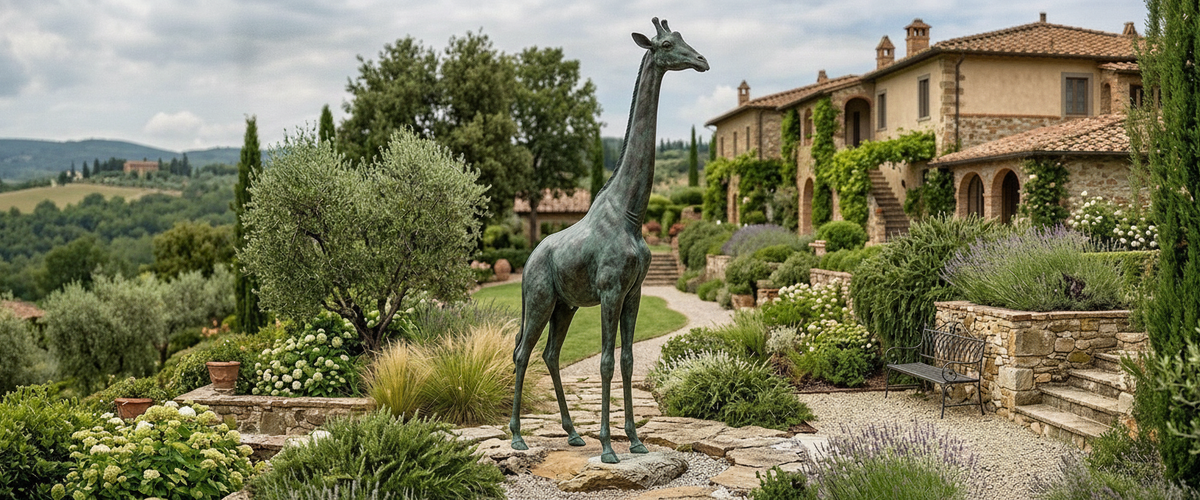

Buy the wrong giraffe and you will know within three winters. A giraffe statue for the garden puts more stress on its own structure than almost any other animal figure we make: a long neck acting as a lever, a heavy skull at the top of it, and four thin legs carrying the whole thing down into ground that freezes, thaws and shifts. Lions sit low. Horses spread their mass. A giraffe stacks it. That is why the same silhouette can look identical in two catalog photos and behave completely differently after a decade outdoors.

Key Takeaways Before You Shortlist
Six things decide whether a giraffe statue for garden display survives its first ten years outside.
The neck is a lever. Wind load 13 feet up multiplies stress at the ankles and the base plate.
Bronze and marble outlive fiberglass outdoors, usually by decades, not years.
The leg-to-body joint fails first on poorly built pieces. Ask how it is reinforced.
Footing depth matters more than statue weight. A top-heavy figure needs an engineered base, not a paving slab.
Finish quality decides how it ages. Sealed patina holds; sprayed color chalks.
Budget depends on material, height, complexity, engineering and installation. Ask for a tailored quote rather than assuming a scale price.
The Neck, the Legs, the Ankles: Three Places Thin Material Gives Up
For wider placement ideas, Wingtips Chip First: Choosing an Angel Statue for Garden Longevity is useful companion reading before finalising the setting and sightlines.
Every giraffe statue for garden use has three pinch points. The neck, where a long span of material has to resist bending. The legs, which are slender by definition and cannot be thickened without ruining the animal. And the ankles, where the cross-section is at its narrowest and where corrosion, impact and load all meet in the same square inch.
In cast bronze, those areas need extra wall thickness inside the mold, plus an internal armature of stainless steel running from the hoof up through the leg and into the body. You cannot see it once the piece is finished, which is exactly why buyers rarely ask about it. In marble, the answer is different: the carver has to read the grain and veining of the block, then keep the legs closer together or add a subtle base element so the load path stays inside the stone. Where the composition can do some of that structural work, a two-figure piece such as the Giraffe and Calf Pink Marble Statue at 350 cm (about 11 ft 6 in) makes sense: the calf gives the group a second point of contact with the ground and shortens the unsupported spans.
A mother-and-calf marble group shortens the unsupported spans and adds a second load path to the ground.
Bronze, Fiberglass and Cast Stone After Ten Winters
Ten years is the honest test for a giraffe statue for garden conditions. Cast bronze, properly alloyed and patinated, is still recognizably itself: the color deepens, the high points brighten where rain runs, and a wax coat brings it back. Museums have been managing that behavior for centuries, and the patina on outdoor bronze is treated as part of the work rather than a defect to scrub away.
Fiberglass and resin composites tell a different story. UV breaks down the gel coat, water finds any hairline crack, and freeze-thaw cycles open it wider each season. In wet, mild winters the failure looks like crazing and staining; through a Colorado winter it looks like a split at the ankle. Cast stone lands somewhere in between: dense mixes with good aggregate can hold up well, but thin cast-stone legs on a tall animal are asking a brittle material to do a structural job.
Marble sits with bronze in the long-life category, provided the stone is sound and the piece is sited away from de-icing salt and lawn-mower strikes. It reads cooler and lighter than bronze, which suits pale gravel courtyards and Napa-style planting where a dark figure can vanish against oak shadow.

The Leg-to-Body Joint Fails First
If a giraffe statue for the garden is going to fail, it will nearly always fail where the top of the leg meets the torso. That junction takes bending from wind, vibration from vehicles and mowers, and the accumulated cycling of hot days and cold nights. On cheap production pieces the leg is often a separate part bonded or lightly welded to a hollow body with almost nothing behind the seam.
Good makers handle it three ways: increased wall thickness through the shoulder and haunch, an internal stainless armature that passes through the joint rather than stopping at it, and full-penetration welds that are then chased and re-patinated so the seam disappears visually but not structurally. When we bench-check a leg assembly in the studio, we are looking for movement at that joint before the piece ever sees a crate. Ask any supplier a direct question: is the armature continuous through the leg-to-body joint? The answer tells you a lot.
Wind Load on a Top-Heavy Figure
A giraffe statue for garden settings presents a tall, narrow sail. At 400 cm, roughly 13 feet, the head sits well above any hedge line and catches gusts that never reach a low garden figure. Structural engineers calculate this using standards such as ASCE 7, and the practical result for a garden client is simple: the footing does the work. A single tall figure on the scale of the Life-Size Standing Giraffe Bronze Sculpture - 400cm needs a poured reinforced pad with cast-in anchor bolts sized to the piece, set below the local frost line, not a bed of compacted sand under pavers.
At 400 cm the head clears the hedge line, so the anchor bolts and footing depth do the real work.
We shipped a standing giraffe to a coastal property in the Hamptons where the client's landscaper had planned a shallow slab. The revised detail went deeper, with a stainless base plate hidden under a lip of planting. Two seasons of nor'easters later, nothing has moved. If you want the sculpture on a lawn or a deck, tell the maker at quote stage; the base design changes, and retrofitting is far more disruptive than getting it right first.
Smaller pieces relax those rules. Where the setting is a terrace or a poolside rather than an open lawn, a low, wide-based figure such as the Life-Size Resting Baby Giraffe Bronze Sculpture - 120cm (about 4 ft) can be placed with minimal groundwork, which makes it a sensible first piece for buyers testing how bronze reads in their space.
Finishes That Hold Color, and Finishes That Chalk
Color is the first thing anyone notices in a giraffe statue for garden display, and the first thing to go wrong. Sprayed automotive-style paint on a composite giraffe looks superb in year one and tired by year three. Chalking, fading on the sun-facing side and a dull cast where rain sheets down are all normal for pigmented coatings left outdoors without maintenance.
Chemical patina behaves differently because the color is a reaction in the metal surface, not a film sitting on top of it. Protected with a hot wax or a conservation-grade lacquer, it ages gradually and can be refreshed. For stone, the finish question is polished versus honed: a honed or lightly textured surface hides water spotting far better than a mirror polish, which is why our outdoor marble giraffes are finished with weathering in mind rather than gallery lighting.
Buyer's Checklist for a Giraffe Statue for Garden Settings
Sightline: stand where you will see it most (kitchen window, driveway arrival, pool terrace) and check the head is not lost against trees.
Height versus context: a 13 ft animal needs 20 to 30 feet of viewing distance to be read properly.
Ground conditions: soil type, frost line, drainage, and access for a crane or telehandler.
Structure: continuous internal armature, reinforced leg-to-body joint, engineered base plate.
Material match: bronze for dark, weathered depth; marble for pale, light-reflecting calm.
Maintenance you will actually do: rinse and wax annually for bronze, gentle wash for stone.
Delivery logistics: crate dimensions, gate widths, overhead cables, offload point.

Maquette to Crate: What a Bespoke Giraffe Commission Involves
A commissioned giraffe statue for garden placement starts with intent, not with a sketch. We ask where the piece sits, what it is seen against, how tall the surroundings are, and whether it is one animal or a group. Groupings change everything: a family arrangement lets you stagger heights and create movement across a lawn, while a single tall figure works as a full stop at the end of an axis.
From there the sequence runs: scaled maquette for approval, structural review of the armature and base plate, mold making, casting or carving, assembly, welding and chasing, patination or stone finishing, then a full trial assembly before anything is crated. Custom-built crates carry the neck horizontally with the joint supported, because transit damage is far more common than storm damage. Anchor bolts and a setting drawing travel ahead of the sculpture so the contractor can pour the footing while the piece is still in finishing.
Lead times and cost depend on scale, material, complexity, engineering and installation requirements, so the sensible move is to send us the site photographs and ask for a tailored quote. Browse the bronze sculpture collection to see how patina reads at different heights, and tell us what the giraffe is meant to do in the garden. That answer usually shapes the piece more than any measurement does.