





































































































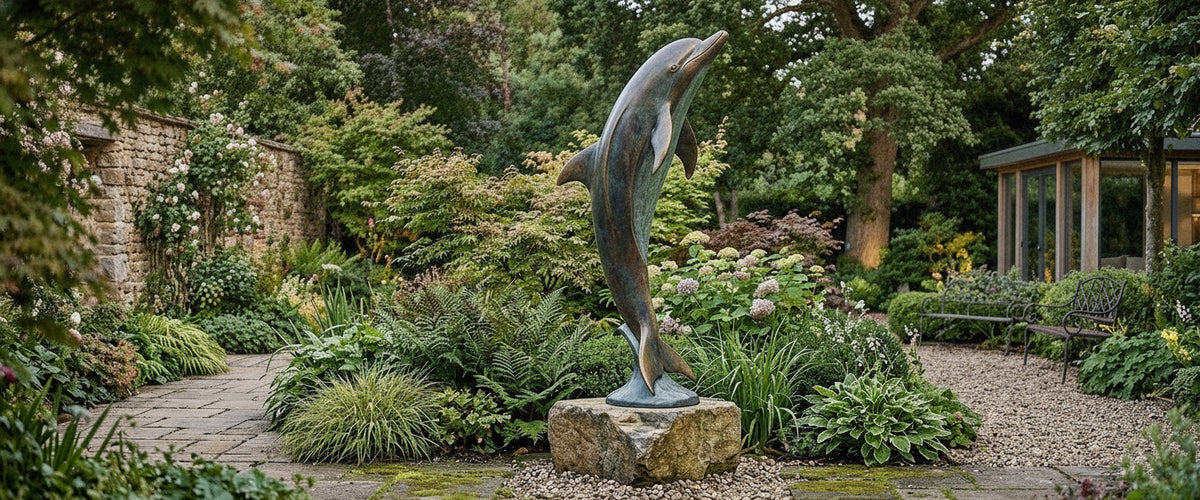

Most gardens do not need more planting. They need one strong object that pulls the eye and gives the space a center. That is the job garden contemporary sculpture does when it is chosen well, and the reason a single well-placed piece can do more for a landscape than another season of borders. Get the material, scale and position right and the whole garden reads as designed rather than decorated.
Looking for the full range in this category? Browse our Contemporary & Modern Sculptures collection for every available finish, size, and configuration.
The tricky part is that outdoor sculpture is unforgiving. The wrong size disappears against a big lawn. The wrong finish streaks or fades. And a piece that looked confident in a photograph can feel timid once it is standing on real ground. This guide is about avoiding those mistakes before you spend.
A single well-scaled piece gives an open lawn its center.

Quick Answer: What Makes Garden Contemporary Sculpture Work
Scale first. Outdoor space eats size. A piece that feels large indoors often reads as small once it is out on a lawn or terrace.
Material decides lifespan. Bronze, stainless steel, Corten and stone are the honest outdoor choices. They handle weather over decades, not seasons.
Placement is half the result. A sight line, a turning point in a path, or the end of a view will do more than any pedestal.
Contemporary does not mean abstract only. Clean, stylized animal and figurative forms sit firmly in the contemporary category.
Bespoke solves the awkward spot. If nothing off the shelf fits the height, angle or story you want, a commission usually costs less drama than forcing the wrong piece.

What Garden Contemporary Sculpture Means, and Who It Suits
Contemporary is a style, not a subject. It covers pared-back abstract forms, but it also covers stylized figures and animals rendered with modern lines and finishes. A smooth, upright bronze reading of a dolphin belongs in the same conversation as a geometric steel column; both feel current rather than traditional. What ties the category together is restraint: cleaner surfaces, more considered silhouettes, less ornament.
This kind of work suits people who want the garden to feel deliberate. A collector placing a focal piece by the coast, a design-led family redoing a hillside, a courtyard that needs one confident object rather than a scatter of ornaments. It also suits commercial settings; hotels, vineyards and corporate campuses use contemporary metal garden sculptures because they photograph well and age with dignity. Many buyers searching for contemporary garden sculptures start from exactly this brief: one resolved object rather than a collection of small accents.

How to Compare Garden Contemporary Sculpture Options Before Buying
Before you fall for a specific piece, run it through a few plain questions. They save more regret than any style guide.
Will it read from your main viewing distance? Stand where you will actually see it most (a kitchen window, a terrace, the top of a drive) and judge the size from there, not from arm's length.
Does it work from every approach? A garden piece is walked around. It needs a strong silhouette from the back and sides too, not just a hero front view.
How will it look in winter? Bare branches and low light expose a sculpture. The best contemporary pieces get better when the planting drops away.
Is the finish rated for your climate? Coastal salt, hard frost and pool chemicals all matter. Ask specifically.
Can the ground actually take it? Weight and footing decide whether you need a concrete pad or a hidden ground anchor.
Run those five questions and a shortlist of contemporary garden sculptures shrinks fast to the ones that genuinely fit.

Key Materials, Finishes and Scale Decisions
Bronze is the long game. Cast bronze handles outdoor life for generations and develops a patina that is part of its appeal rather than a fault. A patinated surface is a controlled chemical layer, and reputable foundries seal and wax it so it weathers evenly; the Smithsonian's conservation guidance on caring for outdoor bronze is a useful primer on why that maintenance matters. Where the setting needs a modern silhouette in a classic material rather than something overtly nostalgic, a stylized bronze like the Contemporary Upright Dolphin Bronze Sculpture (170cm) is closer to the right design language.
Bronze, stainless steel and Corten each weather and reflect light differently.
Stainless steel is the clean-lined choice: reflective, sharp-edged, and happy near water. It bounces sky and planting back at you and suits minimalist gardens and modern architecture. Among contemporary metal garden sculptures it is the option that changes most with the light through the day.
Corten (weathering steel) gives you a warm rust-orange surface that stabilizes into a protective layer. It sits beautifully against grasses and gravel and reads unmistakably contemporary.
Stone and marble bring weight and permanence, though carved contemporary work is a slower, more specialized process.
On scale, the honest rule is to size up. Open sky and lawn shrink everything. A figure that feels generous in a studio can look lost across 40 feet (12 m) of grass. For larger gardens, pieces at or above human height are the safer bet; something like the Large Contemporary Dual Pelican Bronze Sculpture (250cm) at roughly 8 feet (2.5 m) holds a big open space that a 3-foot piece would simply vanish into. When in doubt, mock it up: a cardboard or timber stand-in at full height, viewed from your main sight lines, tells the truth immediately.

Where to Place Garden Contemporary Sculpture for the Strongest Impact
For wider placement ideas, Where Contemporary Sculpture Actually Works: A Placement Guide for Real Rooms and Gardens is useful companion reading before finalising the setting and sightlines.
Placement is where good pieces earn their keep. A few positions consistently work:
End of a view. Terminate an axis, a path or a lawn with the sculpture so the eye is drawn straight to it.
The turning point. Where a path bends, a piece rewards the walker and pulls them onward.
Against a plain backdrop. A hedge, a rendered wall or open sky lets a contemporary silhouette read cleanly. Busy planting behind a piece kills its outline.
Near water. Reflective steel and polished bronze double their presence beside a pool or pond. If you want movement, a water feature can anchor a whole courtyard; our garden fountains and water features collection shows how sculpture and water read together.
One lesson from a project we shipped: a client set a tall bronze at the far end of a lawn, then found it fought with an existing specimen tree behind it. We moved the piece 15 feet (4.5 m) to sit against open sky instead, and it suddenly looked twice as confident. Nothing about the sculpture changed. The backdrop did.
Contemporary figurative work rewards eye-level engagement too. A contemporary garden art sculpture such as the Large Contemporary Violinist Bronze Sculpture (220cm) works best where people pass close and catch the gesture, rather than marooned in the middle of a lawn.

Budget, Commissioning and Delivery Considerations
People always want a number first, and it is the one thing that cannot be honestly given in the abstract. Cost on a serious garden piece depends on material, scale, complexity of form, engineering and mounting, finishing, and crating and shipping to your site. A large cast bronze involves far more foundry work than a compact one; a mirror-polished stainless form is a different labor story again. The sensible move is to shortlist by style and size, then request a tailored quote so the figure reflects the actual piece.
Delivery of large sculpture is a real logistics exercise, not a courier drop. Big pieces travel crated and often need lifting equipment and clear access on site. Talk through gate widths, ground conditions and craning before the piece leaves the studio, not on the day it arrives.
Commissioning is worth considering when the space has a specific demand: an exact height to clear a wall, a subject that tells your story, or a finish matched to your architecture. A bespoke route also lets you resolve the base and anchoring properly from the start, which matters more outdoors than most buyers expect.
How Giant Sculptures Helps With Bespoke Garden Projects
Giant Sculptures is a bespoke sculpture supplier focused on large-scale, durable work, and most of our involvement starts before a piece is chosen. We help buyers, designers and landscape architects get the scale right, pick a material suited to the climate and the sight lines, and plan the base, anchoring and delivery so the finished result stands correctly for decades.
For a courtyard or hard-landscaped space that needs a grounded, characterful anchor rather than a tall vertical accent, a stylized animal like the Large Contemporary Wild Boar Bronze Sculpture (150cm) holds its position well. If nothing in the catalog is the exact height or gesture you need, we commission new work and adapt existing designs in scale and finish. Either way, the aim is one strong piece that makes the whole garden feel resolved.