





































































































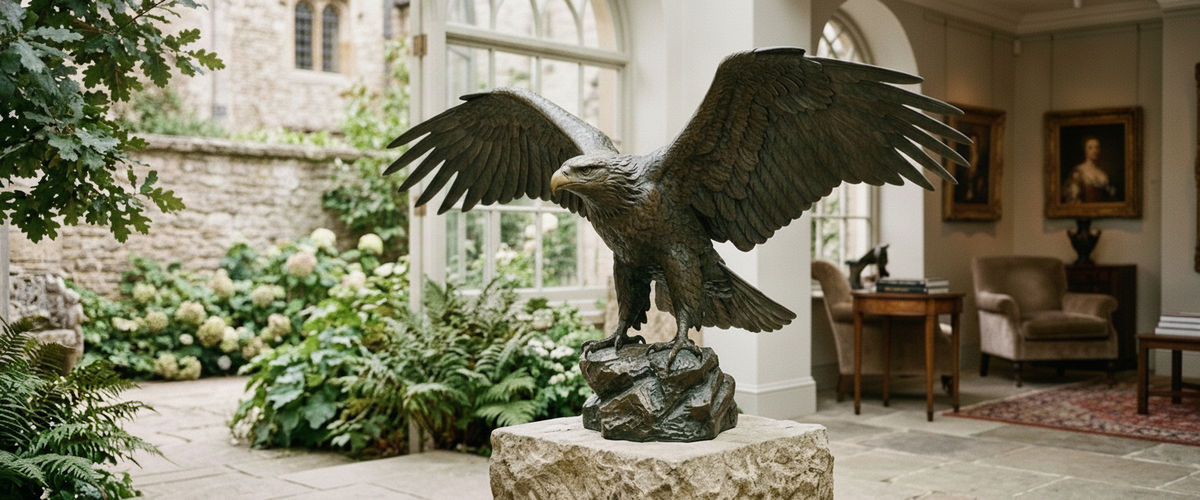

Set an eagle on the lawn and people read it as an ornament. Lift the same bird onto a plinth or a boulder and they read it as a bird, alert and above them, exactly as they would in the wild. That single decision does more for an eagle statue for a garden than material, patina or price ever will, and it is the one most buyers make last instead of first.
Looking for the full range in this category? Browse our Eagle Statues & Sculptures collection for every available finish, size, and configuration.

Key Takeaways Before You Buy
Elevation beats size. A 5 ft (1.5 m) eagle on a 3 ft (0.9 m) plinth outperforms a bigger bird sitting on grass.
Wings open or folded changes your planting. Open wings need air behind them; folded wings can sit against a hedge.
Judge it from the seat you actually use, not from the delivery pallet or a product photo.
Point it outward. An eagle looking over a boundary reads as watchful. Looking back at the house, it reads as decor.
Winter is the honest test. Once borders die back, only the silhouette and the surface are left.
Height multiplies wind load, so the footing and fixings need engineering, not guesswork.
Grass Level or Raised: The First Decision to Make
Eagles are perching birds. Every visual memory your visitors carry involves the bird looking down from a snag, a cliff edge or a fence post. Put a cast bird at ankle level and you fight that memory. Put it above eye line and the sculpture borrows all the authority the species already has.
We learned this the hard way on a commission for a Napa hillside garden. The client set a bronze eagle on a low stone pad while the plinth was being cut, and everyone agreed it looked like something from a garden center. Three weeks later it went up on a 40 in (1 m) block of local stone and the whole terrace reorganized itself around it. Nothing about the bronze had changed. Mounting height is the first specification for an eagle statue for a garden, not the last.
Elevation does the heavy lifting: the same bird reads as a sentry once it clears eye line.
One practical consequence: if the bird will be viewed from below, the undersides of the wings and tail matter more than the back. Our foundry team chases feather detail on the underside for precisely that reason, because on a plinth that is the surface people actually see.

Wings Open or Folded, and What Each Does to the Planting
An open-winged eagle is a horizontal gesture. It needs sky, water or open lawn behind it, and it will visually cancel anything busy planted immediately to the rear. Where the garden can give a bird that much lateral room, a landing pose with real span such as the Alighting Eagle Grey Marble Garden Statue at roughly 7 ft 3 in (2.2 m) belongs at the end of a sightline, over a pool edge, or on a retaining wall where the drop gives the wings somewhere to go.
Folded wings are a vertical gesture, compact and upright. They tolerate a yew hedge, a stone wall or a shrub bank directly behind them, which makes them the safer choice when an eagle statue for a garden has to work in a narrow spot such as a gate pier or a courtyard corner. For those positions a tight, formal shape like the Large Heraldic Eagle Bronze Sculpture at about 5 ft (1.5 m) holds its own against a dense green backdrop instead of getting lost in it.
Wild reference helps here. A bald eagle spans roughly 6 to 7.5 ft (1.8 to 2.3 m) across the wings according to the US Fish and Wildlife Service, so an open-winged piece scaled near life size already occupies more lateral space than most buyers picture on plan.
Judge It From the Patio Chair, Not the Packing Crate
Before you commit to an eagle statue for a garden, walk to the place you will see it from most often. Usually that is a kitchen window, a dining terrace or the turn in the driveway. Measure that distance.
Under 25 ft (7.6 m): detail carries. Feather chasing, beak modeling and talon grip all register, so buy for craftsmanship.
25 to 60 ft (7.6 to 18 m): silhouette leads, detail supports. This is the sweet spot for life-size work.
Over 60 ft (18 m): only mass and outline survive. Scale up rather than detail up; a monumental bird at 9 ft (2.7 m) or more will not look excessive once distance compresses it.
Mock it up. A stepladder with a cardboard cutout taped to the top costs nothing and settles arguments that drawings never will. It is also the quickest way to find out whether a long view across paddock or parkland calls for something on the order of the Monumental Bald Eagle Bronze Sculpture - 280cm at 9 ft 2 in (2.8 m) rather than a life-size bird that distance will simply shrink.

Facing Out, Not In
Turn the head toward the boundary, the valley, the drive or the water. An eagle facing away from the house reads as sentry, and guests instinctively follow its gaze, which pulls the eye outward and makes the plot feel larger. Turn it inward and it becomes a mascot staring at your windows. Orientation is the cheapest upgrade available to any eagle statue for a garden, because it costs nothing but a swing of the base plate.
For entrance work this matters twice over. On a Texas ranch gate we set a pair about 15 degrees off parallel, opened outward, so arriving cars caught both profiles rather than two flat frontals. Small rotation, large difference.
The February Test: Which Materials Still Hold the Eye
Any bird looks good in June with roses behind it. February is the audit. Borders collapse, color drains, and the sculpture is left carrying the garden alone. This is where the material you specified either earns its keep or quietly stops working.
Pale stone gains contrast as the borders die back, while bronze deepens rather than dulls.
Bronze wins that test more often than anything else. Its patina deepens rather than dulls, and a well-formulated surface keeps reading as warm brown or green-black against bare soil. The Copper Development Association notes that copper alloys form stable protective films as they weather, which is why architectural bronze finishes age gracefully outdoors instead of failing.
Marble and cast stone go the other way, brightening as light levels drop. Pale stone against wet winter hedging is genuinely arresting, though carved stone needs sensible detailing at thin points such as an outstretched primary feather.
Fiberglass and composite resin can look convincing on day one, but in low winter light the surface reads flat, and UV exposure eventually tells. For a permanent focal point in an exposed plot, we steer buyers toward cast metal or stone.
Memorial and Remembrance Gardens
An eagle statue for a garden of remembrance should earn quiet, not drama. Lower plinths, matte or dark patinas, and a folded or alighting pose usually work better than a triumphal spread. Emblematic pieces, such as an eagle with globe and anchor at around 13 ft (4 m), belong on civic or campus sites where sightlines are long and the approach is formal. Domestic memorial gardens are better served by something closer to human height, set among evergreen planting with room to stand in front of it.

Plinths, Boulders and Bolt Depth
Elevation multiplies wind load. A bird with open wings on a tall plinth is a sail on a lever, and the fixing detail has to reflect that rather than the weight of the bronze alone.
Match plinth to pose. Slender columns suit folded wings; broad blocks and boulders suit spread wings.
Specify the footing. Reinforced concrete pads sized by an engineer for your soil and exposure, not a paving slab.
Use stainless fixings. Mixed metals plus rain equals corrosion at the one joint you cannot see.
Set the base plate level. A degree of tilt on a 9 ft (2.7 m) bird is visible from fifty paces.
Plan the lift. Access width, ground protection and crane or telehandler reach, agreed before the piece ships.
Every eagle statue for a garden we supply comes with fixing guidance for that specific pose and base, and our team will work with your landscape contractor on the pad detail. If you want a different wingspan, patina or plinth height, bespoke commission is usually the better route; browse the wider bird sculptures collection for pose ideas, then send us the site photographs. Budget depends on scale, material, complexity, engineering and installation, so we quote each project individually rather than publishing a fixed figure. Get the height, the pose and the direction of gaze right, and the rest of the specification follows.
For wider placement ideas, The Pose Decides Everything in a Large Rabbit Garden Statue is useful companion reading before finalising the setting and sightlines.