






















































In 1957, in Leominster, Massachusetts, a young designer named Don Featherstone modeled a plastic bird that would make two generations of garden designers wince. The pink lawn flamingo is so familiar that any flamingo garden sculpture now has to argue its way past it before anyone notices the form. That argument is winnable. It depends on decisions most buyers never think to ask about: the curve of the neck, what happens to pink after three Texas summers, and what is actually holding a top-heavy bird upright on one thin leg.

Key takeaways
Judge the silhouette first. A good flamingo garden sculpture reads clearly from 30 feet (about 9 m) away with no color at all.
Painted pink on resin or fiberglass fades in hard sun, so plan for recoating or choose a finish that does not rely on pigment.
Polished stainless steel and patinated bronze keep the elegance and lose the kitsch.
One leg means hidden engineering: a steel spine, a base plate and a proper footing.
Light the bird from the ground, not from inside it.
The Plastic Flamingo's Long Shadow
The trouble with the lawn flamingo was never the bird. Real flamingos are some of the most architectural animals you can put in a garden: a long S-curve of neck, a body balanced like a counterweight, legs that read as pure vertical lines. The trouble was scale and finish. Small, glossy and mass-molded, the plastic version turned a poised animal into a joke, and the joke stuck.
So when a landscape architect in Napa or a designer working on a Miami pool terrace tells us they cannot do flamingos, they usually mean they cannot do that flamingo. The fix is to make the sculpture about line and material, and to treat pink as a deliberate choice rather than a default.
Neck Curve and Leg Line: Where a Flamingo Garden Sculpture Is Won or Lost
Watch a live flamingo and the neck is rarely a smooth question mark. It kinks, folds back on itself and often hangs the head low, because the bird feeds with its bill upside down in the water (the National Audubon Society describes this filter-feeding posture well). Sculptors who smooth that curve into a tidy arc end up with something closer to a swan, or worse, a lawn ornament.
In our studio the neck is the part that gets reworked most. A maquette can go through several revisions because a shallow curve makes the bird look startled rather than composed, and a few degrees at the base of the neck changes the whole mood. Legs deserve the same scrutiny. They should taper, show the backward-bending joint (the ankle, which most people mistake for a knee) and stay thin enough to look slightly precarious. Thicken the legs to feel safe and you lose the bird.
A genuine kink in the neck and a visible ankle joint keep the bird composed rather than cartoonish.

Pink That Stays Pink: How Resin, Painted Steel and Fiberglass Age in Full Sun
Flamingos get their color from carotenoid pigments in their diet. Garden sculpture gets it from paint, and reds and pinks are among the first pigments to shift under ultraviolet light. Resin and fiberglass with a gelcoat finish tend to chalk and drift toward salmon or beige on a south-facing lawn in Scottsdale long before they would in a shaded Hamptons border. Painted steel holds up better when it carries an automotive-grade or two-pack polyurethane clear coat, but it still needs recoating over the years.
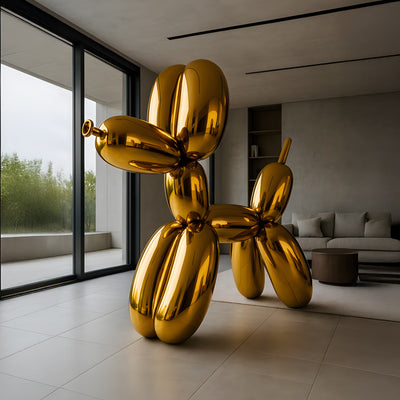
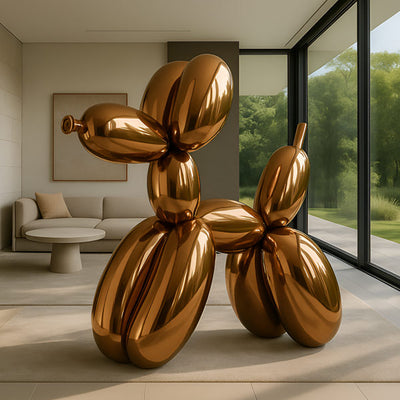
If pink is the point, go big and go glossy so the color reads as intention. The Flamingo Pink Balloon Dog Sculpture (200 cm) shows the principle: at around 6.5 feet, with a saturated lacquer, that shade lands as pop art rather than lawn ornament. The same logic applies to a flamingo garden sculpture: commit to the color, keep the surface immaculate, and budget time for maintenance.
Brushed Steel and Bronze Flamingos That Drop the Color
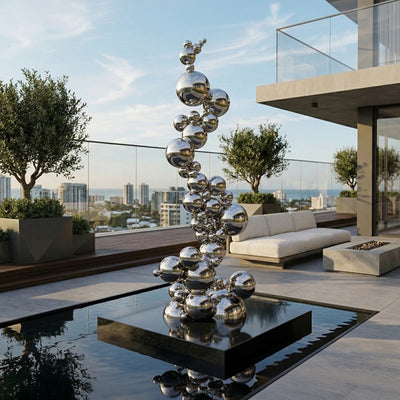
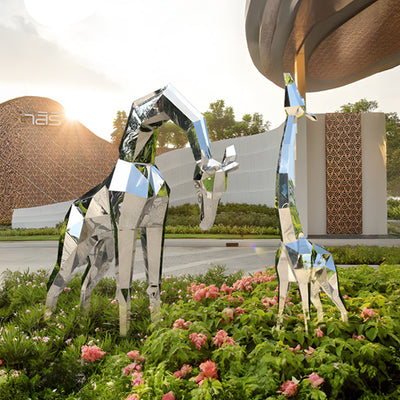
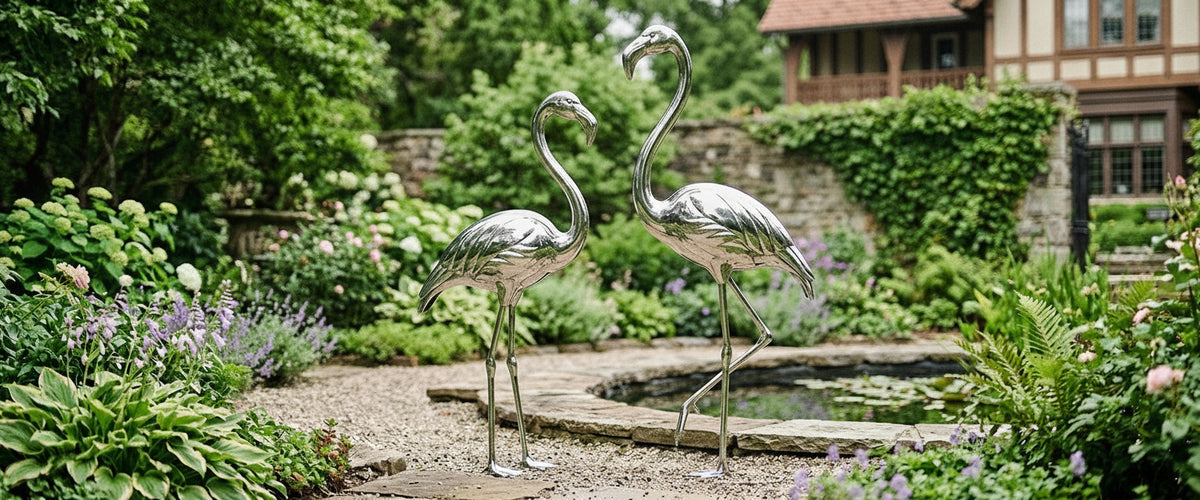
The surest route past kitsch is to remove the pink altogether. A polished steel bird borrows color from its surroundings, so at dusk it turns coral and gold without a drop of paint; a brushed finish gives a softer, more diffuse version of the same effect. Where the garden calls for reflection rather than pigment, a pair such as the Flamingo Stainless Steel Outdoor Sculpture, made at about 37 inches (94 cm) and 58 inches (147 cm), speaks the right design language: the height difference gives you a conversation rather than two identical birds. Near salt water, ask for 316 marine-grade steel. If you are still weighing mirror polish against a brushed surface, our stainless steel sculptures are a useful place to compare how each finish handles light.
Mirror-polished steel picks up coral and gold from the evening sky with no paint at all.
Bronze is the quieter option. A brown or verdigris patina settles into planting and stone, improves with age, and the extra mass helps stability. It suits clients who want a flamingo garden sculpture that feels collected rather than playful.
Lights and Moving Parts: Wit or Novelty?
Solar-powered eyes, glowing bodies and nodding necks almost always tip a flamingo back into novelty. The joke becomes the point. Light works far better from outside the sculpture: a single warm uplight at the base catches polished steel beautifully, and a lit hedge behind a dark bronze bird turns it into a crisp silhouette. Kinetic necks can be witty in a private courtyard, but bearings need servicing, and we usually steer clients toward a strong static pose instead.
One Leg, Heavy Body: The Anchoring You Never See
A flamingo concentrates its weight high up in the body, then balances it on one or two narrow legs. Wind pushing on that body creates serious use at the ankle and the base. A well-built flamingo garden sculpture runs a solid steel bar or threaded rod up through the standing leg into the body, welds it to a base plate, and bolts that plate to a concrete footing sized for local conditions. In cold states the footing should sit below the frost line; in hurricane country along the Florida and Gulf coasts, have a structural engineer review larger pieces. We can supply fixing details so your installer can plan this before the sculpture arrives.

Before You Buy a Flamingo Garden Sculpture: A Checklist
Photograph the maquette or product in black and white. If the silhouette still works, the sculpture works.
Check the neck for a genuine kink and the legs for taper and a visible ankle joint.
Decide on color honestly: painted pink needs recoating; steel and bronze do not rely on pigment.
Confirm the internal spine, base plate and fixing method in writing.
Map sun exposure, wind and soil before choosing a position.
Plan any lighting as external uplighting.
Commissioning a Bespoke Flamingo
Many of our flamingo projects start as variations: a lower head, a pair with interlocking necks, a flock scaled to a reflecting pool. Giant Sculptures works with designers and private clients on bespoke pieces in stainless steel, bronze and painted metal. Budget depends on material, scale, complexity, engineering, installation and finishing, so share your site photos and dimensions and request a tailored quote.
For wider placement ideas, Why Boston Will Fill Its Streets With Elephant Sculptures, and What Your Garden Can Learn is useful companion reading before finalising the setting and sightlines.