
















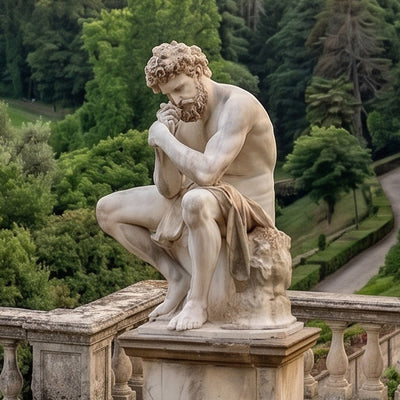









































































Many famous marble gods hide a structural compromise: a tree stump propping up a leg, or a stone bar bridging wrist to hip, added by a copyist who knew the stone would snap without it. Bronze Greek gods statues rarely need that crutch. If you are choosing a Zeus, Poseidon, Athena or Hera for a garden, courtyard or hotel forecourt, that difference in material decides which poses you can have, where the piece can stand, and how it will look in thirty years.
Looking for the full range in this category? Browse our Bronze Sculptures collection for every available finish, size, and configuration.

Quick answer
Choose bronze for gods in action: outstretched arms, raised tridents, thunderbolts mid-throw.
Stone or bronze both work for calm, standing goddesses with drapery that reaches the base.
A well-cast bronze is hollow, with an internal armature and a properly engineered fixing.
Watch for bronze recasts of marble copies that still carry struts the metal never needed.
Why Bronze Greek Gods Statues Came Before the Marble Copies
Many of the classical masterpieces people picture as white marble began as bronze. Greek sculptors of the fifth century BC prized cast metal for its reach and fine detail, and Roman workshops later copied those bronzes in marble for villas and baths. Most of the originals were melted down for their metal. The few survivors came mostly from the sea, such as the bronze god from Cape Artemision, a Zeus or Poseidon caught with his arm drawn back and nothing supporting it but the casting itself.
That figure is the best argument for bronze Greek gods statues in a modern garden: he was designed for metal from the start, and the pose depends on it.
The Trident Problem: Why Marble Needs Struts and Bronze Doesn't
Marble is strong under compression and weak under tension. A horizontal arm holding a long trident acts like a diving board: the shoulder joint takes all the bending load, and stone cracks at exactly that point. Roman copyists solved it with stumps, rocks, dolphins and stone bridges. Sometimes they hid these well. Often they didn't.
Bronze behaves differently. Its tensile strength lets a thin arm, a spear shaft or the tines of a trident stand free, even with wind, frost and the odd curious visitor working on them.

Poseidon and Zeus Mid-Throw: Poses Only Metal Can Hold Outdoors
The striding, throwing gods are where bronze earns its keep. Place a Poseidon at the end of a lake on a Texas ranch or facing the dunes in the Hamptons, and that extended arm becomes a line you read from a hundred feet away. Placement here is about the gesture's direction. Aim the reach along a sightline, such as down a drive or across water, never toward a wall or hedge where it looks cramped.
An extended trident reads best when it points along a sightline, here across open water.
One lesson from our own commissions: on an exposed coastal site, we now check the prevailing wind before fixing the plinth orientation. A long trident held broadside to the strongest gusts takes far more load than one angled closer to the wind's line, and a small rotation usually keeps the client's view intact.
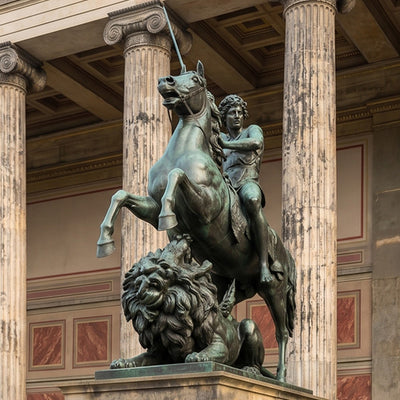
Scale matters too. At roughly 59 inches (150cm), a life-size bronze such as the Life-Size Classical Roman Commander Bronze Statue - 150cm shows how that size behaves: it sits comfortably on a terrace or in a courtyard, where it is seen from a few paces away. Across open lawn, a god at the same scale needs a raised plinth or a larger bespoke cast to keep from shrinking into the landscape.
Athena and Hera at Rest: When Stone Works Just as Well
Not every god needs metal. A standing Athena with spear grounded, or Hera in heavy drapery falling to her feet, carries her weight straight down. Stone handles that load comfortably, and the drapery acts as a natural, honest support. Marble suits a sheltered loggia; bronze suits a frost-prone garden in Aspen or Connecticut, where wet stone can suffer through freeze-thaw cycles.
Paired goddesses are a good middle case. Where you want that calm, stone-like composure but the garden sees hard winters, a cast group such as the Large Classical Goddess Pair Bronze Sculpture - 180cm, at about 71 inches (180cm), keeps the drapery-weighted stillness of marble, and its patina deepens with weather where marble would stain.

Hollow Walls and Hidden Armatures
The best bronze Greek gods statues are hollow. The lost-wax process makes an even metal wall possible, and that consistency is what lets a god keep his reach for decades. Thin spots crack; thick spots add weight that strains the ankles. In large figures, a stainless steel armature runs inside the legs and down into the base, tying the statue to its footing.
An even wall and an internal armature let a lifted arm hold its pose for decades.
In the studio we check wall thickness at the weakest points (fingers, trident tines, the shoulder of the lifted arm) and ask for weep holes in cold-climate pieces, so condensation can drain instead of freezing inside the casting.
Spotting a Marble Copy Recast in Bronze
Plenty of Greek-Roman statues for sale are bronze casts taken from marble originals, struts and all. The giveaway is a support with no job to do: a lump of metal joining wrist to thigh, a tree trunk beside a leg that clearly stands on its own, or a rock under a heel. These are sculptural fossils. They add weight and clutter without adding strength.
Not every support is a flaw. In multi-figure groups, contact points are often part of the story; in a composition like the Classical Centaur and Nude Female Figure Bronze Sculpture (Dark Patina) - 100cm, the place where the bodies meet is the narrative itself, not a prop. Ask whether the element belongs to the story or to a long-dead copyist's worries.

A Buyer's Checklist for Bronze Greek Gods Statues
Pose: Action poses call for bronze; calm standing poses give you a free choice.
Sightline: Point gestures along a view, not into a boundary.
Scale: Judge size from the main viewing distance, not from beside the plinth.
Casting: Ask about wall thickness, armature and fixing method.
Struts: Reject supports that serve no structural or storytelling purpose.
Climate: Plan drainage and patina care for frost or salt air.
If you are comparing bronze Greek and Roman gods statues for sale, our Greek and Roman statues and bronze mythology statues are a good place to weigh poses and scales side by side, and Giant Sculptures can take any of them further as a bespoke commission. Budget depends on material, scale, complexity, engineering, installation and finishing, so we prepare a tailored quote for each piece.
For wider placement ideas, Buying Life Size Bronze Statues: What the Listing Photo Won't Tell You is useful companion reading before finalising the setting and sightlines.