







































































































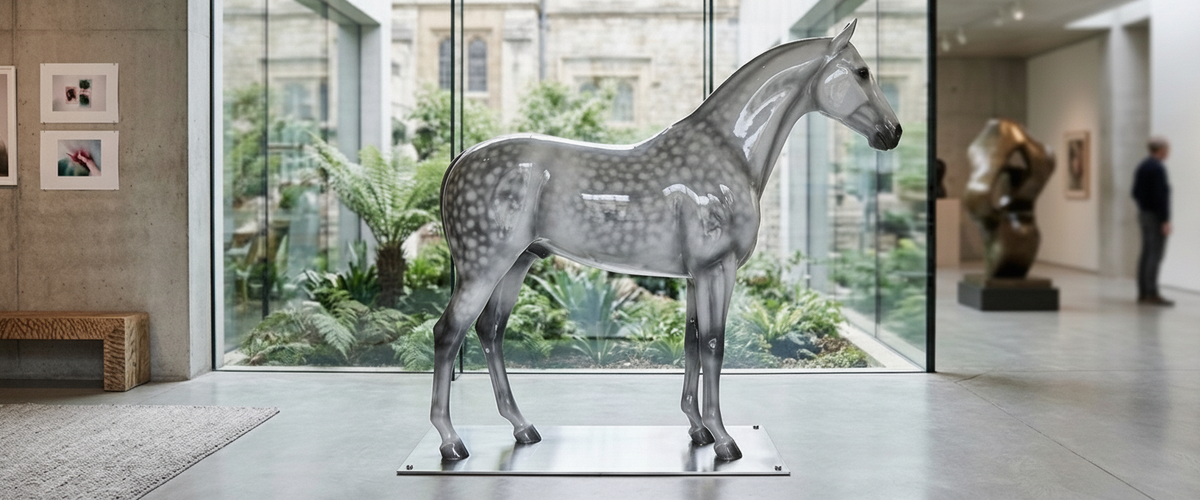

Knock on the life-size horse outside a resort in Scottsdale or a polo club in Wellington, and it will probably ring hollow. That is a fiberglass horse sculpture. When it is built properly, it will outlast the planting around it. When it is built badly, the first sign is a hairline crack just above the hoof, often by the second winter. The difference is mostly invisible on delivery day, so it pays to know what to ask before you sign off a commission.
At a Glance
Fiberglass gives you life-size scale at a fraction of the weight of bronze, which suits roof terraces, showrooms and seasonal installs.
Ask what steel runs through the legs. The fetlock is where weak horses fail.
Dark coats fade fastest outdoors. Specify the finish system as carefully as the pose.
A rearing horse needs engineered anchoring. A standing horse is far more forgiving.
Breed, pose and proportion are locked at the mold stage, so approve them there.

Why a Fiberglass Horse Sculpture Became the Venue Default
Bronze is the heirloom choice, and for a permanent estate centerpiece we still steer many clients toward our bronze horse statues. A life-size bronze horse, though, is a serious lift. It needs crane access, a substantial foundation and a long casting schedule. Cast resin is quicker and cheaper to produce, but it tends to be brittle at scale, and solid resin gets heavy fast once you pass waist height.
Fiberglass sits in the gap. Glass-fiber matting laid up in resin over a mold produces a thin, stiff shell that can be painted in any coat color and moved by a small crew. For hotels, racecourses and brand showrooms that may relocate a piece every few seasons, that flexibility is the whole point of a fiberglass horse sculpture. Our wider range of fiberglass sculptures gives a sense of how far the material stretches in finish and form.
The Steel Armature Through the Legs, and Why Cheap Horses Crack at the Fetlock
A horse is a large mass carried on four slender columns, and the narrowest point of each column is the fetlock joint. In a hollow shell, every gust, every lean from a guest posing for a photo and every thermal cycle concentrates stress right there. Budget horses often rely on the laminate alone, or on a short stub of rebar that stops at the knee.
Continuous steel from body cavity to baseplate is what protects the fetlock.
When a damaged horse comes into our studio for repair, the fetlock is where we look first, and the story is usually the same: the shell flexed, the gelcoat crazed, water got in, and the following freeze opened the crack. A well-built fiberglass horse sculpture carries a welded steel armature that runs continuously from the body cavity down through each load-bearing leg and out through the hoof into a baseplate. Ask your supplier to describe it in writing, and ask whether the steel is galvanized or coated, because rusting steel inside a sealed leg will split it from within.

Gelcoat Versus Paint: What Three Summers of UV Do to a Dark Bay Coat
Dark bay, brown and black horses look superb on day one and suffer most in strong sun. Dark pigments absorb heat, and ultraviolet light breaks down the resin binder at the surface. Within a few summers, that shows first as a dull, chalky bloom and then as a shift toward a dusty red-brown. The American Composites Manufacturers Association publishes technical resources on composite durability, and they are worth a read if you are specifying for Texas or Arizona.
Pigmented gelcoat puts color into the outer layer of the shell itself, so minor scuffs show less. The catch is that refreshing a faded gelcoat evenly is skilled work. A painted finish sealed under a UV-stable automotive clear coat gives you more control over subtle coat shading, dapples and a convincing sheen, and it can be recoated on site. For exposed sunbelt locations we generally recommend paint plus clear coat, with a recoat planned into the maintenance budget rather than discovered later.
A Rearing Horse Catches Wind Like a Sail
A standing horse spreads its load across four hooves and presents a fairly modest profile to the wind. Rear it up and everything changes. The broad flank becomes a sail, the center of mass swings over two hind legs, and every gust acts on a long lever arm. The light weight that makes a fiberglass horse sculpture so easy to place indoors becomes a liability on an exposed lawn.
One coastal client wanted a rearing stallion on open grass facing the Atlantic. We talked them out of the decorative ground spikes they had seen online and into a low stone plinth with through-bolted hind hooves, sitting on a footing designed by their local structural engineer. In the US, that engineer will typically reference the wind provisions in ASCE 7. If your site is coastal, elevated or on a rooftop, budget for that design work from the start.

Hotel Drives, Racecourse Lawns and Showroom Floors
On a hotel drive, the horse is seen from a moving car and photographed by every arriving guest. Set it well clear of the turning circle so bumpers and mirrors cannot reach it, and plan lighting for night arrivals. On racecourse and polo lawns, assume people will climb it. Specify a thicker laminate on the back and a mounting height that discourages it. Fiberglass earns its keep here because the piece can be lifted off its plinth by forklift for event days.
A low plinth set back from the turning circle keeps the horse visible and out of harm's way.
Indoors, the rules relax for a fiberglass horse sculpture. A showroom has no UV, no frost and no wind, so you can choose a gloss or metallic finish that would be impractical outside. Nor does every brand space need a life-size animal: at 90cm (about 35 inches), a piece such as the Canter White Horse Sculpture gives a clear equestrian note without taking over the floor plan. Where a hotel lobby wants movement rather than realism, a sculptural group like the Black Abstract Horse Group Sculpture - 130cm reads better from across a large room than a single anatomical horse.
Breed, Pose and the Mold Stage That Locks In Every Decision
A Thoroughbred has long, fine cannon bones and a lean neck. A draft horse is all shoulder and feather. An Arabian carries a dished face and a high tail. These differences change how much steel each leg needs and how the piece balances. That is why breed and pose come before finish in our commissioning process.
Once the clay or digital sculpt is approved, the mold is taken, and after that any change to the ear angle, head carriage or leg position means a new mold. Ask for photographs of the sculpt from at least four sides and from the eye height of your future viewers. Color, by contrast, stays flexible later in the process, and it can do more work than buyers expect: a non-natural coat on a familiar pose, as on the Steed Blue Horse Sculpture - 67cm, can make a classical horse feel contemporary without any change to the mold.

Before You Commission: A Buyer Checklist
Site: indoor, covered, or fully exposed? This sets the finish and anchoring.
Armature: continuous steel through every load-bearing leg, with a coated or galvanized frame.
Finish: gelcoat or paint with UV-stable clear coat, plus an agreed recoat plan.
Anchoring: baseplate, plinth and footing designed for local wind, especially for rearing poses.
Access: can a forklift or small crane reach the final position?
Sign-off: approve the sculpt before the mold is taken.
Budget depends on scale, pose complexity, engineering, finish and installation, so the honest answer is a tailored quote. Giant Sculptures builds each bespoke fiberglass horse sculpture for gardens, venues and showrooms worldwide. Start with our horse sculptures and tell us where yours will stand.
For wider placement ideas, Grounds Horse Sculpture: Why a Handler Changes Everything is useful companion reading before finalising the setting and sightlines.