


























































































Most stone sculptures that fail outdoors were compromised at the quarry, long before a chisel touched them. A raised wing splits along a hidden seam. A carved face goes soft and sugary after fifteen winters. The pose was never the problem. The stone was. Choosing a stone material sculpture well means thinking like a geologist for ten minutes before you think like a collector, and that short detour saves decades of regret.

Stone Material Sculpture at a Glance
The stone material used by sculpture studios falls into four working families, and each one behaves differently once it leaves the workshop.
Granite outlasts almost anything outdoors, but resists fine detail and slows the carving schedule.
Marble takes the crispest edge of any common stone and is the most vulnerable to acidic rain and urban air.
Limestone and sandstone carve kindly, weather visibly, and suit gardens where a little patina is welcome.
Alabaster and soapstone are indoor materials. No exceptions worth making.
Bedding planes in sedimentary stone dictate which poses are safe at scale.
Site conditions (salt air, pollution, frost pockets) matter as much as the stone itself.
Bedding Planes and Cleavage: The Fault Lines That Decide a Pose
Sedimentary stone was laid down in layers, and those layers never fully disappear. Carve across them and you get a strong, coherent form. Carve a slender projecting element parallel to a bedding plane and you have built a hinge into your sculpture. Water gets in, freezes, and does the rest.
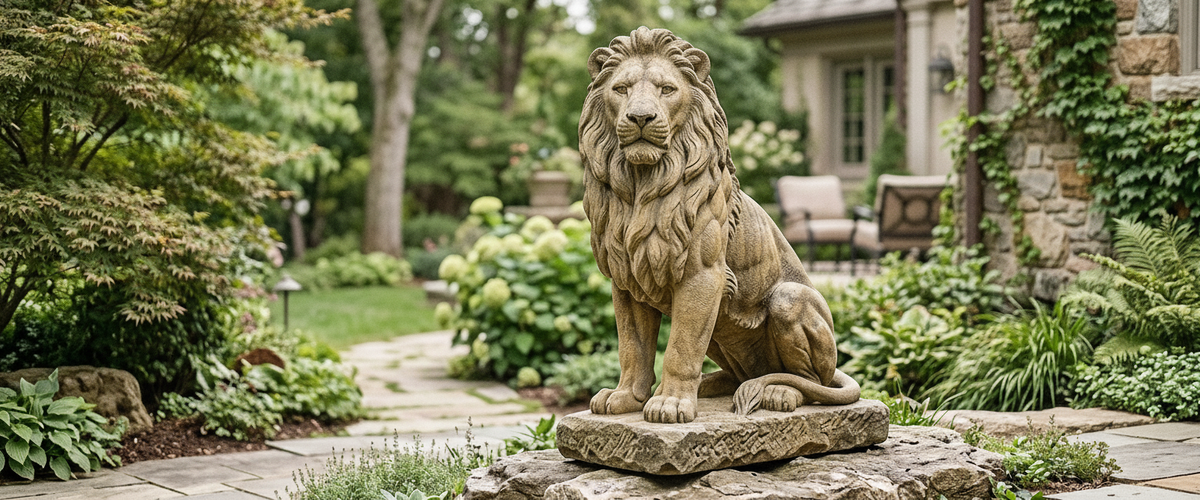
One of our carvers once flagged a faint bedding line running diagonally through the block earmarked for a lion with a raised forepaw. The fix was unglamorous: rotate the block ninety degrees, redraw the pose slightly, lose two days. That is the sort of decision that separates a stone material sculpture still standing in eighty years from one that needs a pinned repair in eight. Metamorphic and igneous stones behave differently, but marble has its own crystalline weak directions, and granite carries mineral grain that experienced carvers read before roughing out.

Marble Holds an Edge, Then Gives It Back to the Rain
Marble's fine, tight crystal structure is why classical drapery still looks like fabric. It undercuts beautifully, polishes to a soft translucency, and rewards the kind of detail that makes people walk closer. Indoors, or under a loggia in Napa or Santa Barbara, it is close to ideal.
Outdoors it has a chemistry problem. Marble is calcium carbonate, and acidic rainfall dissolves it slowly and permanently; the USGS has documented the sugaring and detail loss this causes on carved marble in polluted air. In cities such as NYC or Chicago, assume an exposed marble stone material sculpture will soften over generations, which some collectors accept as honest aging and others find intolerable. If you want marble's refinement with more resilience, discuss denser, lower-porosity marbles with us at the design stage. Marble's long association with memorial work is not sentimental; it is about how the stone reads inscription and carved relief, which is why our marble headstones stay a steady request.
Limestone and Sandstone: Forgiving Under the Chisel, Honest About Weather
These are the workhorses of garden sculpture. Both carve at a sane pace, hold generous form well, and develop color and lichen that make a piece look like it has always been there. Most garden-scale stone material sculpture is cut from one of these two. Sandstone in particular takes strong animal forms with real character. Where a garden threshold calls for presence at eye level rather than mass, a carved bird such as Barn Owl on a Post Sandstone Statue, 150cm, at roughly 4 ft 11 in, is the more sympathetic choice, because the stone's slight grain flatters feather texture rather than fighting it.
Sandstone grain flatters feather texture instead of fighting it.
Scale changes the conversation entirely. When a piece has to hold the end of a long gravel turning circle, something on the order of Indian Elephant in Pink Sandstone Statue, 220cm, about 7 ft 2 in tall, moves the specification work into the base rather than the beast. Heavy sandstone on soft ground will lean within a few seasons. Reinforced pad, correct bearing area, done properly once.

Granite Resists Everything, Including the Sculptor's Schedule
Granite is the closest thing to permanence in the stone material used by sculpture studios today. It shrugs off frost, salt spray and acid rain, holds a polish for generations, and needs almost nothing from you beyond an occasional wash. The Natural Stone Institute is a useful guide to how quarried stone types are graded and specified.
The trade-off is time and detail. Every hour spent on granite is a slower hour, undercutting is limited, and fine facial modeling is hard to justify against the cost of the work. Granite rewards bold silhouettes, geometry, lettering and abstract mass. It is also why granite dominates our granite headstones: nothing else combines legibility and lifespan so reliably.
Alabaster and Soapstone: Soft, Fast and Strictly Indoors
Both carve almost like hardwood, which makes them wonderful for studio work and interior pieces with sensuous, flowing surfaces. Alabaster is water-soluble enough that rain will visibly erode it. Soapstone marks with a fingernail. Put either outside on a Texas patio and you have bought a temporary object. Inside a hallway or gallery wall niche, they are superb, and they take hand-polishing to a depth harder stones cannot match.
Reading the Surface: Chisel, Rasp and Polish Marks
Surface finish tells you how a stone material sculpture was made and how it will age. Point and claw chisel marks left visible give a lively, light-catching skin that hides small weathering changes. Rasped and abraded surfaces sit in the middle, matte and quiet, good for figurative work meant to read softly at distance. A full polish maximizes color and mineral figure but shows every future chip.
Tooled, rasped and polished areas catch light and age at different rates.
Run your hand over a carved piece before buying. Machine-cut repetition feels uniform; hand carving has small variations of rhythm. On a mixed-finish piece such as Roaring Lion on a Rock Outcrop Stone Statue, 120cm, the contrast between smoothed mane and rougher outcrop base is a deliberate finishing decision, not an accident of production, and it is worth asking a maker to explain that logic on any piece you are considering.
Matching Stone to Site: Coastal Salt, City Pollution and Frost Pockets
For wider placement ideas, Marble Garden Statues: What Winter Really Does to White Stone is useful companion reading before finalising the setting and sightlines.
Three site conditions decide most outdoor stone failures. Salt-laden air in the Hamptons or Malibu drives crystallization inside porous stone, so favor granite or a dense, tight-grained limestone. Urban pollution attacks carbonate stones, which pushes marble indoors or under cover. Frost pockets, low ground where cold air and moisture collect overnight, are brutal on any absorbent stone; raise the piece, drain the base, and keep water from sitting in carved hollows.
Orientation matters too. A north-facing wall in Aspen keeps stone damp and encourages biological growth. Full southern exposure dries a piece fast but cycles it through sharper temperature swings.

A Buyer's Checklist for a Stone Material Sculpture
Ask which stone type and quarry region the piece comes from, not just "stone".
Check how projecting elements sit relative to bedding planes or grain.
Confirm the base, footing and bearing surface before delivery day, not after.
Test your site: salt air, acidic rain, frost pocket, shade, drainage.
Decide whether patina is a feature or a fault for you; it changes the material choice.
Ask about fixings, dowels and any stainless or non-ferrous pinning used internally.
Get the annual care routine in writing: wash method, what never to use, inspection points.
Commissioning Stone Work with Giant Sculptures
Every bespoke stone material sculpture starts with the site, not the sketch. Tell us the exposure, the sightlines, the approach distance and the ground conditions, and the material shortlist narrows quickly. From there, scale drives everything: block availability, carving time, transport engineering and installation method. Budget for a large stone piece depends on material, size, carving complexity, base engineering, finishing and installation access, so we quote each commission individually rather than pretending a figure exists in advance.
If you are still comparing directions, walk through our garden statues and notice which pieces hold your attention at twenty paces rather than at arm's length. That instinct usually tells you more about the right stone material sculpture for your site than any spec sheet will.