






































































































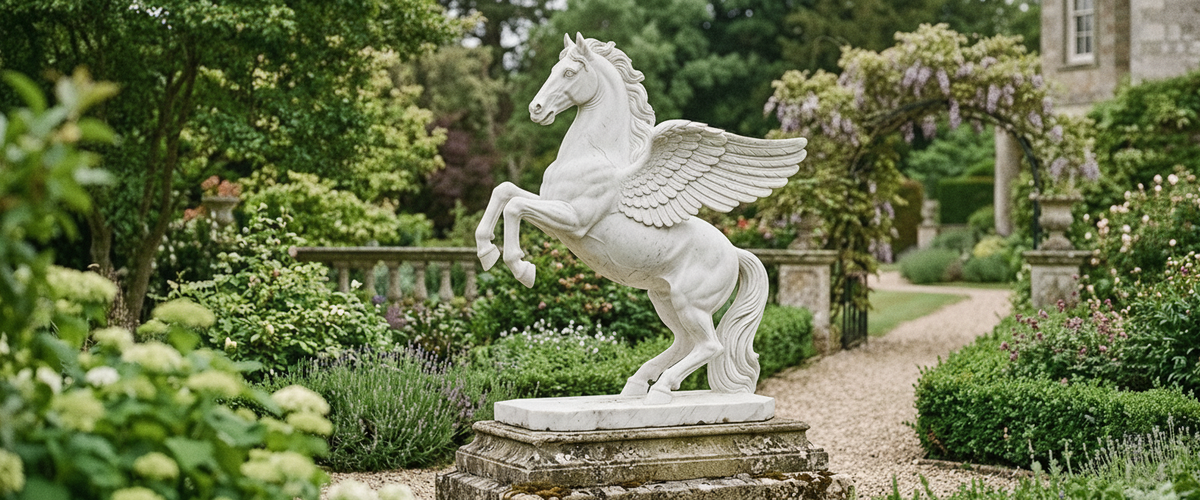

The crack that ruins a marble garden statue almost never starts in January. It starts in a wet October, when the stone drinks rain through its open pores and nobody notices. Then the first hard freeze arrives, the water expands, and the damage begins as a hairline you cannot see. Buyers ask us which marble garden statues last outdoors. The honest answer is that stone choice matters, but siting and drainage decide more outcomes than geology does.
Looking for the full range in this category? Browse our Marble Sculptures & Statues collection for every available finish, size, and configuration.

At a Glance: Marble Garden Statues Outdoors
Frost is the main threat, not cold. Repeated freeze and thaw cycles do the damage, so a damp Virginia winter can be harder on stone than a dry Colorado one.
Dense, fine-grained marble ages best. Coarse, sugary stone with visible crystals drinks more water and sheds detail faster.
Drainage beats sealing. A raised plinth on a compacted gravel bed outlasts any product you can brush on.
Lichen and the gray-green bloom are normal by roughly year three in shaded, damp positions. Both are manageable; neither means the stone is failing.
Antique marble garden statues carry real charm and real risk. Read the patina before you read the price tag.

Frost Cycling Explained: Water in the Stone From November to March
Marble is a metamorphic stone with interlocking calcite crystals and a low but genuine porosity. Water enters through micro-fissures, tool marks and old repairs. When it freezes it gains volume and pushes the crystals apart, and when it thaws the gap stays. Twenty cycles a winter, several winters running, and a crisp carved fold becomes soft. In our studio the pieces we worry about are never the ones that spend winter under snow; they are the ones sitting in a shaded corner where meltwater refreezes every night for a week.
Freeze and thaw cycling, not low temperature alone, softens carved detail over successive winters.
This is why the same figure behaves differently in a Napa courtyard and a Hudson Valley garden. Sun exposure, wind drying and how quickly rainwater leaves the base all change the number of cycles the stone actually experiences.
Carrara, Sichuan White and Cast Composite, Ranked for Outdoor Life
For wider placement ideas, Contemporary Garden Art Sculpture: A Buyer's Guide to Getting It Right is useful companion reading before finalising the setting and sightlines.
Italian Carrara carves beautifully and holds fine detail, which is why it dominates classical figure work. Outdoors it is respectable rather than bulletproof; the softer, more sugary blocks weather noticeably in acidic rainfall. Sichuan white marble, used widely in the large-scale animal and figure work we produce, tends toward a tighter grain and a slightly warmer white, and it holds up well in exposed positions. Darker stones behave differently again: where a site is dusty, tree-shaded or close to traffic, black stone such as the Graceful Horse Black Marble Outdoor Sculpture at roughly 7 ft 3 in (220 cm) hides atmospheric staining far better than white, though it will show mineral salts if drainage is poor.
Cast composite marble, sometimes sold as marble resin or bonded marble, is a different proposition. It is lighter, cheaper to ship, and fine under a covered loggia. Left in full weather it chalks, yellows in UV, and eventually shows its binder. If you want a piece your grandchildren argue over, buy solid stone.

Acid Rain, Lichen and the Gray-Green Bloom That Arrives in Year Three
Calcite dissolves in mildly acidic water. Rainfall carrying dissolved sulfur and nitrogen compounds slowly etches exposed surfaces, rounding sharp arrises and dulling polish; the US Geological Survey has documented this reaction on marble and limestone monuments for decades. In practice, the effect on a well-sited garden piece is gradual and mostly cosmetic over a normal ownership span.
Biological growth arrives faster. Algae, then lichen, then that soft gray-green bloom on north-facing surfaces. Lichen roots into the stone lightly and pulling it off dry takes crystals with it. Leave it if you like the look on an aged figure. Remove it slowly and wet if you want the original white back.
Antique Marble Garden Statues: What a Good Patina Hides
Antique marble garden statues are the most emotionally persuasive things in any dealer's yard, and the hardest to assess. Genuine age gives an even, warm surface with wear concentrated on upward-facing planes. What that patina can hide: iron dowels rusting inside limbs, filled cracks colored to match, and a replaced hand or nose that only shows under raking light. What it admits, if you look, is repair history; mismatched surface texture almost always marks an intervention.
Tap the extremities. Look at the base for saw marks that suggest the figure has been cut down. Ask what is inside the joints. If a nineteenth-century figure has been repinned with stainless steel, that is good news. If nobody knows, budget for conservation before you budget for the piece itself.
Drainage First: Why a Plinth and Gravel Bed Outlast a Lawn Spike
We once shipped a pair of seated figures to a garden in the Hudson Valley where the designer had set them straight onto turf. Within two seasons both leaned, and both had wicked ground moisture up into the base until the lower six inches went visibly darker. The fix was the same one we now specify by default: a compacted gravel bed, a concrete pad sized to the footprint, and a stone or granite plinth that lifts the sculpture clear of splash and standing water.
A raised plinth over compacted gravel keeps ground moisture out of the base far better than any surface treatment.
Scale changes the engineering. Where the piece is small enough to lift by hand, a pedestal in a planted bed is enough; a compact seated figure of about 20 inches (50 cm) such as the Seated Polar Bear White Marble Outdoor Sculpture can also be relocated under cover each winter. At roughly 11 ft 6 in (350 cm), something like the Graceful Giraffe White Marble Outdoor Sculpture belongs to a different conversation entirely: a proper foundation, stainless dowel pins, and crane access resolved before anyone talks about planting.

Covering, Moving or Leaving It: The Honest Overwintering Options
Three approaches, each with a real cost. Leaving it works for dense stone on good drainage in most of the US South and West; it is the option we recommend for large pieces that cannot practically be lifted. Covering helps only if the cover breathes. A sealed plastic shroud traps condensation against the stone and makes the problem worse; a breathable, vented cover clear of the surface is the right specification. Moving it indoors suits smaller figures and busts, and is genuinely the safest answer in the Northeast and Upper Midwest, provided you have the rigging to do it without chipping an ankle.
The Annual Wash and Seal Routine That Keeps White Stone White
Late spring, dry day. Rinse the whole piece with clean water first so dirt does not scratch on contact.
Wash with pH-neutral soap and a soft natural bristle brush, working bottom to top to avoid streaking. Museum guidance on stone care from the Victoria and Albert Museum is a sensible baseline here.
Never use acid, bleach, or a pressure washer. Acid eats calcite. High pressure blasts detail off carved hair and drapery permanently.
Treat biological growth slowly with a proprietary biocide made for limestone and marble, then rinse thoroughly after the dwell time.
Dry fully, then apply a breathable impregnating sealer rated for calcareous stone. Film-forming sealers trap moisture and blister.
Check the base and joints for standing water, moss in the seating, and any rust weep that suggests a ferrous fixing.
Commissioning Marble Garden Statues at Scale
Most of our marble commissions start with a placement problem rather than a subject. A sightline down an allée, a blank courtyard wall in Dallas, a pool terrace that needs weight at one end. From there we work through stone selection, carving detail, plinth design and fixing method as a single package, because a figure carved for a sheltered atrium is specified differently from one facing an Aspen winter. Where the design carries dramatic cantilevers, a rearing pose with the mass held off one hind leg or a pair of raised wings, internal reinforcement has to be decided at the design stage, not after carving.
Budget depends on stone grade, finished size, carving complexity, engineering, crating and installation, so we quote each commission individually rather than publishing bands that would mislead you. If you are still shaping the brief, browsing our marble busts and torsos or the wider sculptures and statues catalog is a useful way to test scale and subject before we start drawing.