





































































































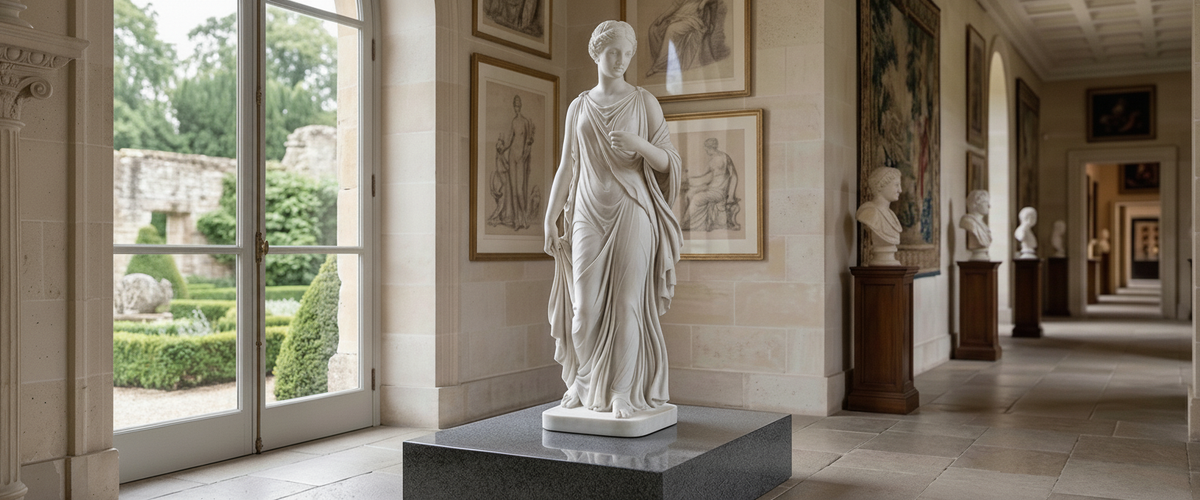

Search for marble granite statues and you will find the two stones lined up like rivals, as if a buyer has to pick a side. The gardens that still look right twenty years later rarely pick one. They use marble where the eye lingers and granite where the weather attacks, and that split is more practical than aesthetic. At Giant Sculptures we carve and ship both, and many of the outdoor commissions that leave our studio combine them.
At a Glance
Marble for faces, busts, drapery and anything viewed up close.
Granite for fountains, basins, plinths and pieces that touch the ground.
Pair them: a granite base under a marble figure solves most frost and staining problems.
Keep contrast clean: white against gray or black, never beige on beige.
Gazebos and benches can go either way depending on climate and use.

Why Serious Gardens Use Marble and Granite Statues Together
The two stones behave differently because they formed differently. Marble is metamorphosed limestone: soft enough for a chisel to raise a curl of hair, calcium-based, and slowly dissolved by acidic rain, a process the US Geological Survey documented on the marble monuments of Washington, DC. Granite is an igneous rock of interlocking quartz and feldspar. It is far harder, far less porous, and close to indifferent to weather.
Treat those properties as a job description. A garden scheme built from marble and granite statues, busts, fountains, gazebos and sculptures works when each stone does the work it suits, and fails when a buyer forces one to do the other's job.
Faces and Busts Belong in Marble
This is the first split to settle in any plan for marble and granite statues, and granite's crystal structure is the reason. Those speckled grains can be several millimeters across, and when a carver tries to cut an eyelid or the corner of a mouth, the crystals fracture along their own edges instead of the line the sculptor intends. At conversational distance the result reads as blurred. Our carvers will happily cut lettering and bold geometric forms in granite. Ask them for a lifelike face in granite and they will steer you to marble.
Marble's fine, even grain holds a crisp edge and takes a polish that seems to glow, because light travels a fraction of an inch into the surface before bouncing back. That translucency is what lets a carved face read as skin rather than stone. For a covered loggia in Napa or a sheltered terrace in Dallas, a bust around 65 cm tall, such as the Aphrodite Marble Bust Sculpture - 65cm, sits at the right scale for close viewing and will age gracefully for decades under cover. The marble busts and torsos collection is the best place to compare poses and scale side by side.

Fountains and Basins Belong in Granite
Of every job marble granite statues do outdoors, holding standing water is the harshest. Marble absorbs a little of it, and in a freezing climate that water expands inside the stone every cold night. Add acidic cleaners or algae treatments, which attack marble's calcite, and a white basin can turn sugary and pitted within a few seasons. Granite shrugs off both. A granite bowl in a Hamptons garden will look much the same after twenty winters as it did on delivery day.
That does not rule out marble water features entirely. A carved marble figure spouting into a granite basin puts the detail where people look and the durability where the water sits.
Fountains follow the same division of labor as marble granite statues: carved detail in marble, standing water in granite.
Granite Plinths Under Marble Figures
This is the single most useful pairing we recommend. Marble set directly on soil or lawn wicks ground moisture upward, carrying iron, tannins and mineral salts with it. The first sign is a tea-colored tide mark around the base. It happens fast: a white figure set straight onto a gravel bed can show a brown stain creeping several inches up the drapery after a single wet winter. Lift it onto a granite plinth, clean the marble, and the staining does not return.
A granite base of roughly 18 to 24 inches (45 to 60 cm) breaks that moisture path, keeps the marble clear of splash-back and wet ground, and lifts the figure closer to eye level. It is the reason most marble granite statues we install outdoors are really two pieces of stone. On a smaller footprint, such as a courtyard corner or the edge of a planted border, a piece like the Resting Swan on a Granite Base Marble Statue - 80cm arrives with the pairing already built in: the carved bird carries the detail, and the granite carries the weather.
A granite plinth keeps ground moisture and splash-back away from the marble above it.

Getting the Color Contrast Right
Pairing the stones in marble and granite statues also hands you a color decision, and this is where many schemes go wrong. Crisp white marble against mid-gray or black granite reads cleanly from across a lawn. Cream marble on tan or pink granite does the opposite: the tones blur into one muddy mass, and the sculpture loses its outline against paving and gravel.
Memorial makers have long favored white over black for exactly this reason: white figure, dark mass, no ambiguity. Where a garden is meant to hold a commemorative piece, a composition such as the Marble Angel and Black Granite Chest Memorial - 160cm carries that contrast at a height that still reads from a distance. The same logic holds for marble granite statues set in an Austin garden or a Santa Barbara courtyard. If your paving is pale limestone, go darker on the granite so the base does not disappear into the ground.
Where the Rule Breaks
The neat division that works for marble and granite statues gets looser with gazebos, benches and architectural pieces. A granite bench is nearly indestructible and suits exposed sites and commercial venues where people sit, spill and lean. A marble bench feels warmer and more refined, but it needs sealing and a sheltered spot. Gazebos often end up mixed: granite for the base and steps, marble for columns and carved capitals where the ornament lives. In mild coastal climates such as Southern California, an all-marble structure is realistic. In Aspen, we would push granite for anything load-bearing or at ground level.
Buyer Checklist: Choosing the Right Stone
Run through these points before you commission marble granite statues for an outdoor site.
Viewing distance: seen within ten feet (3 m) and finely detailed? Marble. Seen from across the garden? Either works.
Water contact: any basin, bowl or splash zone should be granite.
Ground contact: set marble on a granite plinth, never straight onto soil.
Climate: hard freeze-thaw cycles favor granite for exposed and horizontal surfaces.
Tones: compare stone samples side by side, in daylight, against your actual paving.
Access: both stones are heavy, so confirm crane or lifting access before you commission.

Commissioning a Mixed-Stone Piece
Most of the marble granite statues we ship travel as two components, figure and base, joined with stainless steel pins on site. Budget depends on the stone, the scale, the amount of hand-carving, the engineering of the base and the installation, so the only honest figure comes from a tailored quote. When you contact Giant Sculptures, send site photos, rough measurements and a note about your winters, and we will suggest which parts should be marble, which should be granite, and how they meet. The marble sculptures and statues collection is a good starting point; almost any figure there can be adapted to sit on a granite plinth.
Before you settle where your marble and granite statue will stand, Is That Vintage Three Marble Statue Really Old? How to Read the Stone is useful companion reading for finalizing the setting and sightlines.