





































































































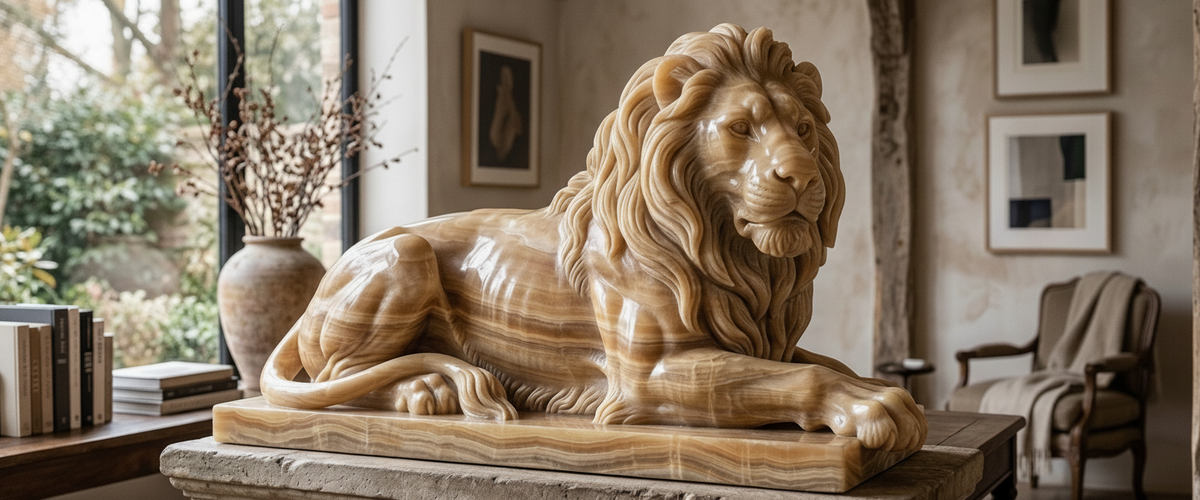

A collector in Scottsdale sent us a photo of a large onyx lion statue she had bought at a trade fair, asking why it looked magnificent in the seller's tent and faintly unfinished in her entry hall. The stone was fine. The lighting was the problem, and so was the viewing distance. Onyx carries light several millimeters into the block, and every millimeter of glow softens the cut edges a carver spent weeks sharpening. Get the stone, the light and the standing position right and the animal breathes. Get them wrong and you own a beautiful, expensive blur.
Backlit, a large onyx lion statue reads as light rather than mass.

Key Takeaways Before You Buy
Six things worth settling before you commission a large onyx lion statue:
Onyx glows deepest, hides fine detail at close range, and belongs indoors.
Alabaster is softer again: a fingernail will mark it, so it is strictly an interior stone.
Marble holds a crisp mane, reads well from every distance, and is the only one of the three we recommend for exposed gardens.
Vein direction across the shoulder and haunch decides whether the lion looks carved or cracked.
Facing pairs should come from one block wherever possible; mismatched banding is obvious the moment someone walks between them.
Budget follows stone grade, scale, carving complexity, base engineering and installation. Ask for a tailored quote rather than a guess.
Three Stones, Three Depths of Light
You will see listings bundled under phrases like "large onyx alabaster marble mountain lion statue", which mashes three different stones and two different animals into one line of text. Worth separating. Onyx in the trade sense is banded calcite, laid down by mineral-rich water, and light travels through its surface layer before scattering back out. Alabaster is gypsum, softer and creamier, with a shorter, milkier glow. Marble is recrystallized limestone; light penetrates a thin skin only, which is exactly why classical carvers loved it. The Natural Stone Institute is a useful reference for comparing stone families on hardness and absorption.
Depth of glow is not a quality ranking. It is a design decision. A large onyx lion statue set against a backlit niche becomes an object of light. The same carving in a flat, evenly lit room can look oddly soft, because ambient light enters the stone from all sides and cancels the shadows the sculptor relied on.

Why Translucency Softens a Mane at Two Paces
Stand six feet back from a honey-banded onyx lion and the mane reads beautifully: mass, rhythm, direction. Step to arm's length and individual locks dissolve, because subsurface scattering fills the deep cuts with borrowed light. Marble does the opposite. It rewards close inspection with tool marks and crisp undercutting, which is why so many large marble lion statues live at gate posts and stair heads where visitors pass within touching distance.
Practical rule we use when advising clients: if the piece will be viewed mostly from six feet away or more, a large onyx lion statue is a gift. If people will brush past it daily, pick marble. A deeply cut heraldic mane in a dense stone keeps its rhythm at every distance, because the material holds its own shadows instead of borrowing light through them.
Vein Direction Decides Carved or Cracked
This is the detail most buyers never think about and every carver argues over. Banding that runs diagonally across the shoulder and down the foreleg can read as a fracture line from across a room, especially in a large onyx lion statue with dark, high-contrast veining. Banding that follows the body's length reinforces the muscle and makes the animal look heavier and more alive.
When we commission, we ask for photographs of the raw block with a chalk outline of the pose on it. If a carver will not do that, be cautious. The same logic governs clouded marbles: on the Standing Lion in Grey-Clouded Marble Statue, 140cm, the gray drift runs with the spine and haunch rather than across them, which keeps the banding reading as muscle instead of damage. Decide early, too, whether you want a heraldic lion or a mountain lion. A cougar has no mane, a longer spine and a low, prowling shoulder line, so it needs a much calmer stone; heavy banding on a smooth cat body looks like a crack.
Alabaster Is a Soft Touch
Alabaster sits around 2 on the Mohs scale, which means a steel key, a belt buckle or a dog's claw will mark it. It also reacts to water. Leave a damp vase on an alabaster plinth and you will see a ring within days. We treat it as an indoor-only material, ideally above waist height and out of traffic routes. It carves gorgeously and takes candlelight like nothing else, but it is a stone for a study or a gallery landing, not a pool terrace.

What Kills a Large Onyx Lion Statue in a Single Winter
Three things, in order of speed. Frost: onyx and alabaster are porous enough to take on water, and one hard freeze in Aspen or upstate New York can spall a paw or open a bedding plane. Acid rain and de-icing salt: calcite dissolves in mild acid, so surfaces go chalky and the polish dies. Patio cleaners: the bleach and acid formulas people use on flagstones will etch a calcareous statue permanently, as conservation bodies such as Historic England keep pointing out.
If your heart is set on a lion outdoors in a freeze-thaw climate, go for dense marble, granite or bronze, and raise it clear of splashback on a well-drained base. The bronze lion statues we ship to exposed coastal sites in California and Long Island exist precisely because stone has limits.
Matching a Facing Pair From One Block
Gate lions are almost always bought in twos, and twos are where things go wrong. A pair of large onyx lion statues cut from a single block will share banding, ground color and translucency. Source two blocks and you may end up with one warm lion and one gray one, which nobody notices in photographs and everybody notices in the driveway. When one block cannot yield a pair, we ask the carver to mirror the pose and keep the strongest veining on the outer flanks, so the inward-facing surfaces stay quiet. Where a drive entrance calls for two flanking guardians rather than a single focal animal, a heavy symmetrical figure such as the Imperial Gate Guardian Lion Marble Statue, 180cm is normally ordered as a mirrored pair from the outset, with left and right paw placement reversed.
Plinth Height and Lamp Angle
Indoors, a couchant lion in a hallway wants a low plinth, around knee height, so the head sits near chest level as you walk past. Light it from above and slightly to the side at roughly 30 degrees; a single narrow-beam fitting creates the shadow structure that translucent stone loses on its own. Never uplight a large onyx lion statue from directly below unless you want a lantern effect, which can be lovely in a bar or spa and disastrous in a formal entry.
A narrow beam, 30 degrees off vertical, rebuilds the shadows translucency softens.
In a double-height atrium, the calculation shifts. A sculpture seen from a mezzanine needs height and mass, not intimacy, so a tall standing figure like the Tall Guardian Lion Cream Marble Statue, 260cm, around 8 ft 6 in, holds the volume better than a smaller lion lifted on a tall base. Check floor loading with the structural engineer first; suspended slabs and older timber floors often need a spreader plate.

Commissioning Checklist
Confirm the stone by name, not by marketing term. Ask whether the "onyx" in a large onyx lion statue listing means banded calcite or a marble trade name.
Request raw block photos with the pose marked, plus a close-up of intended shoulder veining.
Specify indoor or outdoor use in writing and match the stone to the climate.
For pairs, put "one block, mirrored" in the spec.
Agree plinth material, height and fixing method before carving starts.
Plan the lighting position at design stage, not after installation.
Check access: doorways, turning circles, lift capacity and final placement route.
Ask for a written care routine. Neutral pH cleaner, soft cloth, no acids, ever.
A large onyx lion statue is a long-horizon purchase; handled properly it will outlive the room it was bought for. We build these as bespoke commissions as often as we sell them from stock, and the conversation always starts the same way: where will it stand, who will walk past it, and what light will be falling on it at seven in the evening. If you are still weighing poses and scale, the full lion statues collection is the fastest way to compare couchant, seated and standing forms before you fix a stone.
For wider placement ideas, A Large Angel Wing Sculpture Lives or Dies by Its Span is useful companion reading before finalising the setting and sightlines.