
























































































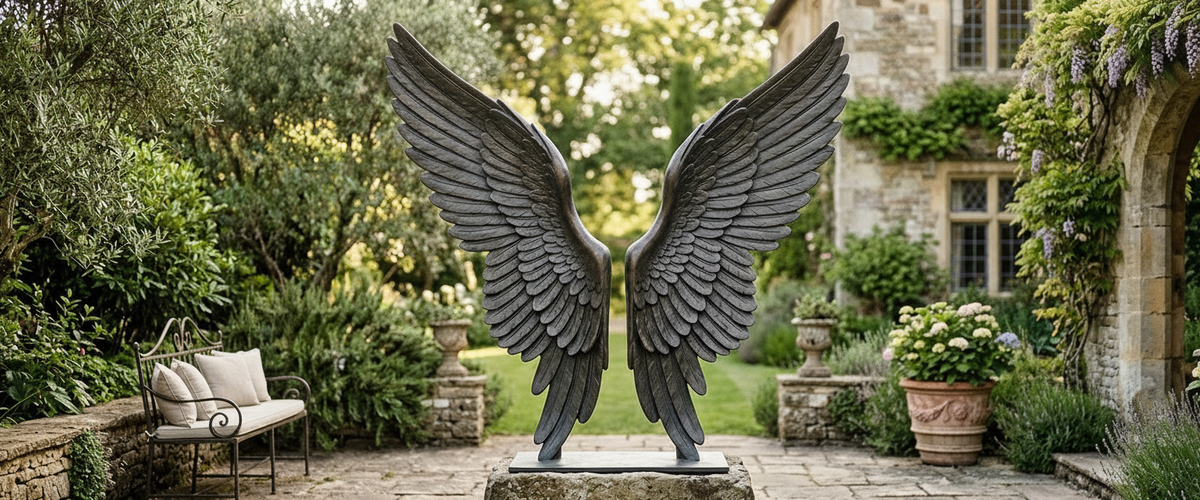

The most common mistake with a large angel wing sculpture is buying it to suit a wall instead of a person. Wings are one of the very few sculptural subjects that people walk into, stand between and photograph themselves inside. That single behavior changes every specification decision: the span you order, the way the piece transfers load, the depth of the feather carving, the finish at shoulder and hand height, and where the light sits after dusk. Get the span wrong and the piece looks like decoration. Get it right and it works like architecture.

Key Takeaways Before You Measure Anything
Measure to a standing person, not to the wall. The gap between wing roots and the top of the feathers is what the eye judges.
Freestanding pairs carry load through a base plate. Wall-mounted wings push that load into your brickwork or render, which is a structural question, not a decorative one.
Feather depth must survive distance. Shallow relief reads beautifully at six feet (1.8 m) and disappears at twenty (6 m).
Hand height is a finish decision. Anything below about 5 ft (1.5 m) will be touched, so specify a surface that tolerates it.
Budget for a large angel wing sculpture depends on material, scale, feather complexity, engineering and installation. Ask for a tailored quote rather than guessing from span alone.
Measure the Gap to a Standing Person, Not to the Wall It Sits On
Take a photograph of the spot with someone standing in it. That image tells you more than any floor plan. For most adults, wings that top out around 8 to 9 ft (2.4 to 2.7 m) with an inner gap of roughly 30 to 36 inches (76 to 91 cm) produce the proportion buyers actually want: feathers rising well above the head, shoulders framed rather than crowded. Drop the height to 6 ft (1.8 m) and the same piece reads as a prop. Push past 12 ft (3.7 m) and it stops being a portrait frame and becomes a gateway, which is a different and perfectly valid brief.
Span is judged against the person standing between the feathers, not against the wall behind them.
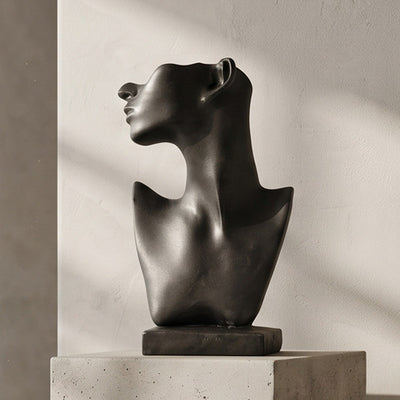
Scale is relative to the subject too. A piece like the Contemporary Contemplative Angel Bronze Sculpture, 50cm works as a considered interior object on a plinth or console, read from a chair rather than walked into. The moment you want people to interact with a form, you need something several times larger. That is why searches for a large angel wing sculpture for sale almost always end in a conversation about custom span rather than a stock size.

Freestanding Pairs Carry Load Through the Base; Mounted Wings Carry It Through Your Brickwork
Every large angel wing sculpture has to get its weight to the ground somehow, and there are two honest ways to do it. A freestanding pair sits on a steel base plate, usually bolted or ballasted, with the weight travelling down through the plinth into a slab or footing. This is the safer option for gardens, courtyards and venues where the substrate is unknown, and it is the route we recommend for most outdoor commissions. Bronze and stainless steel both work; Corten suits a rusted, weathered look that sits well against dry, gravel-heavy planting.
Wall-mounted wings are a different animal. Every pound of wing and every gust of wind turns into a pull-out force on your fixings. Solid brick behaves differently from brick veneer, and render over blockwork hides a multitude of sins. Anchor performance in masonry depends on the unit, the mortar and the embedment depth, as the Brick Industry Association technical notes set out in detail. We ask for a photograph of the wall and, on commercial jobs, a structural sign-off before we finalize the fixing detail. One gallery client discovered mid-project that their exposed brick was a non-structural skin; the wings moved onto a freestanding frame and looked better for it.
Feather Depth That Reads from Six Feet and Vanishes from Twenty
Feathers are shadow, not line. What you are buying is the depth of the undercut between each layer, because that is what throws a shadow and keeps the surface alive at distance. Cast bronze holds crisp overlapping quills well; fabricated stainless can be laser-cut and layered for a sharper, more graphic feather; carved marble gives softer transitions and a luminous edge in sunlight. If the piece will mostly be seen from across a lawn, ask for deeper separation at the outer primaries, the kind of modeling used on the Large Traditional Spread-Wing Owl Bronze Sculpture, 150cm, where the plumage is built to hold definition from the far side of a driveway rather than only at arm's length.
Deep undercuts between the primaries keep the plumage legible from across a lawn.
Hand Height Is a Finish Decision
Anything a visitor can reach will be reached. Plan for it. Below roughly 5 ft (1.5 m), skin oils, sunscreen and rings all leave their mark, so choose a finish that ages gracefully rather than one that shows every touch. A warm, waxed bronze patina develops a burnished sheen at hand height that most owners come to like. Mirror-polished stainless is the opposite: fingerprints are permanent visual noise until the next clean, so specify a brushed or satin band on the lower third if the piece sits in a busy venue. Marble takes a soft honed finish better than a high polish in public settings. Conservation guidance flags handling and surface contamination as a common cause of tarnish and corrosion on metalwork, and a protective wax layer reapplied annually is the practical defense, as the V&A's guidance on caring for metals explains.

Backdrops That Hold the Silhouette
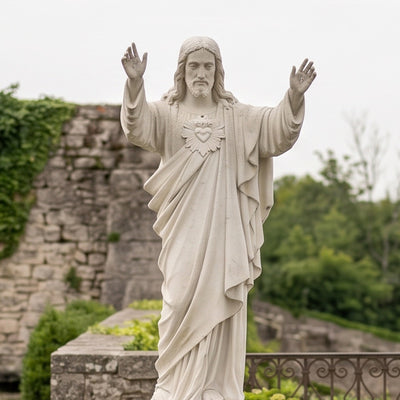
A pair of wings only works if you can read the outline. Dark render, weathered brick, a tightly clipped yew or boxwood hedge, or a plain stone wall all give the silhouette something to push against. Busy planting, mixed stonework and glazed walls all eat the shape. Bronze against a dark background needs a lighter patina to separate; pale marble against a hedge separates on its own, which is why a full-height stone figure such as the Standing Angel With Open Arms Marble Garden Statue, 220cm keeps its outline at the end of a long garden walk. If your backdrop is unavoidably busy, consider a freestanding pair set 3 to 4 ft (0.9 to 1.2 m) forward so the wings gain their own shadow gap.
Uplight from Below, or the Feathers Turn Into One Gray Mass
Overhead light flattens plumage. Two narrow-beam uplights set close to the base, angled to graze the feather edges, keep the layering legible after dark and throw the outline onto the wall behind. Warm color temperature suits bronze and marble; cooler light suits stainless. Keep the beams tight and shielded so the fixtures do not spill upward, which also keeps you aligned with the responsible outdoor lighting principles many US municipalities now reference. A single flood from the front is the fastest way to make an expensive commission look cheap.
Specifying a Large Angel Wing Sculpture to a Real Wall, Ceiling and Standing Spot
Before you request a quote, gather the following. It saves weeks.
Overall span available, wall to wall or planting to planting, in feet and inches.
Clear height, including any soffit, canopy, ceiling or overhanging branch.
A photo of the location with a person standing in the intended spot.
Substrate: slab thickness, footing, or wall construction if mounting.
Indoor or outdoor, coastal or inland, plus expected wind exposure.
Access route for delivery: gate widths, turning circles, stairs, elevator dimensions.
Whether visitors will stand between the wings, and how often.
Preferred material and finish, or an open brief if you want our recommendation.

Where the Budget Actually Goes on a Large Angel Wing Sculpture
Span drives material volume, but complexity drives the hours. Individually modeled feathers cost more than a simplified massed wing. Fabricated steel armatures, base plates and hidden mounting hardware are engineering line items in their own right. Finishing, whether that is a hand-applied patina, a mirror polish or a carved and honed marble surface, is skilled labor measured in days. Crating and installation at this scale are significant and vary enormously by site access. Rather than working to a guessed figure, send the specification list above and ask for a tailored quote.
Giant Sculptures builds large angel wing sculptures to measured spans in bronze, stainless steel, Corten and marble, alongside our range of angel statues and sculptures and cast bronze angel and cherub pieces. If a winged figure suits the setting better than a standalone pair, the same feather language can be carried across to a full figure. Send us the photograph with someone standing in the spot. That is where every good commission starts.
For wider placement ideas, How to Place a Large Angel Statue in a Garden so It Reads From the House is useful companion reading before finalising the setting and sightlines.