





































































































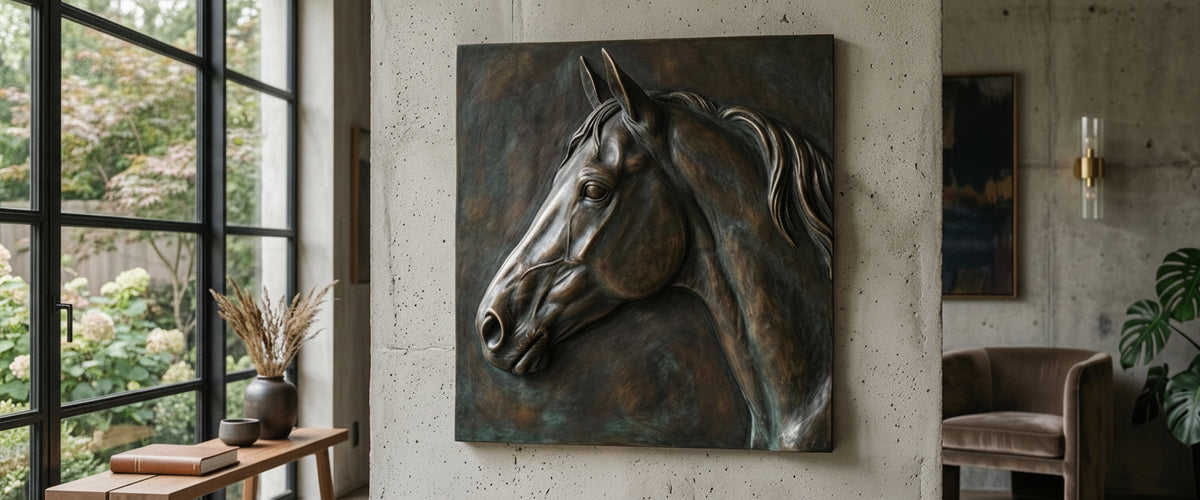

A hallway is the hardest wall in the building to get right, because nobody ever stands still in one. People pass it at walking speed, shoulder close, often in poor light, usually while carrying something. That changes everything about how wall art for hallway settings has to be built. A flat painted canvas that sings above a sofa can read as wallpaper in a corridor; a sculptural relief with real depth does the opposite, catching light from a new angle every few steps. Most of the calls we make in the studio before a single mold is pulled come down to that one difference.
Looking for the full range in this category? Browse our Bronze Wall Art collection for every available finish, size, and configuration.

Key Takeaways Before You Commission
- Depth beats width. In a narrow corridor, relief height off the wall (typically 1 to 4 inches / 25 to 100 mm) does more visual work than overall size.
- Design for two viewing distances. The long approach view and the arm's-length passing view need different information in the surface.
- Projection is a safety spec. Circulation routes have to stay clear, so mounting depth and edge treatment matter as much as the composition.
- Light is half the commission. Grazing light at a shallow angle reveals modeling; flat downlight flattens it.
- Budget is driven by material, scale, relief complexity, fixings, finishing and installation. Ask for a tailored quote on wall art for hallway commissions rather than assuming a size equals a figure.

What Sculptors Think About Before Taking on a Wall Art for Hallway Commission
The first questions we ask have nothing to do with subject matter. Every wall art for hallway brief starts with the corridor, not the catalog. How wide is the passage at its tightest point? What is the wall built from, and is there blocking or masonry behind the plaster? Where does daylight come in, and at what time of day does the client actually walk through? A 40 inch (100 cm) bronze relief in a 4 ft (1.2 m) passage is a different object from the same piece in an 11 ft (3.3 m) gallery hall, even though the casting is identical.
Wall construction decides the engineering. Stud partitions need the load path planned to timber or steel, not drywall anchors; solid masonry gives freedom but demands resin fixings and a drill schedule that will not blow out the face. On one commission for a Napa house with a 40 ft (12 m) circulation hall, the drawings showed studs where there was actually a services void. We supplied a template and a stainless cleat system that spanned to solid framing on either side, and the client's contractor set it in an afternoon. That kind of pre-work is invisible in the finished piece, and it is exactly what separates a considered commission from a heavy object leaning against the wrong wall.
Subject choice comes last, and it is more constrained than buyers expect. Art in hallway settings gets read in fragments, so compositions built on one strong silhouette outperform busy narrative scenes. Animal heads, torsos, classical fragments and abstract geometry all survive being glimpsed. A crowded frieze with twelve small figures does not, unless the corridor is long enough to give you a proper standing distance.

Craft Decisions That Change the Result and the Quote
Relief depth is the first real decision on any wall art for hallway project. Bas-relief keeps projection shallow and the drawing tight, which suits tight corridors and doorways where sleeves and shoulders pass close. High relief pushes forms further out, sometimes with fully modeled elements breaking free of the ground plane, and the shadow it throws is what makes it visible from the far end of a hall. The distinction between low and high relief goes back to architectural sculpture on temples and civic buildings, where the same problem existed: how do you make a wall-bound figure legible to someone walking past it?
Material sets the light behavior. Bronze with a dark patina and hand-polished highlights gives you contrast at low light levels, which is why so much wall art for hallway work in our catalog is cast bronze rather than painted panel. Where the only light is a single wall washer 8 ft (2.4 m) away, a deep-shadow subject such as the Traditional Horse Head Bronze Relief - 80cm keeps reading, because the muzzle and jaw hold shadow even when the light level drops. Stainless steel does the reverse: it bounces whatever light exists and can go near-invisible on a bright white wall, so we tend to specify a brushed or shot-blasted finish for interior corridor work rather than mirror polish.
Then there is the question of whether the piece should also make light. Sconce-form sculpture solves two problems at once, and it is one of the oldest answers to the corridor problem. Set a pair of pieces in the manner of the Classical Figural Torso Wall Sconce Bronze Sculpture - 90cm opposite each other and you get rhythm along a long hall plus light on the route, which is worth more than a single large panel in most houses. Rhythm is underrated in hallway design. Two or three related pieces at even spacing give a walker something to move through; one big object gives them something to walk past.
Fabrication route affects cost more than most buyers realize. A lost-wax bronze relief carries pattern making, molding, casting, chasing and patination. Fabricated metalwork in Corten or stainless is cut, formed and welded, with the labor sitting in fettling and finishing. Hand-carved stone or marble relief is priced by the hour of carving and the block. None of these is automatically the affordable option; the driver is the complexity of the surface, the tolerance on the finish and how much hand-work the design demands after it leaves the mold or the machine.

Why Wall Art for Hallway Settings Reads Right at 10 Feet and Wrong at 30
Every relief has two audiences. At 30 ft (9 m) the viewer sees a silhouette and a light-and-shadow pattern. At 10 ft (3 m) they start reading form. At arm's length they read tool marks, patina variation and edge quality. A design that only works at one of those distances always disappoints.
The common failure is scaling up a small model without re-cutting the detail. Fine surface texture that looks lively on a 12 inch (30 cm) maquette turns to noise at 4 ft (1.2 m); big planes that look bold at model scale can go slack. When we enlarge, the sculptor reworks the surface at final size, tightening the primary masses and letting go of detail that will never be seen. It costs studio time and it is the difference between a piece that holds a corridor and one that looks like an oversized souvenir.
Height matters as much as size. Standard picture-hanging advice puts the center at eye level, around 57 to 60 inches (145 to 152 cm). For sculptural wall art for hallway installations we usually go slightly higher, because the viewer is moving and often looking up-and-forward rather than straight ahead. Raising the center by a few inches also keeps knuckles and shoulders away from the projecting edges. A compact, heavy-browed form like the Classical Bull Head Bronze Relief - 70cm gains authority when it is set a touch high; drop it to sofa height in a narrow hall and it simply gets in the way.
Light angle is the last variable and the one clients most often get wrong. Aim a fixture almost straight down and a relief flattens out; set the fixture closer to the wall so the beam rakes across the surface and the modeling comes alive. We had a client in Dallas convinced their new bronze relief was under-modeled until their electrician re-aimed two adjustable fixtures. Same object, completely different piece. Guidance from the Illuminating Engineering Society on accent and grazing techniques is worth reading before your electrician sets anything permanently.

Studio Process: Maquette, Sample, Fabrication, Install
Every wall art for hallway commission runs through the same seven stages, whatever the material.
- Brief and site survey. Corridor dimensions, wall build-up, door swings, lighting positions, sightlines from both ends. Photographs with a tape measure in shot beat drawings every time.
- Concept and maquette. A scaled model, physical or digital, tested against the actual approach distances. This is the cheapest point to change your mind.
- Material sample. A patina swatch or finish panel viewed on your own wall, under your own light. Bronze patina shifts noticeably between daylight and warm interior lighting.
- Fabrication or casting. Enlargement, surface rework at final scale, casting or forming, chasing, welding, finishing, patination or sealing.
- Fixings and template. Concealed cleats or threaded studs specified to the wall type, with a paper or ply template so the contractor drills once.
- Crating and delivery. Heavy relief travels on a braced pallet with the face protected. We ship worldwide, and corridor access is the thing to check before dispatch, not after.
- Installation and light aiming. Set the piece, then aim the fixtures. In that order.
Honest Red Flags Buyers Should Ask About
Run this checklist past any studio quoting wall art for hallway work, including ours, before you sign.
- Who engineers the fixing? If the answer is "your installer will figure it out," ask again. Weight, projection and wall type should be documented.
- Is the enlargement re-modeled at final size? Straight pantograph scaling of a small model is a shortcut you will see on the wall.
- What exactly is the finish? "Bronze" can mean cast bronze, bronze-filled composite or bronze-colored paint. Ask for alloy, patina method and sealant.
- Can you see a sample before production? A refusal on finish samples for a bespoke commission is a warning sign.
- What does the piece look like from the other end? Ask for a render or photo from the far approach, not just a straight-on studio shot.
- How is it crated, and who unloads it? A 200 lb (90 kg) relief needs two people and clear access, and stairs change the plan.
- What is the long-term care? Interior bronze is low-maintenance, though it still wants a dry cloth and an occasional wax rather than household spray cleaners.
One more practical point on interior corridors: humidity. Hallways next to kitchens, mudrooms and pool doors swing more than the rest of the house. Sealed bronze and stainless handle it easily, untreated steel and some woods do not. If the wall is on an exterior envelope in a cold climate, ask about condensation behind the mounting plate.
Where to Start Browsing
If you are shaping a shortlist of wall art for hallway options, our hallway art collection is the fastest way to see how different scales and reliefs behave in circulation spaces, and the wider wall art and wall decor range shows what happens when you move up in size. For contemporary interiors where a figurative relief would feel too traditional, the metal wall art selection covers abstract forms and fabricated work that still throw useful shadow. Anything in the catalog can be re-scaled, re-patinated or reworked as a bespoke commission, which is usually the right route once you have measured the wall and realized nothing standard fits it.
For wider placement ideas, Hallway Wall Art: What Sculptors Weigh up Before They Say Yes is useful companion reading before finalising the setting and sightlines.