






















































































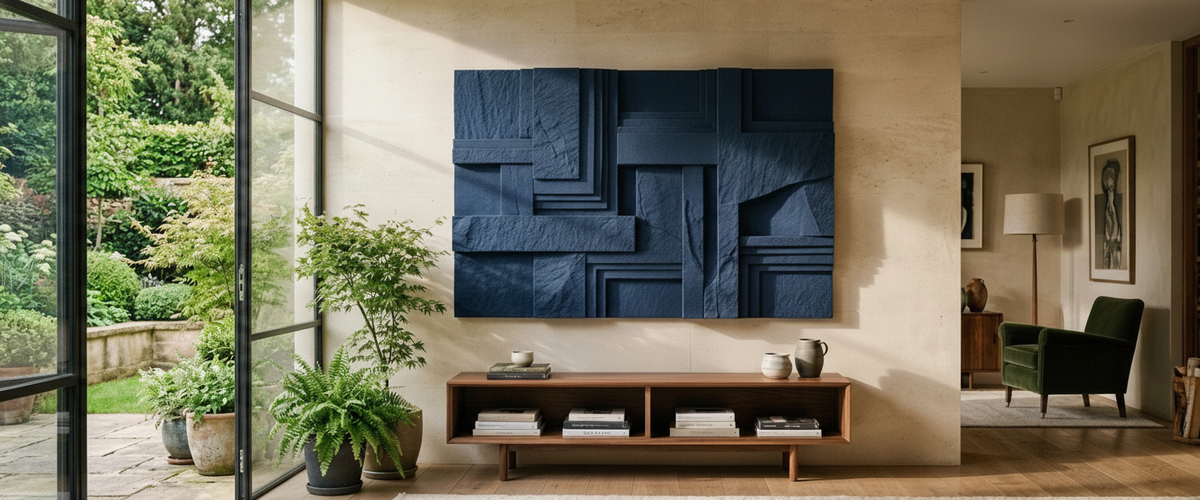

A hallway is the meanest test a piece of wall art ever faces. Nobody stands back to admire it. People pass at walking pace, often side-on, sometimes in half-light, and the eye clocks a piece in under two seconds before moving on. Hallway wall art that works has to survive that glance and still reward the person who slows down. Get the scale or the depth wrong and the same piece that looked confident in a showroom reads flat, cramped, or oddly loud in a corridor.
This is where a good commission earns its keep. Below is how our studio actually thinks through hallway wall art, from the first conversation to the moment it goes on the wall, plus the questions worth asking any maker before you hand over a deposit.

Key Takeaways
- Viewing distance rules everything. A hallway forces close, angled, moving views, so relief depth and edge detail matter more than in an open room.
- Material sets the mood and the budget. Bronze, stainless steel, carved wood, and layered sandstone-effect panels all behave differently under corridor light.
- Scale is a proportion problem, not a size problem. A piece of hallway wall art that sings at 10 ft can fall apart at 30 ft, and vice versa.
- A proper process protects you. Maquette, material sample, fabrication, then install. Skipping steps is the usual source of regret.
- Ask about weight, fixings, and finish care before you commit, not after delivery.

What Sculptors Actually Think About Before Taking on a Hallway Wall Art Commission
The first thing we ask is not "what do you want it to look like." It is "how will people move past it." A hallway wall art piece lives at an angle. Viewers approach from one end, so the raking view along the wall matters as much as the head-on view. That single fact changes how we cut relief, where we place the deepest shadow lines, and which way texture should run.
Then comes light. Corridors rarely get generous, even daylight. You get downlights, a wall sconce, maybe a window at one end throwing long shadows in the afternoon. Deep relief and layered texture love directional light; flat graphic work can die under it. Where a corridor has only modest downlighting to work with, a piece like Rivura Navy Layered Sandstone Texture 3D Wall Art earns its place because its stacked planes catch that light and throw their own shadows, so the surface never looks dead.
Traffic is the third factor buyers forget. Hallways are where shoulders, suitcases, and vacuum cleaners live. If a piece of hallway wall art has fragile protruding elements at hip height, we either pull them back into the composition or move the drama higher up the wall. That is a craft decision made for real life, not for a photograph.

Craft Decisions That Change the Final Result (and the Price)
Most of what drives cost and character in hallway art sits in choices the buyer never sees on a mood board.
Material. Metal wall art behaves very differently from carved wood. Brushed or mirror-polished stainless steel bounces corridor light and can visually widen a narrow space; you will see it working in our metal wall art range. Carved timber brings warmth and a hand-worked grain that softens hard architecture, and where a hallway benefits from that softness plus a built-in light source, something like Ventus Azure Depths Wood Carving 3D LED Wall Art is closer to the right design language than a flat, unlit panel. Bronze and stone carry weight, literally and visually, and suit hallways with the structure to support them.
Relief depth. The deeper the relief, the stronger the shadow play, but depth adds weight, fixing complexity, and fabrication hours. In a tight corridor we often favor medium relief with sharp, clean edges over deep relief that snags sleeves. Good hallway wall art rarely needs to shout in depth to hold attention.
Finish. A matte finish hides fingerprints and handles glare; a high-polish finish demands better light control and more wiping. Patina on bronze can be tuned warm or cool to sit with your flooring and joinery.
Panelization. Long hallways sometimes suit a run of panels rather than one monolith. That eases delivery through doorways and lets the composition breathe along the wall. It also changes install method and cost.
None of these have a fixed price. Budget for hallway wall art depends on material, scale, relief complexity, engineering, finishing, and installation, which is why we quote each commission individually rather than publish a number that would mislead you.

Why Some Corridor Pieces Read Right at 10 ft and Wrong at 30
Scale is the trap. Buyers measure their wall, pick a size that "fills it," and stop there. But a hallway gives you two very different viewing distances: the close pass at 2 to 3 ft, and the long approach from the far end, which can be 20 or 30 ft (roughly 6 to 9 m) in a generous home or a hotel corridor. Any hallway wall art has to earn both.
A finely detailed relief that rewards the close pass can flatten into visual noise from the far end. A bold, graphic composition that reads beautifully at 30 ft can look coarse and empty when you are standing right beside it. The best hallway art ideas solve both at once, usually with a strong overall silhouette for the long view and finer secondary detail for the close pass. Where you want that clarity from both distances, a crisp geometric relief such as Artisana White Grid 3D Paper Wall Art holds a legible pattern at range while still rewarding the close pass with its layered edges. That layering is deliberate, and it is one of the reasons a maquette matters.
Ceiling height feeds into this too. Hang center too high and a corridor feels colder; too low and tall visitors feel it crowd them. As a rule we set the visual center for the moving eye, not the textbook gallery height, because almost no one stops dead in a hallway to view a piece straight on. Museums calibrate hanging heights for standing viewers; hallway wall art is a different problem, and the Tate glossary is a useful primer on relief and finish terms if you want to speak the same language as your maker.
Studio Process: Maquette, Sample, Fabrication, Install
A hallway wall art commission that goes smoothly almost always follows the same four steps.
- Maquette. We build a scaled model or detailed render so you can judge silhouette, relief depth, and proportion against your actual wall and light. This is the cheapest place to change your mind.
- Material sample. You see and touch the real finish: the exact patina, brushed grain, or paint depth, under lighting close to your corridor's. Screens lie about metal and stone; samples do not.
- Fabrication. The piece is made, welded, carved, or layered and finished by hand. Larger metal work gets engineered for its own weight and for the fixings the wall can take.
- Install. We plan access, fixings, and lifting before the piece leaves the studio. For heavier bronze or steel, that means confirming the wall substrate and, sometimes, structural backing.
We once shipped a layered panel run to a client whose hallway had a west-facing window throwing a hard shadow across the middle of the wall every afternoon. Because we caught it at the maquette stage, we angled the relief planes to work with that shadow instead of fighting it. That is the kind of thing you only find by testing before you fabricate.
Honest Red Flags Buyers Should Ask About Before They Commit
A good maker will welcome these questions. Be wary of anyone who waves them off before your hallway wall art is even drawn.
- What does it weigh, and how does it fix? Get the weight in pounds (and kilograms) and the exact fixing method. A heavy piece on drywall without backing is a callback waiting to happen.
- Will it fit through the door? Sounds obvious. It is the single most common near-miss on large wall art. Panelized designs solve tight access.
- How does the finish age? Bronze patina shifts over time; painted finishes can chalk in direct sun; timber moves with humidity. Ask what changes and how you slow it.
- What is the care routine? Matte metal, polished steel, and oiled wood each want different cleaning. You should leave with a one-line care plan, not guesswork.
- Who owns the design? On a bespoke commission, clarify whether the piece is unique to you and whether the maker may reproduce it.
- Is there a proper contract? Deposit, milestones, and install responsibilities in writing. Vague terms are the real red flag.
On subject matter, hallways are semi-public. Anything a guest or client passes should suit that setting, which is why provocative narrative scenes rarely translate to real hallway wall art. We steer bespoke work toward compositions that hold up under daily, mixed company, and that is a design conversation worth having up front.
Where to Start
If you are gathering hallway art ideas, begin with the wall's real constraints: length, light, traffic, and the two viewing distances. Then choose material for the mood you want. Browse the hallway art collection to see how depth and finish behave, and the wider wall art range for scale reference. When you are ready to commission hallway wall art specific to your space, Giant Sculptures builds bespoke corridor pieces designed for the space they will actually live in, engineered to hang safely and age well.
For wider placement ideas, 3d Butterfly Wall Art: What Sculptors Weigh Before They Say Yes is useful companion reading before finalising the setting and sightlines for your hallway wall art.