






































































































A 24 inch canvas on a 16 foot wall looks like a postage stamp on a moving box. That one miscalculation spoils more rooms than questionable taste ever has, which is why living room wall art deserves planning before you buy rather than after the sofa is delivered. Get the mass right and almost any style holds. Get it wrong and even a beautifully made piece reads as an afterthought.
Most of our work sits at the larger end of the market, so we hear the same conversation over and over: the client has the wall, the room is nearly finished, and nobody has checked what the piece will look like from the seat people actually sit in. Here is how we approach living room wall art in the studio, and what we tell designers before a commission goes into fabrication.

Key Takeaways
Size the living room wall art to the wall plane and the furniture beneath it, not to the room's square footage.
Hang for a seated sightline. Standing-eye gallery rules were not written for sofas.
Bronze, metal and carved wood catch light in completely different ways, so the wall finish behind the work matters nearly as much as the work itself.
Heavy wall sculpture needs blocking, studs or masonry fixings. Confirm the structure before you commit to a size.
Outdoor and covered walls open up Corten, stainless steel and cast bronze, all of which age well in the open air.
Budget for living room wall art depends on material, scale, complexity, engineering and installation, so ask for a tailored quote rather than guessing from a size chart.
What Living Room Wall Art Looks Like in Real Homes
The phrase living room wall art covers wildly different problems. In a prewar Manhattan apartment, the usable wall is often a narrow pier between two windows, maybe 30 inches across, with a radiator below it. A wide horizontal piece is impossible there. A vertical bronze form, mounted high and lit from one side, turns that dead strip into the strongest thing in the room. Where the wall is that tight, something like the Classical Figural Torso Wall Sconce Bronze Sculpture, 90cm is the more workable proportion, because roughly 3 feet (90 cm) of vertical bronze fills a slim pier without crowding the window trim.
Then there is the Texas great room with a 20 foot stone chimney breast. Here a single framed print is hopeless. You need either one large object with real physical depth, or a considered group. A cast relief casts its own shadow, which is why sculptural work survives on big architectural walls where flat art disappears.
Scale the piece to the sofa beneath it, not to the room's footprint.
The third version is the indoor-outdoor living room, common in Napa, Palm Springs and coastal California. A loggia wall, a pool house, a covered terrace with sofas: functionally a living room, structurally an exterior. That distinction changes the material conversation entirely, and it usually changes the budget conversation too.

Scale, Sightlines and Mounting Height
Start with two measurements: the width of the wall plane, and the width of whatever furniture anchors it. As a working rule, a single piece of living room wall art should occupy roughly two thirds to three quarters of the furniture width below it. A 9 foot (2.7 m) sofa wants something in the region of 6 to 7 feet (1.8 to 2.1 m) across, whether that is one object or a composed group read as one shape.
Height is where most people go wrong. The museum convention of centering work at about 57 to 60 inches (145 to 152 cm) assumes a standing visitor moving through a gallery. In a living room, the audience is seated for hours. Dropping the center point by 3 to 6 inches (8 to 15 cm) makes the piece feel deliberate rather than floated. Above a fireplace, the constraint is different again: leave clear space above the mantel and keep the bottom edge of the work from crowding it, especially if the firebox is in use.
Vertical clearance matters more with sculptural work than with canvas. A relief that projects several inches from the wall needs breathing room, or it starts to feel like it is leaning into the room. We had a client in Aspen who wanted a heavy bronze panel above a low-slung sectional, and the fix was simple: raise the piece about 8 inches (20 cm) higher than the standard rule suggested, so the projection sat above the eyeline of anyone leaning back. It stopped feeling looming and started feeling architectural.
Indoor Versus Outdoor Placement: When Each Wins
For wider placement ideas, Bronze Metal Wall Art: How Placement Changes What You See is useful companion reading before finalising the setting and sightlines.
Interior walls give you control over living room wall art. Stable humidity, no UV, no freeze-thaw, so you can use waxed bronze, carved wood, gilded surfaces and finer patinas without worrying. That is where pieces from our wood wall art range make sense; timber is expressive and warm indoors, but it is unforgiving outside unless it is specified and detailed for exposure.
Outdoor walls win on drama. A courtyard wall, a garden boundary or a covered terrace lets a piece be larger than any interior would tolerate, and weather does interesting things to metal. Corten develops a stable oxide skin. Stainless steel throws reflected sky and planting back into the space. Bronze develops a green or brown patina depending on the alloy, the coating regime and the local air, which is why the American Institute for Conservation recommends a documented waxing and inspection cycle rather than leaving outdoor bronze to fend for itself (see their Caring for Your Treasures guidance).
A covered terrace behaves like a living room but reads as an exterior, which changes the material list.
The decision is usually about how the room is used. If the sofa faces glazing onto a terrace, the strongest move is often to put the sculpture on the exterior wall and let the window frame it. We shipped a bull-motif relief to a Hamptons pool house on exactly that logic: the Classical Bull Head Bronze Relief, 70cm went on the stucco outside, and the interior seating group got a clean wall and a view with a subject in it.

Light, Backdrop and Contrast
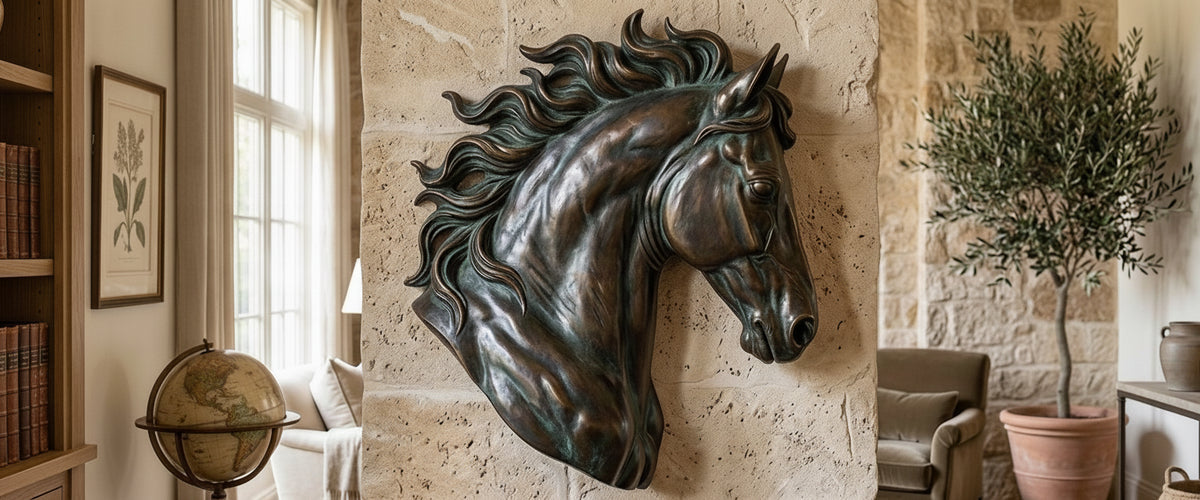
Flat frontal light kills sculptural living room wall art. Reliefs and cast heads live on shadow, so aim for light arriving at an angle of roughly 30 degrees from the wall, which grazes the surface and pulls out modeling. A single adjustable downlight or a discreet picture light does more for a bronze than four recessed cans firing straight down. On a rough ground like limestone or board-formed stone, a deeply modeled piece such as the Traditional Horse Head Bronze Relief, 80cm depends on that raking light entirely, since the mane and jaw only read once something is throwing shadow across them.
Backdrop contrast is the other lever. Dark patinated bronze on a dark plaster wall looks sophisticated in photographs and vanishes in person. Warm metal wants a mid-tone or pale ground. Polished stainless wants something to reflect, so it performs best opposite a window, a fireplace or a planted courtyard. Rough backgrounds like limestone, board-formed concrete and reclaimed brick flatter smooth objects; smooth backgrounds flatter textured ones. Our metal wall art selection covers both ends of that range, and the choice is worth making with a sample against the actual wall rather than on a screen.
How to Choose Living Room Wall Art: A Working Checklist
Measure the wall plane and the anchor furniture. Write both numbers down before browsing anything.
Tape the outline. Painter's tape on the wall at full size settles arguments faster than any renderings.
Check the structure. Stud spacing, masonry, or is it a plasterboard wall that needs blocking added? Weight class dictates the fixing, and the fixing sometimes dictates the piece.
Decide indoor or exposed. That single answer narrows the material list to something manageable.
Test the light. Look at the wall at 9am, at 4pm and at night with lamps on. Rooms lie at one time of day.
Set the sightline. Sit down, and have someone hold a mockup at the proposed height.
Plan for ownership. Interior bronze wants an occasional dust and wax; exterior work wants a seasonal check. Ask what maintenance the finish expects.
Get a tailored quote. Material, scale, complexity, engineering, finishing and installation all move the number, so a specification-based quote beats a guess.

Common Placement Mistakes We See in Commissions
The most common living room wall art mistake is buying small out of caution. Clients under-scale far more often than they over-scale, and the smaller piece is the one that gets replaced within two years. If you are torn between two sizes on a large wall, the bigger one is almost always right.
The second is symmetry worship. A perfectly centered piece above a perfectly centered sofa can feel inert. Offsetting a strong sculptural object toward the circulation side of the room, then balancing it with a floor lamp or a tall plant, gives the composition tension. A single characterful head works better slightly off-axis, where it feels encountered rather than presented.
The third is ignoring depth. Wall sculpture projects; canvas does not. If a piece stands 5 inches (13 cm) proud of the wall and sits beside a doorway or a walkway, people will clip it with a shoulder. We have had to re-site more than one commission for exactly that reason.
The fourth is treating gallery walls as a filler exercise. If you are grouping, keep gaps consistent (2 to 3 inches, or 5 to 8 cm, between smaller works) and let one piece dominate. Nine equally sized objects at equal spacing reads as wallpaper.
Commissioning Bespoke Living Room Wall Art
Awkward proportions are the usual trigger for a commission: a wall too tall for anything in stock, a chimney breast with a strange offset, a double-height stairwell visible from the seating area. Bespoke living room wall art also solves subject matter, whether that is a family horse, a regional animal, an abstract form pulled from the architecture, or a relief scaled to a specific stone course.
Relief carving has a long architectural pedigree for precisely this reason; bas-relief was developed to work with a wall rather than fight it, as the antiquities collections at the Louvre show across several millennia of building decoration. A commissioned relief inherits that logic. It becomes part of the wall instead of an object hung on it.
Talk to us early, ideally while the walls are still being built. Blocking, conduit for lighting and fixing points are trivial at framing stage and irritating afterward. Browse the living room art and broader wall art and wall decor collections for scale references, then send us the wall dimensions, a couple of photographs and a note about the light. Everything else follows from that.