





































































































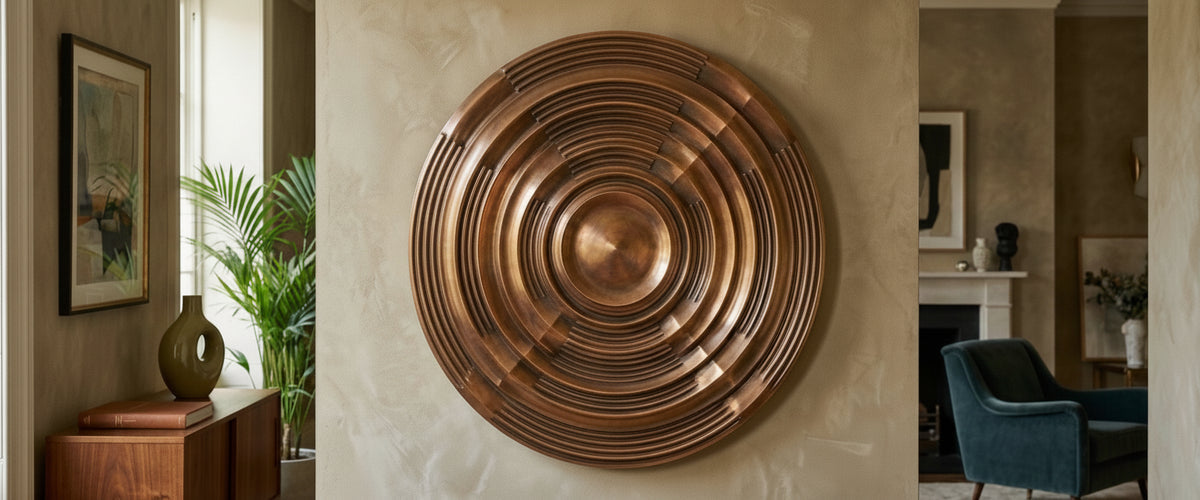

Most people choose bronze metal wall art the same way they choose a painting, then wonder why it looks flat once it is on the wall. Bronze is not a flat medium. It catches light, throws shadow, and reads differently from ten feet away than it does from two. The same piece can look commanding in one spot and apologetic in another, and the deciding factor is almost never the sculpture itself. It is where you put it.
We have shipped bronze metal wall art to double-height entryways in Dallas, coastal terraces in Malibu, and a wine-cellar wall in Napa where the client wanted something that would read under warm low light. The pieces were well made in every case. The ones that sing are the ones placed with intent.
A reflective relief hung opposite a window shifts through the day.

Key Takeaways
Placement beats purchase. Scale, height, light, and backdrop decide whether bronze metal wall art commands a room or disappears into it.
Relief depth matters. The more three-dimensional the piece, the more raking light and viewing distance you need to plan for.
Indoors and out both work, but they reward different finishes and different backdrops.
The common mistakes are predictable: hanging too high, fighting the backdrop, and choosing scale from a screen instead of the wall.
Bespoke removes the guesswork. A commissioned bronze metal wall art piece is sized and finished for your exact wall and light.

What Bronze Metal Wall Art Looks Like in a Real Room
Bronze metal wall art behaves differently depending on the room and the finish. A polished or reflective surface, like a large circular relief, picks up movement and color from everything around it; hang it opposite a window and it becomes a soft mirror that shifts through the day. Where the setting has something worth reflecting, whether that is a garden view or a well-lit dining space, a piece such as the Orbitra Bronze Reflective Circular 3D Wall Art works harder than a matte relief would in the same spot.
Antique bronze wall art does the opposite. A darker, patinated surface absorbs light and reads as weight and history rather than shine. That matters when you are matching a room. For a paneled study or a stair landing that wants quiet sculptural presence rather than a bright gallery feel, a figural piece such as the Classical Figural Torso Wall Sconce Bronze Sculpture - 90cm at 90cm carries that weight far better than a reflective surface would.
Outdoors, bronze metal wall art earns its reputation. It is one of the most durable materials we work in, and a genuine patina develops slowly and protectively over years of exposure. The Metropolitan Museum of Art's conservation research covers how surface patinas both color the metal and shield it, which is one reason bronze has survived outdoors for centuries where other materials have not (see The Met's overview of bronze and its patinas).

Scale, Sightlines, and Height: The Choices That Change How a Piece Reads
Scale is the single most common thing buyers get wrong with bronze metal wall art, and it is almost always undersized. A wall reads bigger in a photo than it does in person, so a piece that looks generous on your phone can look like a postage stamp once it is up. As a rough studio rule, a single wall sculpture should fill roughly two-thirds of the visual width of the wall or furniture it sits above. On a large blank feature wall, go bigger than instinct tells you.
Angled light pulls the modeling forward and makes a relief read as carved.
Height is the second. The old gallery habit of centering art at 57 to 60 inches (145 to 152 cm) from the floor works for eye-level viewing, but relief is not a flat print. A deep relief head, such as a Traditional Horse Head Bronze Relief - 80cm at 80cm, projects from the wall and casts shadow, so it wants to sit where a standing viewer catches that shadow line rather than looking straight at the flattest part of the modeling.
Sightlines decide the rest. Walk the actual path people take through the space. Is the piece first seen from across an open-plan room, from the bottom of a staircase, or up close in a hallway? Distance viewing rewards bold silhouettes and strong outlines. Close viewing rewards fine detail and texture. A gargoyle relief like the Classical Gargoyle Demon Bronze Wall Sculpture - 90cm reads as dramatic mass from across a courtyard and as intricate carving up close, which is why it works better on an approach than tucked in a corner nobody walks past.

Indoor Versus Outdoor Placement: When Each Wins
For wider placement ideas, Contemporary Metal Wall Art: How to Place It so It Actually Lands is useful companion reading before finalizing the setting and sightlines.
Indoors, you control everything: light, temperature, backdrop, and viewing angle. That is the setting for reflective and copper bronze wall art where you want the finish to stay bright and the detail crisp. It is also where framed and sconce bronze metal wall art belongs, since those pieces lean on interior lighting to model their surface.
Outdoors is where bronze metal wall art becomes a long-term investment rather than a decoration. A bronze framed wall art panel or a heavy relief mounted on an exterior masonry wall will outlast almost anything else you could hang there. Two practical points we always raise with clients. First, fixings must match the substrate; the metal is dense, and a large relief needs proper masonry anchors, not drywall plugs. Second, decide early whether you want the patina to keep evolving or to be sealed and held. A garden wall in the Hamptons that gets salt air will weather differently from a sheltered Aspen courtyard, and that is a choice worth making on purpose, not by accident.
If you are still deciding between an interior statement and an exterior anchor, browse our bronze wall art collection alongside the broader metal wall art range, then think about the wall before the piece.
Light, Backdrop, and Contrast
Light does more for bronze metal wall art than any other single factor. Flat, even light kills relief because it removes shadow, and shadow is what tells your eye the piece is three-dimensional. Aim for light that arrives at an angle. Raking light from a side window, a picture light angled down, or a discreet spot mounted a foot or two off the wall will pull the modeling forward and make a good piece look carved rather than printed.
Backdrop is the partner to light. Antique and dark-patina bronze needs a lighter or textured wall behind it to separate the silhouette; put a dark surface on a charcoal wall and the outline vanishes. Polished or copper bronze wall art, by contrast, can take a darker or richer backdrop because the surface throws its own light. A bull relief such as the Classical Bull Head Bronze Relief - 70cm at 70cm needs enough clear wall around it to breathe; crowd it with shelves or frames and the mass gets lost.
Contrast is the finishing decision. You want the piece to differ from its background in at least one of three ways: tone, texture, or temperature of color. Warm bronze against a cool gray wall, matte relief against smooth plaster, dark metal against pale stone. Get one of those working and your bronze metal wall art holds the wall on its own.
Placement Mistakes We See Most Often
These come up again and again on bronze metal wall art commissions, and every one is avoidable.
Hanging too high. These pieces are heavy with presence, and lifting them above the natural sightline makes them feel adrift. Lower is usually better than higher.
Choosing scale from a screen. Tape a paper template to the wall at full size before you commit. It takes ten minutes and saves an expensive mistake.
Fighting the backdrop. Dark bronze on a dark wall, or a busy patterned wall behind a detailed relief, cancels the piece out.
Ignoring the light. A flat-lit relief looks like a shadow of itself. Plan the lighting before you plan the hanging.
Underspecifying fixings. A large relief is a structural load. Fix into masonry or blocking, and get the weight confirmed before installation day, especially outdoors.
Buying a stock size for a bespoke wall. If your wall has an unusual proportion, forcing a standard piece onto it rarely reads well.
When a Commission Makes More Sense
There is a point where choosing from a catalog stops being the right move. If your wall is oversized, oddly proportioned, or the focal point of a room that people see first, a bespoke piece of bronze metal wall art sized and finished for that exact space will always outperform an off-the-shelf choice squeezed into place. At Giant Sculptures we commission bronze wall work to specific dimensions, patinas, and relief depths, and we plan the mounting and weight with the wall's substrate in mind from the start.
Budget for a commission depends on material, scale, relief complexity, finishing, engineering, and installation, so the honest answer is that it varies. The sensible next step is a tailored quote against your actual wall and setting rather than a guess. Bronze metal wall art rewards that kind of forward planning; it is a material you buy once and live with for decades, so the placement thinking you do now is the thinking you will be glad of every day you walk past it.