






































































































A blank corner in a double-height living room is one of the hardest spaces to solve. Rugs slide around it, a floor lamp looks lonely, and a console table just underlines how much empty air sits above. This is exactly where a well-chosen indoor sculpture earns its keep. When clients ask us for 3 indoor decorative options that actually change how a room feels, we tend to point them toward three distinct approaches: a sculptural tree or nature form, a graceful animal or bird study, and a contemporary figure. Each solves a different spatial problem, and each behaves differently depending on material and scale.
Looking for the full range in this category? Browse our Decorative Sculptures collection for every available finish, size, and configuration.
Below is how we think about these 3 indoor decorative directions, drawn from commissions we have shipped to homes and venues across California, Texas and the Northeast.

Quick Answer: The 3 Indoor Decorative Directions Worth Considering
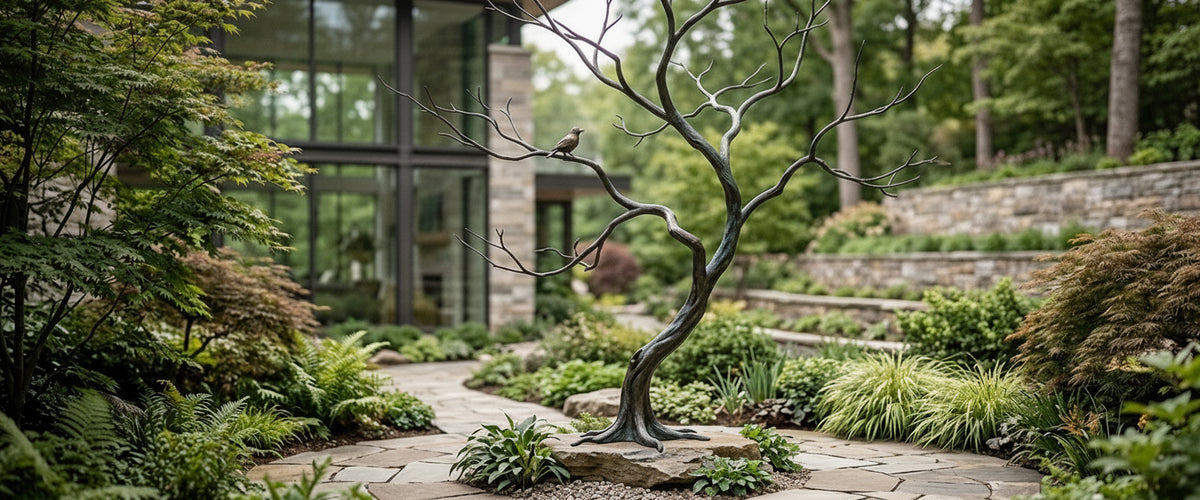
Sculptural tree or branch form: best for tall, vertical voids and stairwell atriums; reads as art and softens hard architecture.
Animal or bird study: best for a console, plinth or reading nook; adds warmth and a point of eye contact at human height.
Contemporary figure: best as a room anchor near a window or gallery wall; carries scale and holds attention without competing with furniture.
These 3 indoor decorative forms each fill a different gap. Match the direction to the space you are solving, then let material and finish do the rest.

What 3 Indoor Decorative Means and Who It Is Best For
When people search for 3 indoor decorative sculptures for sale, they usually are not looking for a matching set. They are trying to compare a few strong options for one important spot. That is the right instinct. A single considered piece nearly always beats three smaller objects scattered across a room.
These three directions suit different buyers. Designers furnishing a spec home in Austin often want a modern figure that photographs well and reads clearly in a listing. Private collectors in Aspen or Napa lean toward an animal or bird study with genuine craft in the surface. Developers finishing a hotel lobby or a corporate atrium usually need a tall nature form that fills volume without crowding the floor plate. Where the ceiling itself is the real design challenge, a piece built at true architectural scale like the Monumental Contemporary Bird and Tree Bronze Sculpture - 800cm at roughly 26 feet is the kind of nature form that fills that volume rather than getting lost in it. It sits at the ambitious end of the 3 indoor decorative directions we recommend.

Key Materials, Finishes and Scale Decisions
Indoor placement changes the material conversation. You are not fighting weather, so patina stability and freeze cycles matter less. What matters more is how the surface reads under interior light, how the weight interacts with your floor structure, and how the finish ages next to the rest of your interior.
Bronze remains our default recommendation across all 3 indoor decorative forms. It holds fine detail, takes a wide range of patinas from near-black to warm brown to verdigris, and it lasts for generations with almost no maintenance. If you want to understand why applied patinas behave the way they do indoors, away from rain and UV exposure, the Metropolitan Museum of Art publishes accessible conservation material on bronze surfaces and their care. Stainless steel is the other strong option when you want a polished, mirror-bright contemporary read that bounces light around a space.
Scale is where most buyers slip. A piece that looks large in a studio photo can vanish in a room with a 14-foot ceiling. Our rule of thumb: a floor-standing figure should reach at least two-thirds of the height between the floor and the nearest strong horizontal line, whether that is a mantel, a window head, or a stair rail. Where the setting needs a room anchor that still relates to the people standing near it, the Large Contemporary Headless Figure Bronze Sculpture - 220cm at around 7 feet 2 inches lands close to human scale while still commanding the floor.
Finish Choices That Change the Mood
Dark or oil-rubbed patina: grounds a bright, neutral interior and adds visual weight.
Warm brown bronze: pairs with wood, leather and layered textiles; the traditional gallery look.
Polished stainless or gilded highlights: for reflective, modern rooms where you want light to move.
Matte or brushed surfaces: quieter, sculptural, better when the form itself is the star.
Any of the 3 indoor decorative directions can take any of these finishes, so decide the mood before you decide the surface.

Where to Place 3 Indoor Decorative Pieces for the Strongest Visual Impact
For wider placement ideas, Large Indoor Sculptures: How Scale, Sightlines and Light Decide the Room is useful companion reading before finalizing the setting and sightlines.
Placement is half the value of the piece. A contemporary indoor decor sculpture in the wrong spot reads as clutter; the same piece three feet to the left, catching a window, reads as the reason the room works. Each of the 3 indoor decorative forms wants a different spot.
For a decorative tree sculpture indoor, think vertically. Stair atriums, double-height entries and the dead space above a low console are ideal. A branching bronze form draws the eye upward and gives tall architecture something to talk to. Keep at least a couple of feet of clearance around the canopy so the silhouette reads cleanly against the wall.
For an animal or bird study, work at seated eye level. A console table, a plinth beside a reading chair, or the end of a kitchen island all put the piece where people naturally look. An indoor swan sculpture decor piece, for example, rewards a low, uncluttered surface where the neck line can arc without visual interference. Where the taste runs more playful and you want movement rather than stillness at that eye level, the Contemporary Octopus Bronze Sculpture - 80cm at around 31 inches carries more energy in the form.
For a contemporary figure, treat it as the room's anchor. Position it slightly off-center from the main sightline as you enter, ideally near a light source so the surface has something to model against. We shipped a bronze figure to a client in the Hamptons who set it at the pivot point between an open kitchen and a living space; it quietly told guests where one room ended and the next began, without a single wall.

Budget, Commissioning and Delivery Considerations
There is no honest single price for interior sculpture, and anyone who quotes one before understanding your project is guessing. Cost depends on material, scale, complexity of the form, the amount of hand-finishing, and how the piece needs to be crated and delivered. Across the 3 indoor decorative directions, a cast bronze with intricate surface work takes far more studio hours than a simpler polished form of the same height, and that shows up in the quote.
A few practical points buyers often miss:
Weight and floor loading. A large solid bronze can weigh several hundred pounds (well over 100 kg). On an upper floor or over a basement, check the structure before you commit to placement.
Access and doorways. Measure the tightest turn in the delivery path, not just the front door. Stair returns and elevator depths defeat more installations than front doors do.
Base and mounting. Interior pieces often need a discreet plinth or floor anchor. Factor this into both budget and lead time.
Lead time on bespoke. A commissioned piece is made, patinated and cured; it is not pulled off a shelf. Build that into your project schedule.
For a first commission that ships more easily and tests how a bronze reads in your own light, a smaller head study such as the Contemporary Dog Head Bronze Sculpture - 45cm at around 18 inches gives you real craft on a console or shelf without the structural planning a floor-standing figure demands. It is a low-risk way into any of the 3 indoor decorative directions.
How Giant Sculptures Can Help with Bespoke Projects
Most of what we make is large-scale and built to last, and a good deal of it is bespoke. If you have a specific corner, a ceiling height, or a form in mind that you cannot find ready-made, that is squarely our work. Whichever of the 3 indoor decorative forms fits your room, we handle bronze, stainless steel and stone, advise on patina and finish against your interior palette, and manage crating and worldwide delivery so the piece arrives ready to install.
Start by browsing the indoor sculptures collection to calibrate your eye on scale and finish, then send us the room details: ceiling height, floor type, the sightline as you enter, and any color or material you want the piece to sit against. From there we can recommend a stock piece or scope a bespoke commission, and give you a tailored quote rather than a number pulled from the air.
Three directions, one clear spot to fill. Pick the 3 indoor decorative form that solves your actual problem, get the scale right for the room, and let the material carry the piece for the next fifty years.