

































































































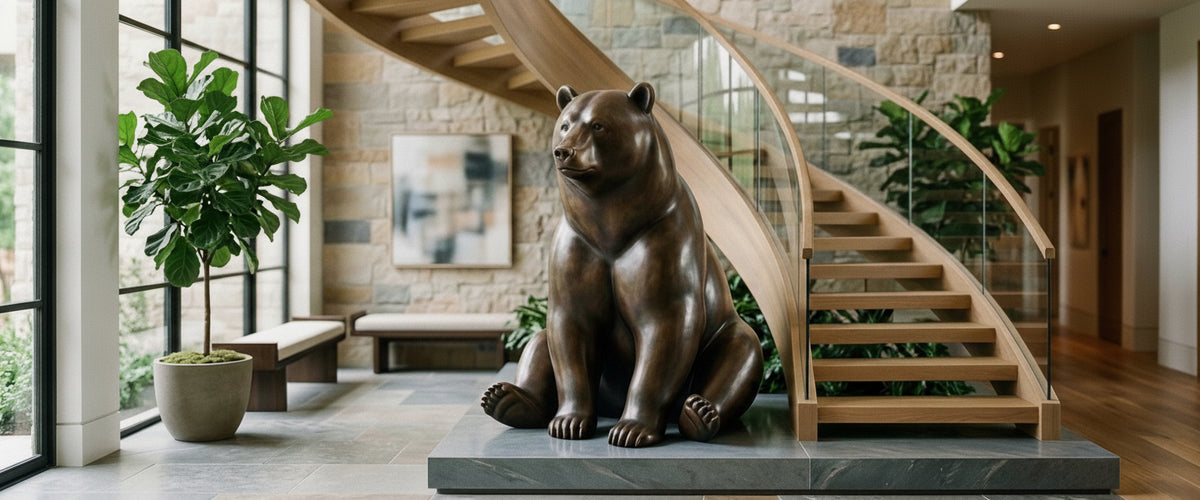

A large indoor sculpture either commands the room the moment you walk in, or it sits in a corner looking apologetic. There is very little middle ground. The difference is rarely the piece itself; it is the decisions made around it. Scale against the ceiling, the sightline from the front door, the height of the base, the wall behind it, the light falling across the surface. Get those right and a bronze figure or a polished steel form becomes the reason the space works. Get them wrong and you have spent serious money on something people walk past.
We ship large-scale and bespoke pieces to homes, hotels, and corporate lobbies across the US, and the same questions come up whether the destination is a Napa winery tasting room or a duplex in NYC. This is the practical thinking behind choosing large indoor sculptures for real rooms.

Key Takeaways
- Scale to the room, not the floor plan. A 6 ft (1.8 m) piece reads small under a 20 ft (6 m) ceiling and huge in a standard 8 ft room.
- Pedestal height changes everything. Lifting a figure 12 to 18 inches (30 to 45 cm) can move the focal point to eye level and transform how it reads.
- Backdrop and contrast matter more than the piece. A dark bronze needs a light or textured wall behind it; a polished form needs something to reflect.
- Indoor placement protects the surface but demands more of the sightlines, because people view large indoor sculptures up close and often.
- Budget depends on material, scale, engineering, and finishing. Ask for a tailored quote rather than guessing.

What Large Indoor Sculptures Actually Look Like in Real Rooms
The phrase covers a wide spread. In a double-height entrance hall, large indoor sculptures usually means something over 6 ft (1.8 m) tall that can hold the vertical space. In a wide living room with a normal ceiling, a 4 ft (1.2 m) seated animal or reclining figure can feel monumental because it dominates the horizontal plane instead.
Where you want a grounded, low-slung mass that works the horizontal plane rather than the vertical one, a 220 cm piece such as the Large Contemporary Seated Bear Bronze Sculpture - 220cm behaves differently depending on where it lands. Placed at the base of a curved staircase it becomes a greeting; set in the middle of an open loft it becomes a room divider you happen to admire. Same object, two completely different jobs.
Water pieces change the calculation again. An indoor water sculpture brings sound and movement, which is why hotel lobbies and private atriums like them. For a plumbed atrium centerpiece where sound matters as much as silhouette, a 150 cm piece like the Large Traditional Chinese Dragon Bronze Fountain - 150cm needs a recirculating setup and a floor that can handle occasional splash, so the placement conversation starts earlier than it does for a dry piece. We always talk drainage and reservoir access before we talk sightlines with a fountain.

Scale, Sightlines and Pedestal Height
Most placement failures for large indoor sculptures start with scale measured against the wrong thing. People measure the corner they want to fill, not the volume of the room or the distance from which the piece will first be seen. A sculpture read from 30 ft (9 m) across an open floor needs more mass than one you meet at arm's length in a hallway.
Here is the rule we keep coming back to: the strongest focal point sits where the natural sightline lands. Stand in the doorway. Where does your eye go first? That is where the piece belongs, or close to it. If the best line of sight hits a spot three feet off the floor, a tall standing figure will feel oddly cropped, while a seated or reclining form will sit right.
Pedestal height is the quiet lever. A grounded indoor floor sculpture that reads as heavy, say a large animal, often wants to stay low or sit on a shallow plinth. A refined figure gains presence when lifted so the face or gesture meets the viewer's eye. Where the design turns on a long horizontal line, a reclining form such as the Large Classical Reclining Mermaid Bronze Sculpture (Arching Back) - 120cm reads best lifted onto a low console rather than left on the floor, which keeps the arching line visible instead of losing it below waist height. For bespoke commissions we routinely model pedestal options before casting, because a wrong base height is expensive to fix later.

Indoor Versus Outdoor Placement: When Each Wins
For wider placement ideas on large indoor sculptures, Large Mixed Media, Placed Right: A Buyer's Guide to Scale and Sightlines is useful companion reading before finalizing the setting and sightlines.
Indoors, the sculpture is protected and viewed constantly, sometimes from inches away. That rewards fine detail, warm patina, and clean joins, because nothing hides at close range. It also means glare, fingerprints, and reflections become real considerations.
Outdoors, weather does half the storytelling. Bronze develops its patina, Corten steel earns its rust film, and a piece is read against sky and planting from longer distances. A tall vertical form like the Large Contemporary Flying Cranes Bronze Sculpture - 250cm at 250 cm can feel airy in a garden and slightly overwhelming pressed into a low-ceilinged room. Match the piece to the space it will actually live in, not the photo that first caught your eye.
On the winter storage question people often ask: cast bronze and stainless steel are happy to overwinter outdoors, but decorative iron pieces with painted or thin protective coatings do better brought indoors or sheltered once temperatures swing and moisture cycles begin. Repeated freeze-thaw and standing water are what accelerate corrosion on ferrous metals, a point the American Institute for Conservation makes clearly in its guidance on caring for metal objects. If a piece is iron and precious to you, err toward shelter.

Light, Backdrop and Contrast
Light decides whether large indoor sculptures have depth or look flat. Raking light from the side carves out modeling and shadow; flat overhead light erases it. For a bronze figure, a fixture angled from one side at roughly 30 to 45 degrees usually gives the best read. For polished stainless steel or a reflective surface, the surroundings become part of the piece, so you want something worth reflecting: a window, a considered wall color, a plant mass.
Backdrop is the mistake most people underrate. A dark patinated bronze in front of a dark paneled wall disappears. Give it a lighter, matte, or gently textured background and the silhouette snaps into focus. A pale marble figure wants the opposite: a mid-tone or darker wall so the edges do not bleach out. Contrast is what lets the eye find the shape.
If you plan to photograph the piece, and most owners of a serious sculpture eventually do, treat window light as your friend. Shoot on an overcast day or in soft indirect light, keep the background clean, and move a light or reflector to bring out one clear direction of shadow. Hard direct sun through a window will blow out highlights on bronze and throw distracting reflections across steel.

Common Placement Mistakes We See in Commissions
These come up again and again with large indoor sculptures, and every one is avoidable.
- Buying to fill a gap instead of to hold a sightline. A piece bought to plug an empty corner rarely becomes the thing you notice. Place to the strongest view first.
- Ignoring floor loading. A large bronze can weigh several hundred pounds (well over 100 kg). Upper floors, timber structures, and some tile substrates need checking before delivery, not after.
- Wrong pedestal height. Too low and a figure loses its face; too high and it looms. Model it before you commit.
- No thought to how people move. A sculpture in a traffic path gets bumped and blocks flow. Give it a viewing zone, not a doorway.
- Backdrop clash. Same value background as the piece kills the silhouette. Change the wall or move the piece.

How to Secure a Large Indoor Sculpture
Weight is not the same as stability. A tall, narrow figure with a small footprint can tip more easily than a heavier low form. For anything with a high center of gravity, or in a home with pets or foot traffic, we recommend mechanical fixing: a hidden pin or threaded rod into the plinth, or bolting the base to a discreet floor plate. On stone floors we use a bonded fixing that spreads load. For bespoke large indoor sculptures we can build fixing points into the casting so nothing is visible once installed. Never rely on weight alone for a top-heavy piece near people.

Choosing Well: A Short Buyer Checklist
- Measure the room volume and ceiling height, not just the floor footprint.
- Stand in the doorway and mark where your eye lands. Place to that.
- Decide material for the setting: bronze and marble for warmth and detail up close, stainless steel for reflection and light rooms.
- Confirm floor loading before you order anything heavy.
- Plan the light and the backdrop as part of the purchase, not afterward.
- Ask about fixing for anything tall or in a busy space.
- Request a tailored quote, since cost tracks material, scale, engineering, finishing, and installation.
Giant Sculptures works as a bespoke supplier of large indoor sculptures, so if nothing in the indoor sculptures collection is quite the size, pose, or finish your room needs, we can commission it. That includes scaling an existing form up or down, adjusting a base, or specifying a patina to suit your light and walls. A moving element such as an indoor kinetic sculpture, or a recirculating fountain, can be engineered in from the start rather than bolted on later. Design large indoor sculptures around the room and they will earn their place for decades.