





































































































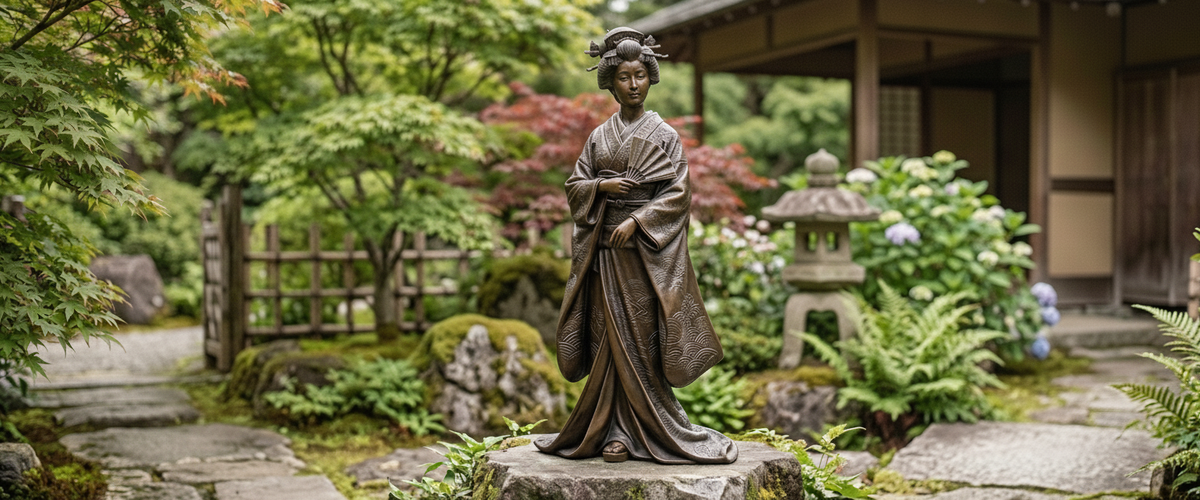

Most people ruin a Japanese bronze figural statue with one decision: they park it under a downlight and walk away. The figure goes dark across the chest, the face disappears into its own shadow, and the fine chased surface that took a metalworker weeks reads as a flat brown blur. Bronze is unforgiving that way. It gives back exactly the light angle you give it, and a ceiling spot gives it the worst one available.

Key Takeaways
Light the outline before the detail. The bell-shaped robe on a Japanese bronze figural statue is a silhouette form, so it needs separation from the wall behind it.
Raking light at a low angle reveals cast drapery and chasing. Overhead light erases both.
Height matters more than floor space. A headpiece read from below looks regal; read from above it looks like an ornament.
Patina is stable but not indifferent. Dry radiator heat and trapped standing water both change the surface over time, in different ways.
Give it room. Clutter within arm's reach turns a serious cast bronze into a shelf curio.
The Bell-Shaped Dress Is a Silhouette Before It Is Detail
A classic Japanese bronze figural statue with bell shaped dress and headpiece is built on outline. The robe flares from a narrow shoulder line down to a wide, grounded hem, and that profile is the first thing the eye registers from across a room. Everything else (sleeve folds, sash, crown or hairpiece) is a second read at closer range.
A Japanese bronze figural statue with bell-shaped dress and headpiece, read as a silhouette against pale plaster.
So plan the background before you plan the fixture. A dark bronze against a dark walnut panel loses its edge entirely. Put the same figure against warm plaster, pale limestone or a light linen wall and the silhouette snaps into focus at fifteen feet (about 4.5 m). Stand where guests will actually stand and squint at it; if the outline still holds at that distance, the placement is working. If the wall behind is dark and you cannot change it, add a low-output wash on the wall itself so the figure reads as a positive shape against a lit field. Light the field, not just the figure.

Why Overhead Light Kills Cast Drapery
Cast drapery on a Japanese bronze figural statue is a field of shallow ridges and valleys. Light coming straight down fills the tops and leaves the undercuts black, which compresses the whole robe into two tones. Move the source to roughly 30 to 45 degrees off the vertical and the same folds develop a gradient across each ridge. Suddenly the fabric has weight.
The practical fix is usually an adjustable track head aimed from the front quarter, or a small uplight set at floor level about 12 to 18 inches (30 to 45 cm) out from the base. Uplighting a figure is a slightly theatrical move, so keep the output low; you want the folds described, not a stage effect. The same rule holds at scale: on a heavily draped figure such as the Life-Size Classical Goddess and Deer Bronze Sculpture - 250cm, over eight feet tall (250 cm), the robe reads as moving fabric or as a solid brown mass depending entirely on where the light sits.
Meiji Surface Chasing Only Appears at a Low Angle
Japanese bronze casting reached an extraordinary level of surface finishing during the Meiji period (1868 to 1912), when export metalwork carried inlay, punchwork and hand chasing across almost every visible plane. The Victoria and Albert Museum's Japanese collections hold pieces where the chasing is finer than the eye resolves at normal viewing distance.
Raking light across the chased hem band of a Japanese bronze figural statue brings the punchwork forward.
That tooling is measured in fractions of a millimeter. Frontal light bounces straight back off it and the surface goes velvety and blank. Skim light across it and every punch mark throws a micro-shadow, which is why a headpiece can look plain in one room and jewel-like in another. If your figure has a chased hem band or a patterned sash, aim one source almost parallel to that surface. Shift that single fixture a hand's width along the wall and the same casting can look like a different object.
Alcove, Console or Sheltered Courtyard
Three settings, three different results for the headpiece on a Japanese bronze figural statue. The difference comes down to how much of the robe profile survives in each one, and where the viewer's eye naturally lands when they walk in.
The Alcove
A recessed niche gives you controlled light and a built-in frame. Downside: alcoves are usually shallow, so the figure gets pressed against the back wall and the profile of the robe is lost. Pull it forward by at least a third of the niche depth and light from the side wall, not the ceiling of the recess.
The Console
Best for viewing the headpiece, because it lifts the crown toward eye level. Aim for the face to land between 55 and 65 inches (140 to 165 cm) off the floor. Too high and you stare at the underside of the chin; too low and the headpiece foreshortens into nothing.
The Sheltered Courtyard
Outdoors, daylight does the raking for you at morning and late afternoon, which is when the piece will look best. An east-facing loggia or a covered breezeway works particularly well, since low sun skims the robe rather than flattening it. Pair the figure with restrained planting rather than dense foliage. Where a courtyard needs the same East Asian register but at garden scale, a water piece like the Large Traditional Crane Pair Bronze Fountain - 190cm carries that language across a much wider footprint without competing with a single standing figure.

Radiator Heat, Rain and What the Patina Tolerates
Bronze patina is a stable oxide and sulfide layer, but it responds to its environment. Indoors, the real enemy is dry, fluctuating heat. Set a bronze directly above a cast-iron radiator and the applied wax will go chalky, often with the lacquer crazing on the side facing the heat. Move a Japanese bronze figural statue at least three feet (about 1 m) from any heat source and keep it out of direct afternoon sun through glass.
Outdoors, rain is fine. Standing water is not. Water pooling at the base or trapped inside a hollow cast will push corrosion from the inside out, so check that drainage holes are clear each spring. Chlorinated pool spray, coastal salt air and de-icing salt all accelerate change. Guidance from the Smithsonian National Museum of Asian Art and most conservation departments points the same way: a soft brush, deionized water, thorough drying and a fresh microcrystalline wax coat once or twice a year does almost all the work.
Placement and Care Checklist
For wider placement ideas, What Makes a Bronze Tribal Figural Statue Read From Across the Room is useful companion reading before finalizing the setting and sightlines.
Check the silhouette against the background from your normal viewing distance, not from three feet away.
Set the primary light source at 30 to 45 degrees, never straight down.
Test one raking source across any chased or patterned surface before committing to a fixture.
Put the face near eye level for interior placements.
Keep three feet (1 m) clear of radiators, vents and glazed south-facing walls.
Confirm floor loading and plinth stability for anything heavy or top-weighted.
Wax annually indoors, twice yearly outdoors or in coastal air.
Clear drainage points on outdoor pieces every spring.
Keeping It Art, Not Curio
The fastest way to shrink a good bronze is to surround it. Books, candles, a tray of small objects, and the figure becomes part of a vignette instead of the subject. Give it a clear radius of at least half its own height in every direction. One companion object at most, and make it low. If the surface behind it is busy with pattern or shelving, the robe outline fights for attention and usually loses.
Plinths help enormously. Raising a Japanese bronze figural statue onto a simple stone or steel base separates it from the furniture and signals intent. Look at how much of the total height goes to the base on the Large Traditional Chinese Guardian Lion Bronze Sculpture (Scalloped Plinth) - 140cm: set the same casting straight on the floor and it reads far smaller and far more decorative. Working through the wider bronze figures and statues range is a useful way to compare base treatments before you commit to one.

Commissioning a Bespoke Figure
If you want a Japanese bronze figural statue at a specific scale, in a specific patina, or sized to an alcove you already have, that is commission territory. At Giant Sculptures we work through wax and clay maquette stages before casting, and we specify patina chemistry against the light conditions of the actual site. That matters most on a bell-shaped robe, where a half-shade difference in the patina changes how much of the chasing survives at viewing distance. Budget depends on scale, alloy, complexity of the chasing, plinth engineering, finishing and installation, so we quote each project individually rather than working from a list. Send us the room dimensions and a photo of the light at two different times of day, and we can tell you quickly whether the piece you have in mind will work where you want it.