

























































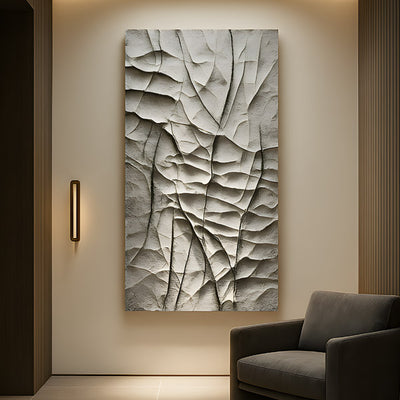






























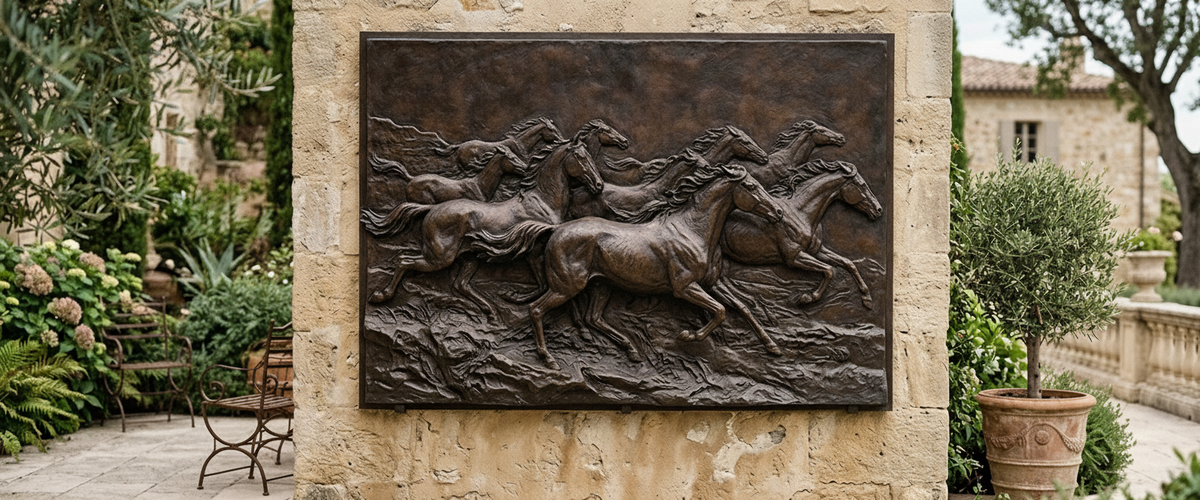

Hang a bronze sculpture relief on the wrong wall and it goes quiet. The casting is still excellent, the modeling is still there under your fingertips, but from eight feet back it reads as a brown rectangle. Relief is a shadow medium. Every ridge, undercut and rolled edge only exists visually because light crosses it at an angle and leaves a dark line behind. Decide the lighting after the panel is bolted up and you are already negotiating with physics.
We have watched this play out on site more than once. A bronze sculpture relief that sang in the studio under a single angled work lamp arrived at a client's tasting room, went up under recessed downlights set two feet off the wall, and lost half its depth on day one.
Raking light arriving at roughly 30 degrees pulls the modeling forward.

Key Takeaways
Projection depth drives everything: shallow bas relief needs directional light, deep high relief can make its own shadows.
Raking light at roughly 30 degrees to the wall surface reveals modeling; a flat downlight washes it out.
Dim corridors suit high relief. Bright, evenly lit rooms suit shallow panels. Swapping them fails in both directions.
North-facing daylight is soft, constant and unfairly good for bronze.
Dark, contrasty patinas hold shadow; heavily polished or pale finishes bounce light and flatten the form.
Budget depends on scale, casting complexity, depth of relief, patina and mounting engineering, so ask for a tailored quote.
Projection Depth Decides Everything
Ask any foundry how far a bronze sculpture relief projects from its background and you get the single most useful number for planning light. A bas relief with about half an inch (12 mm) of projection is a drawing in metal. It needs a light source arriving from one side to cast usable shadow, otherwise the composition collapses into surface texture. Push the projection to an inch and a half (40 mm) or more and the sculpture starts generating its own shade from almost any direction, because the forms are physically standing off the plate.
That difference should shape what you buy. If your wall is fixed, unlit and you cannot run new circuits, commission deeper. If you have control over track positions, shallow work becomes an option, and shallow work is often the more refined choice for interiors because it sits closer to the plane of the wall. Where nothing but daylight is available, a deeply cut bronze sculpture relief is the safer specification: the carved relief bands on the plinth of the Monumental Traditional Chinese Guardian Lion Bronze Sculpture (Carved Relief Plinth) - 250cm stand far enough proud of their background that ambient outdoor light supplies all the shadow the pattern needs, without a single fixture.

Raking Light at 30 Degrees Versus a Flat Downlight
Take one bronze sculpture relief, light it two ways, and the result is not subtle. A downlight dropped straight down the wall face hits every high point and every low point with roughly the same intensity, so the shadows are short and stubby. Move the source out from the wall until the beam strikes at around 30 degrees from the surface and the same panel gains depth you did not know was cast into it. Conservators use grazing light for exactly this reason when they examine surfaces; the Metropolitan Museum of Art's essay on the technique of bronze statuary is a useful primer on how much surface information gets fixed into the metal during the casting process.
Practical version: position the fixture so the beam arrives shallow rather than steep, and commit to one dominant direction. Two lights from opposing sides cancel each other's shadows and you end up back where you started. Warm beams in the 2700K to 3000K range flatter brown and chocolate patinas; cooler light pushes them gray.
High Relief on Dim Walls, Bas Relief on Bright Ones
Corridors, stair returns, wine cellars and paneled studies are dim by design. Put a shallow bronze sculpture relief there and it becomes a plaque nobody looks at twice. Put a deep, muscular panel there and the little available light does plenty. Reverse the pairing and you get the other failure: a high relief panel in a bright, glass-walled great room throws hard black shadows that fragment the composition into unreadable chunks. The room already has light. What it needs is subtlety.
Subject matter matters here too. Animal and figure compositions with strong silhouettes survive difficult lighting better than fine ornamental detail, which is why buyers browsing our bronze animal sculptures often gravitate toward bold, simplified forms for shaded positions.
North-Facing Daylight: The Free Lighting Rig
Painters have used north light for centuries because it is soft, indirect and roughly constant through the day. It behaves beautifully on a bronze sculpture relief. A north-facing interior wall, or a shaded loggia, gives you gentle directional wash without the hard midday contrast that swings across a south elevation. If you have that wall available, use it before you spend anything on fixtures. Add a single discreet accent light for evenings and the panel works around the clock.

Patinas That Hold Shadow and Patinas That Flood It Flat
A dark ground with rubbed-back high points keeps the recesses reading as shadow.
Patina is a lighting decision disguised as a color decision. Dark brown, near-black and deep green chemical patinas absorb light in the recesses and hold contrast, which is why they suit shallow work. Highly burnished, gilt or pale verdigris surfaces reflect light back out of the hollows and can wash the modeling flat, particularly under strong illumination. Many of the best panels split the difference: a darker ground with high points rubbed back so the raised forms catch light and the recesses stay dark.
Outdoors, patina also has to survive weather. A protective wax or lacquer layer keeps a bronze sculpture relief stable, and it needs periodic renewal rather than one-time application. Our bronze sculptures are finished with long-term exterior exposure in mind, but every coastal or high-UV location changes the maintenance rhythm.
Wall Color and Texture as a Second Light Source
The wall behind a bronze sculpture relief is not neutral. A pale limestone or chalk-white plaster face bounces light back up into the underside of the panel, softening shadows and lifting the whole composition. Charcoal, ink blue or dark stained timber does the opposite; the bronze reads as an object floating in front of darkness, with maximum silhouette contrast. Rough render adds its own micro-shadow that competes with shallow work, so keep bas relief on smooth surfaces and save textured walls for deeper carving.
Facade Reliefs at Noon
Exterior architectural panels have one lighting variable you cannot adjust: the sun moves and the wall does not. A south-facing facade gets near-vertical light at midday that shortens every shadow to almost nothing, then long dramatic raking light in the late afternoon. East and west elevations get one strong performance a day. Plan for the hours that matter to your building, then add uplighting for the rest. Memorial and commemorative work is usually cut deliberately deep for exactly this reason, and the same logic governs freestanding pieces such as the Monumental Soldier and German Shepherd Bronze Sculpture - 300cm, which holds its form at noon and at five o'clock alike because the reading does not depend on a narrow window of raking light.
Checklist Before You Commit
Measure the wall's daily light: note direction, hours of direct sun, and existing fixture positions.
Confirm projection depth in inches and millimeters with the supplier before approving a design.
Decide your dominant light direction and stick to one.
Test the beam angle with a clip lamp and a cardboard mock-up at full size. It costs nothing and saves rework.
Choose patina and wall color together, not separately.
Check substrate and fixings: bronze is dense, so structural anchors and a surveyed wall are non-negotiable for large panels.
Ask about drainage and standoff spacing for exterior installations so water does not sit behind the plate.
Request a tailored quote covering casting, finishing, mounting hardware, crating and installation.

GC Marked German Wall Hangings Versus Commissioned Panels
Not every inquiry is architectural. A steady share of buyers arrive with a search phrase along the lines of bronze sculpture relief wall hanging GC artist German, chasing the small cast plaques that surface through European estate sales and auction listings. Those are collectable decorative castings, sized for close viewing in a study or hallway, and their lighting problem is a modest one: a lamp to one side is normally enough. An architectural panel is a different purchase entirely, because it is engineered around a specific wall, viewing distance and light condition rather than bought as found.
Commissioning a Bespoke Bronze Sculpture Relief
Scale sets the terms. For a hallway or study read at arm's length, something in the register of the Traditional German Shepherd and Pup Bronze Sculpture (Cub Companion) - 60cm carries the right intimacy and detail; a lobby panel twelve feet wide is engineered, not just modeled.
At Giant Sculptures we work from your wall outward: elevation drawings, viewing distance, light survey, then clay development, casting and patination. A bespoke bronze sculpture relief lets you set the projection depth to suit the room instead of hoping a stock panel behaves. If you are still weighing subject and setting, browsing the bronze garden statues range is a useful way to see how patina and scale read in real exterior conditions before you commit a design to the foundry.
For wider placement ideas, A Bronze Pegasus Sculpture Only Works if the Pose Matches the Site is useful companion reading before finalizing the setting and sightlines.