





































































































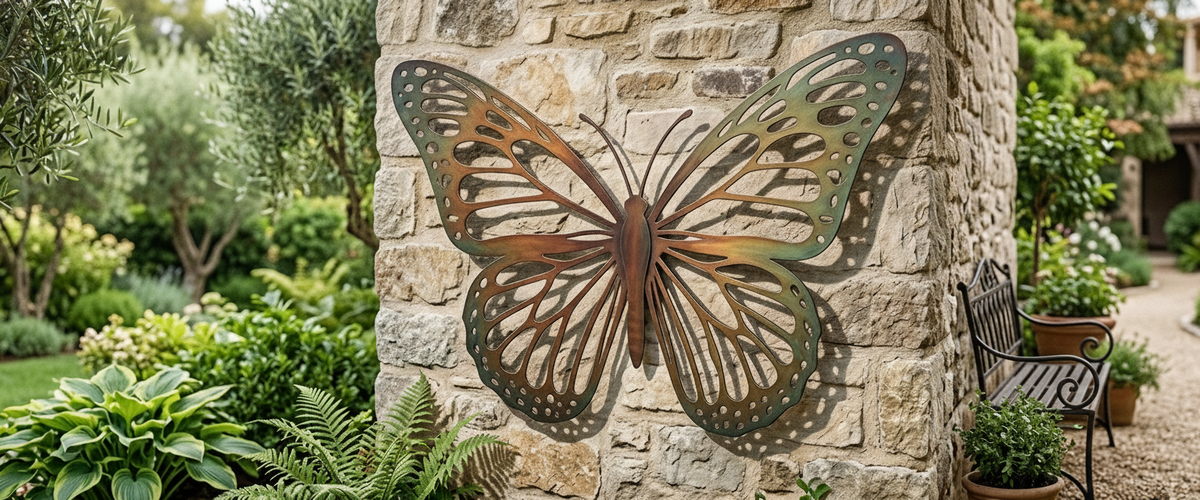

A butterfly with flat wings is a sticker with screws. Hang it on a pale wall under recessed downlights and by midday it has gone silent: the same value as the plaster, no edge, no depth. Most disappointment with large butterfly wall art traces back to that one detail, and it gets decided in the workshop long before the crate lands. Wing geometry, surface finish and the direction of the light decide whether a piece reads from across the room or blends into the paint.

Quick Answer: What Makes Large Butterfly Wall Art Work
Wing pitch: aim for wings angled roughly 15 to 35 degrees off the wall plane. Below that, the shadow is a hairline.
Bare wall: a single specimen wants clear wall to each side of about half its wingspan.
Swarm logic: odd numbers, two or three sizes, a diagonal flight path, and no two pieces at identical spacing.
Finish: powder-coated steel keeps a crisp silhouette outdoors; hand-painted resin gives you gradient and glow indoors.
Height: set centers for the sightline people actually use, which in a lounge is seated, not standing.
Light: one raking source from the side beats four downlights every time.
Flat Wings on a Pale Wall Go Invisible
Shadow is the second artwork you are buying. A relief piece has two ways to separate from its background: color contrast and form contrast. Color contrast fails fast, since most clients want white, bone or soft gray walls, and a light-toned butterfly on light plaster has nowhere to go. Form contrast is the durable one. Depth, cast shadow and a hard edge keep working after the paint color changes.
Carved stonework makes the point at a larger scale. A deep-cut panel such as the Archangel Triumph Marble Relief Wall Art - 350cm stays legible on pale plaster because the undercuts generate their own darks, while a shallow etched panel of identical size would disappear in the same position. Butterfly pieces obey the same rule with a much thinner cross-section to work with, which is why pitch has to do the job that mass does in stone.

Wing Pitch Is Where Usable Shadow Starts
In our experience, the useful range for large butterfly wall art sits between 15 and 35 degrees of pitch. At around 15 degrees you get a shadow line thick enough to survive diffuse daylight. Push toward 35 and each wing throws a genuine dark shape that moves through the day, which is the effect most buyers are chasing without having the words for it.
Pitch, not size, is what keeps a winged relief legible on a pale wall.
Go past that and two things happen. The wingtip silhouette foreshortens, so the outline you fell in love with stops reading head-on, and the piece projects further into the room. That matters in circulation routes. US accessibility guidance caps how far an object can protrude into a walking path at body height, generally 4 inches (100 mm) for leading edges between 27 and 80 inches above the floor, and the US Access Board sets the rules out in detail for commercial projects. Hotel corridors and lobby routes need that checked before wing pitch is finalized, not after.
One Big Specimen or a Scattered Swarm
Almost every brief for large butterfly wall art lands in one of two camps. A single oversized butterfly is an object. It needs breathing room, roughly half its wingspan of clear wall to each side, and it wants to sit on the largest uninterrupted plane in the room. That is the right call above a fireplace, on a double-height stair wall, or at the end of a long sightline where a winged subject carries real presence. For a sense of how much wall a single winged piece swallows before the composition tightens up, the 180cm Striding Winged Figure Marble Relief Wall Art sits near the threshold where one object can hold a chimney breast on its own; anything smaller usually wants company.
A swarm is a composition, and it fails when it is tidy. Use odd numbers, mix two or three sizes, and set the group on a soft diagonal so the eye travels. Keep at least one wing width between neighbors, vary that gap deliberately, and let the cluster occupy somewhere around two thirds of the wall width. Anything closer to symmetrical stops looking like flight and starts looking like a display board.
Odd numbers, mixed sizes and uneven gaps read as flight; even spacing reads as a display board.

Powder-Coated Steel Holds an Edge, Hand-Painted Resin Holds a Glow
Laser-cut and folded steel or stainless gives you the crispest outline available, and a thermoset powder coat is fused in an oven rather than air-dried, which is why architectural specs lean on it for exterior metalwork (the Powder Coating Institute covers the chemistry well). Metal is the right answer for a poolside wall in Palm Springs, a shaded courtyard, or anywhere the piece will see weather. Our metal wall art range is the quickest way to see how those finishes behave side by side.
Hand-painted resin and composite earn their place indoors, where layered translucency and blended pigment do things metal cannot. Where the brief calls for tonal softness rather than a hard cut edge, a layered piece like the Wenlock White & Pastel Gradient Wood Relief 3D Wall Art is closer to the right design language, because the gradient reads as depth before any shadow arrives; the same logic runs through the wider wood wall art pieces. One hard-won lesson from a conservatory commission: unshaded south-facing glass will punish a painted finish over a few summers. If glass is unavoidable, specify a UV-stable topcoat or go metal.
Hang It for a Seated Sightline
Gallery convention puts centers around 57 to 60 inches (145 to 152 cm), which suits a standing viewer moving past. Living rooms do not work that way. In a lounge or a tasting room where people sit for an hour, drop centers to roughly 48 to 52 inches (122 to 132 cm) so the wings sit in the natural line of sight from a sofa. In a stairwell, set height from the landing below rather than the top step, because that is where the piece is first seen whole.
Stairwells, Conservatories and Hotel Corridors
A tasting room took a nine-piece swarm across a rough plaster wall; the texture gave the smaller wings something to cast onto, which is why we argued against a smooth finish there. A mountain-house stair wall suited one large specimen instead, mounted so it sits at eye level from the half-landing. A boutique hotel corridor needed the reverse of the usual advice: shallower pitch for clearance, higher contrast finish to make up the lost shadow. Different problems, one diagnostic question every time. Where does the light come from, and where does the viewer stop?
Light the Wall from the Side
Straight-on downlight flattens relief work. Put the source off to one side, close to the wall, so the beam grazes the surface at a shallow angle and drags the shadows sideways. Match the side your natural light already comes from, keep the color temperature warm at 2700 to 3000K for painted and stone surfaces, and dim it rather than driving it brighter. One raking fixture does more for large butterfly wall art than a row of ceiling cans.

Checklist Before You Order
Run this before you sign off on any large butterfly wall art commission.
Measure the wall, then discount anything below 40 inches (102 cm), where furniture will block the view.
Confirm wall construction: drywall with studs, masonry, or stone all need different fixings.
Ask for weight per piece and the mounting method, especially for stone or engineered metalwork.
Check projection against corridor and doorway clearances in commercial spaces.
Decide interior or exterior before finish, not after.
Plan the light source at the same time as the piece.
Tape out the full footprint on the wall and live with it for a day.
Commissioning Large Butterfly Wall Art with Giant Sculptures
As a bespoke supplier working at architectural scale, Giant Sculptures builds wall pieces to the wall rather than the other way around. That means wingspan set to your plane, pitch tuned to your light, finish matched to a fabric or stone sample, and mounting hardware engineered for the substrate you actually have. Commission budgets depend on material, scale, complexity, engineering, installation and finishing, so the sensible next step is a tailored quote with your wall dimensions and photos attached. Start with our wall art collection or the 3D wall art range to identify the depth and finish language you want, then tell us the wall. We crate and ship worldwide.
For wider placement ideas, Large Abstract Wall Art for Hallways: Bold Lines Win at Walking Speed is useful companion reading before finalising the setting and sightlines.