






































































































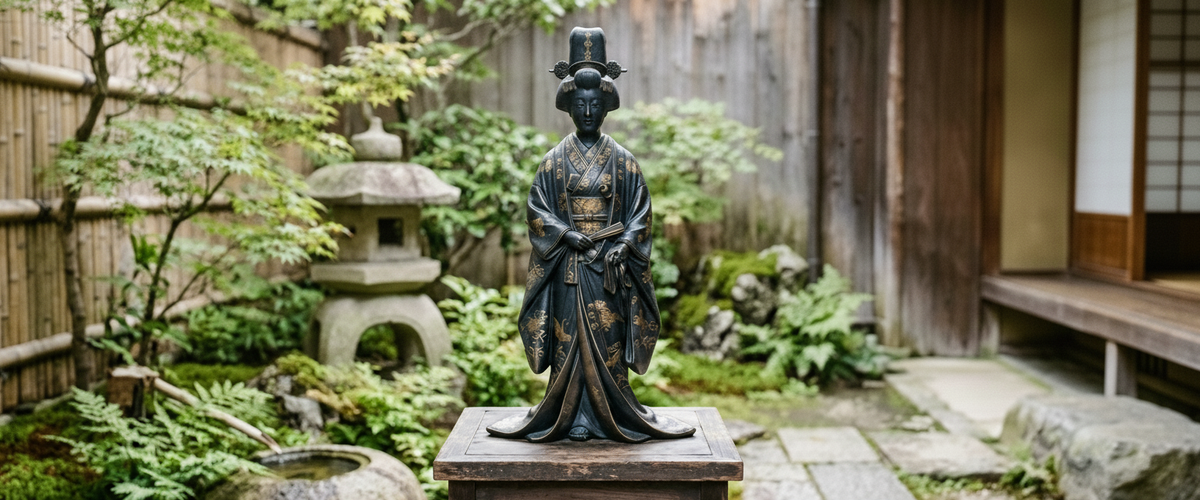

Most Japanese bronze figures that reach Western homes end up in the worst spot in the house: a hallway console, lit from above, glanced at by people walking past at full height. The tradition behind a Japanese bronze figural statue points to the opposite setting. It is best met in a recess, by someone seated, in soft side light, who has stopped on purpose to look. Get that placement right and a 14-inch (35 cm) figure can hold a whole room. Get it wrong and it reads as a souvenir.

Quick Answer
Recess, not pass-through: give the figure a niche, bay or alcove with a back and sides.
Seated eye line: set the face at or slightly below the eye height of someone sitting in a chair, usually around 40 to 48 inches (100 to 120 cm) from the floor.
Low side light: light from one side of the recess, not straight down.
Hands off the surface: dust gilding, inlay and old patina. Never polish them.
Tokonoma Logic: Why These Figures Want a Recess
The tokonoma is the raised alcove in a traditional Japanese reception room. It holds a hanging scroll, a flower arrangement and sometimes a single object, changed with the seasons or the occasion. Guests view it from the tatami floor, and the host arranges it as a quiet statement about the moment. The Metropolitan Museum's essay on the Japanese tea ceremony gives a good sense of how deliberately these interiors were composed.
That context helps explain why a Japanese bronze figural statue so often rewards a framed, frontal view. The back is frequently simpler than the front. The detail gathers in the face, hands and hem, the parts a seated viewer sees first. Many Meiji bronzes were made for export and ended up on Western mantelpieces, but they still look best when treated this way. The recess does the rest of the work: its walls shut out clutter and frame the figure as the only thing in view.
The Bell-Shaped Robe Needs a Seated Eye Line
Collectors searching for a Japanese bronze figural statue with bell shaped dress and headpiece are usually after Meiji-era court ladies and dancers, where the robe flares into a wide bell and a tall headpiece rises above the face. These proportions suffer from a high viewpoint. Seen from standing height, the headpiece foreshortens, the face retreats underneath it, and the robe becomes a heavy dome. Drop your eye line to seated height and the silhouette opens up. The bell reads as movement, and the face comes forward.
The simplest test costs nothing. Sit in the chair you use most in that room and look at where the figure will go. If you are looking down onto the top of the headpiece, raise it.
From a chair, the bell of the robe reads as movement and the face comes forward beneath the headpiece.

Making an Alcove in a Western Room
Few American homes have a tokonoma, but most have something you can adapt into a proper setting for a Japanese bronze figural statue.
Bookshelf bays: empty one bay completely, remove the shelf above to gain height, and darken the back panel.
Built-in niches: if you are renovating, a niche framed between studs is straightforward, though a standard stud bay is only about 3.5 inches (9 cm) deep. Deeper figures need a built-out surround. Size the niche to the figure, not the other way round.
Deep sills: use them only with a blind or sheer drawn behind the figure. Set directly against bright glass, it becomes a black cutout.
The change can be dramatic. Take a dancer figure that has spent years on a hall table: clear one bay of a built-in bookcase, take out the shelf above and line the back with charcoal linen. Nothing about the figure changes, yet people start stopping to look at it.
A Japanese bronze figural statue framed by a cleared bookshelf bay: a dark back, two sides and one low light source.
Where there is no wall recess at all, you can build the frame from furniture instead. A console with a quiet, low profile, such as our Bronze Console Table Base - 150cm, set between two tall cabinets gives the figure a back and two sides, which is all an alcove really needs. The difference from the hallway console is the enclosure: the cabinets block the side view and slow the viewer down.
Okimono and Floor Figures Can't Share the Same Recess
Okimono are small display objects made for exactly this kind of setting, and many sit comfortably in the palm of a hand. Floor figures are a different category, built to stand at ground level or on a low platform. Put a floor figure in a bookshelf bay and it crowds the opening; put a palm-sized okimono in a floor-height niche and it disappears.
Scale your recess to one object, whether that is a Japanese bronze figural statue or a single vessel. At around 6 inches (15 cm), a piece like the Steep Bronze Pomegranate Teapot Sculpture - 15cm sits at roughly okimono scale and wants a tight, shallow niche close to the eye rather than an open shelf. At the other end, a standing figure of 200 cm, such as the Melholme Bronze & Teal Figure Sculpture - 200cm, needs floor space and a sightline from across the room, so it belongs in an entrance hall, an atrium or a garden. That larger scale is where our bronze figures and statues collection and bespoke commissions come in.
Low, Raking Light Brings Out the Casting
Overhead spotlights flatten a Japanese bronze figural statue and throw hot spots onto its gilding. Light that skims across the surface from one side does the opposite: it catches the chased folds of the robe, the texture of the hair, the edge of every inlaid line. A warm LED strip (around 2700K) fixed inside one wall of the niche is usually enough. Keep halogen and other hot lamps away from any figure with lacquer or mixed-metal inlay.

Gilding, Inlay and Old Patina: Surfaces an Alcove Protects
Japanese metalworkers used alloys such as shakudō (a copper-gold alloy patinated to blue-black) and shibuichi (a copper-silver alloy that turns soft gray), along with gold and silver inlay and partial gilding. The color you see is a deliberate chemical layer, not dirt. Metal polish strips it in minutes, and only a conservator can begin to put it back.
The classic disaster is a well-meaning clean with brass polish: blue-black shakudō panels on a robe come up a raw salmon pink, and the figure loses much of its value in an afternoon. An alcove helps simply by keeping hands, splashes and cleaning cloths away. For care:
Dust with a soft, dry brush, working into folds.
Handle with cotton or nitrile gloves, lifting from the base.
No polish, water, waxes or household sprays.
Keep the figure away from kitchens, fireplaces and humidifiers.
Choosing a Japanese Bronze Figural Statue for Your Space
Before buying, work through these points:
Measure the recess first. Allow at least a hand's width of clearance on each side and above the headpiece.
Check the casting. Crisp detail in the folds and fingers suggests careful chasing; soft, blurred detail can point to a later recast.
Look at the surface. Even, untouched patina is worth more than a bright, freshly polished one.
Ask about the stand. An original wooden stand matters for both value and height.
Confirm the weight. Bronze is heavy even when hollow cast, so check that your shelf or sill can take the load.
If you cannot find an antique that fits your space, a new bronze figure can be commissioned to suit the niche or the garden. Giant Sculptures makes bespoke figures in bronze at every scale from tabletop to monumental. Budget depends on size, complexity, finish, engineering and installation, so we quote each project individually. Browse our bronze sculptures for a sense of surfaces and patinas, then send us your recess measurements and a photograph of the room.
Give the figure a frame, a low light and a chair to be viewed from. The rest takes care of itself.
For wider placement ideas, Best Bronze Tabletop Sculptures: What Holds up at Arm's Length is useful companion reading before finalizing the setting and sightlines.