





































































































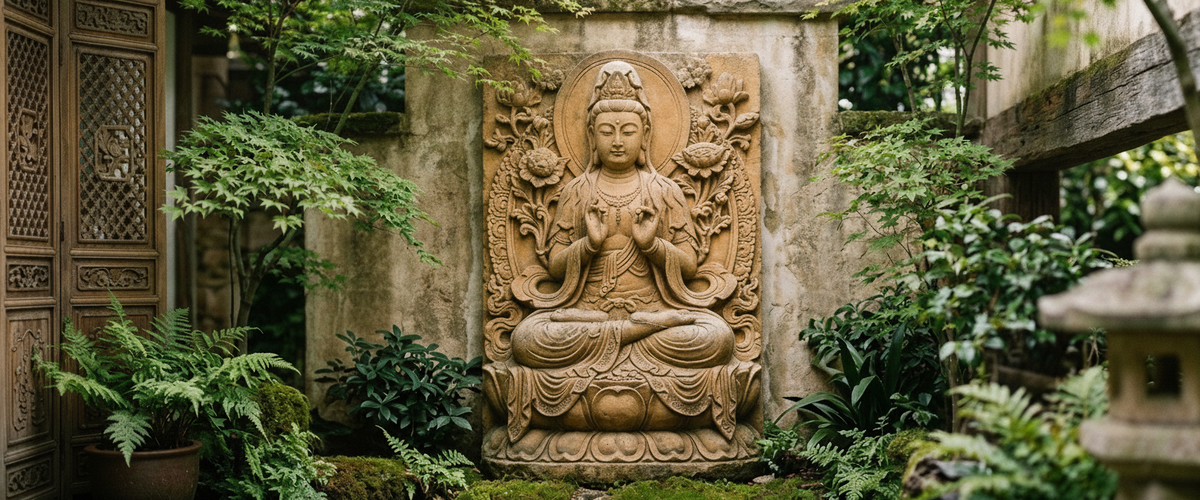

A genuine 12th century sandstone sculpture was almost never carved to hang. It was cut as a building component, set into a temple wall or a gateway jamb, with its weight carried by the masonry below it and its back left rough because nobody was ever meant to see it. Nine centuries later it gets photographed against a white studio backdrop, listed as a wall piece, and bought by someone with 5/8 inch drywall and a stud finder. That gap between how the stone was made and how it is sold is where most expensive mistakes happen.
Period reliefs were cut as masonry components, which is why the reverse face is left coarse.

At a Glance
Original function first: a 12th century sandstone sculpture was usually load-bearing architecture, not one of the hanging sculptures for wall display it is marketed as today.
Weight is the real constraint: a modest panel can pass 250 pounds (113 kg) before the frame is added.
Surface tells the truth: tool rhythm, edge wear and burial staining are harder to fake than the carving itself.
Indoor climate is the enemy: dry heat pulls salts to the surface and lifts the skin off the stone.
Paperwork over patina: no export history, no purchase, whatever the piece looks like.
A studio-carved panel often gives you the same presence with none of the legal or conservation risk.
Cut to Lean, Not to Hang
Look at the back of any authentic 12th century sandstone sculpture and you will usually find a flat, coarsely dressed face, sometimes with mortar residue, sometimes with a shallow keying groove. That surface was designed to sit tight against rubble core masonry. The front carving projects, the mass sits low, and the center of gravity is often several inches forward of the mounting plane. Hang that on a standard partition wall with picture hardware and you are asking two small fixings to resist both downward load and a constant outward lever.
Relief depth matters more than face size. A shallow panel cut two inches deep behaves very differently from a high-relief fragment with undercut limbs and a deep plinth. We have handled 12th century sandstone sculpture panels whose mass sat several inches forward of the back face, which means the fixing has to resist rotation as well as gravity.
Tool Marks, Edge Wear and the Tells of a Period Surface
The carvers behind a 12th century sandstone sculpture worked with point chisels, claw chisels and abrasives, and their marks run in consistent directions dictated by hand position and grain. Modern pneumatic tooling leaves a flatter, more uniform bite, and rotary burrs leave arcs where a hand chisel would leave facets. Check the hidden zones: behind a raised arm, under a drapery fold, inside a lotus petal. Fakers finish what the camera sees.
Edge wear is the second read. Genuine period stone wears unevenly, softened where hands, cloth or weather touched it, crisp where it was protected. Uniform softness across every edge usually means the piece was tumbled, acid washed or sandblasted to age it. Burial staining should sit in the pores and follow the bedding planes of the sandstone rather than sitting on top like a glaze. Museum collections with published Khmer and central Indian temple sandstone are worth studying closely before you look at anything offered privately; the surface vocabulary becomes obvious once you have seen forty authenticated examples.

Salt Bloom and Spalling: What Central Heating Does to a 12th Century Sandstone Sculpture
Sandstone is porous by nature, and stone that has spent centuries in ground contact or monsoon humidity carries soluble salts deep inside it. Move a 12th century sandstone sculpture into a Texas living room running dry forced-air heat, and the moisture inside migrates outward, carrying salts with it. They crystallize just under the surface and pop the skin off in flakes. Conservation guidance from Historic England on stone decay is blunt about salt crystallization being one of the most destructive mechanisms affecting porous stone, and it works exactly the same way indoors.
Practical response: stabilize the room before the stone arrives. Aim for stability rather than a target number, avoid relative humidity swings of more than ten percent over a day, and never let a piece sit through a winter of dry heat followed by a humid summer with no buffering. White powdery bloom appearing weeks after installation is not dust. Brush it off dry with a soft natural bristle brush, never wet, and call a conservator.
Hidden Cleats and Load Spread for Hanging Sculptures for Wall Installation
The correct build is a steel subframe, not a hook. On the commissions we have shipped, the pattern that works is a welded plate cleat bolted through into structure, with the stone carried on a bottom shelf angle that takes the vertical load and a top restraint that stops it tipping forward. The stone should rest, not hang. Load spread across at least two studs, or a plywood backing panel bolted to three, keeps point loading from crushing drywall over time.
A shelf angle takes the vertical load; the top restraint only stops the panel tipping forward.
For a 12th century sandstone sculpture or any heavy carved panel, get a structural engineer to sign off if the substrate is anything other than masonry or a purpose-built stud wall. Isolate the stone from the metal with inert shims so nothing rusts against the back face, and leave an air gap. When we mounted a pair of carved panels for a Napa tasting room, the air gap did more for the stone than the humidification system did.
Three Placements to Refuse
For wider placement ideas, Sandstone Garden Sculptures: How to Read the Stone Before You Buy is useful companion reading before finalising the setting and sightlines.
Placement decides how long a 12th century sandstone sculpture survives indoors. Three spots to rule out before you measure anything:
Above a radiator or forced-air register. The convection column runs a local drying cycle over the stone face every single day.
Under tight-focus spotlights. Halogen and high-output narrow beams create surface heat differentials. Use diffuse, low-heat LED at a wide beam angle and keep the fitting well off the stone.
On an exterior wall with any damp history. Rising or penetrating damp feeds the salt cycle continuously. Test the wall before you commit, not after.
Provenance and Export Paperwork Worth Walking Away Over
South and Southeast Asian temple sculpture has a documented history of looting, and enforcement has sharpened considerably. No 12th century sandstone sculpture is worth buying on charm alone. Anything described as a 12th century Asian wall relief sandstone sculpture hanging for sale needs an ownership history that predates 1970, the year of the UNESCO Convention on illicit cultural property transfer, or clean export licensing from the source country. Old auction catalog entries, dated photographs, customs documents and named prior collections are what count. Vague phrases like "from an old European collection" or "acquired in the 1980s" with nothing attached are a reason to leave.

When a Studio-Carved Reproduction Is the Smarter Piece to Live With
Plenty of buyers want the visual language of a 12th century sandstone sculpture without owning an object that needs climate control and a legal file. A newly carved panel in sound, low-salt sandstone can be cut to the depth your wall can carry, given a fixing system designed from the start, and placed outdoors where an antique never could go.
Freestanding work often reads better anyway. Where a courtyard needs a single anchoring mass rather than a fragment hung on a boundary wall, a piece on the scale of the Indian Elephant in Pink Sandstone Statue - 220cm (roughly 7 ft 3 in) carries the space in a way a relief panel cannot, and it sits on ground bearing rather than borrowed structure.
Scale is the decision most people get wrong. Garden pieces need mass to survive open sky and long sightlines, which is why something like the Roaring Tiger Sandstone Statue - 200cm still holds the end of a long driveway while a two-foot version would vanish entirely. Closer in, on a terrace or beside a pool house, a smaller carving set at eye level rewards short viewing distances and detail. If you are weighing material as much as subject, it is worth comparing across our sandstone sculptures and the wider stone sculpture collection, or talking to us about a bespoke relief cut to your wall build.
Buyer's Checklist
Ask for photographs of the back and all four edges of the 12th century sandstone sculpture, not just the carved face.
Get a stated weight, and confirm who measured it.
Inspect hidden carved areas for tool rhythm and finishing consistency.
Request a condition report noting any salt activity, past consolidation or fills.
Confirm ownership history with documents, not assurances.
Have the wall assessed before purchase, including damp testing.
Budget separately for subframe fabrication, rigging and installation; cost tracks material, scale, complexity and engineering, so ask for a tailored quote.
Decide honestly whether you want a conservation responsibility or a piece you can simply enjoy.
Giant Sculptures works with buyers on both sides of that last question. If a period 12th century sandstone sculpture is right for you, we can advise on mounting and placement. If a studio-carved panel or freestanding stone figure gives you the same presence with fewer constraints, we will carve it to your dimensions and engineer the fixings before a single chisel touches the block.