





































































































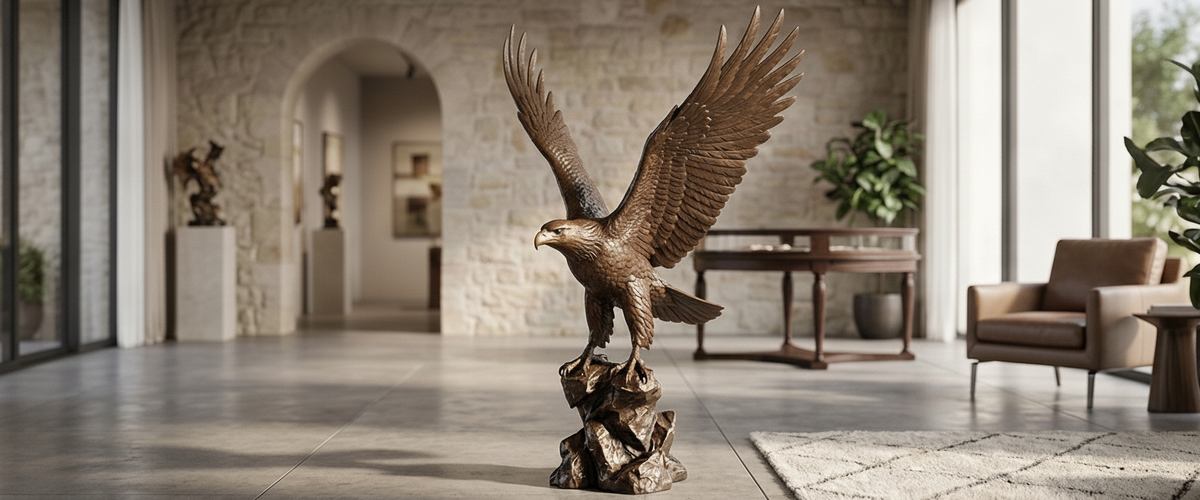

A bronze eagle with its wings flung open looks planted in a showroom, standing on a wide plinth under bright lights. Put the same bird in a hallway in Dallas or on a terrace in Napa and a different question takes over: where is all that weight actually sitting? Tall eagle statues carry most of their mass in the upper body and wings, which is exactly where you do not want it. What follows is the studio-floor view of buying one.

At a Glance
Center of gravity: raised wings push it well above the midpoint, so the base matters more than the bird.
Base: rock and stump bases spread the load; slender talon-on-branch compositions need fixing.
Material: cast bronze at five feet (about 1.5 m) is dense and quiet; hollow resin is light and tends to sway.
Clearance: measure the wingspan against doors, beams and walkways before you measure height.
Fixing: tall eagle statues in homes with pets, guests or wind exposure should be anchored.
Why Tall Eagle Statues Carry Their Weight Higher Than You Think
Sculptors love the moment an eagle opens its wings. The shoulders lift, the primaries spread, the chest pushes forward. Structurally, that pose moves a lot of metal up and out. On a closed-wing bird the mass sits low and centered over the feet. With wings raised, a good share of it sits at head height or above, cantilevered from the shoulders.
Showrooms flatter tall eagle statues because the piece usually stands on a wide temporary plinth. At home, on a narrower pedestal or straight on the floor, the lever arm gets longer and a small nudge travels further. Our rule in the studio: judge a raised-wing eagle by its footprint, not its height. If the wingtips reach well beyond the base on both sides, it needs a heavier base or a mechanical fixing.

Talon, Rock or Stump: Which Perch Base Actually Carries the Load
The perch is part of the engineering. A talon gripping a thin branch looks lively, but that grip is often the narrowest structural point in the whole casting. Rock bases do the opposite, giving a broad, heavy footing that can hide internal steel. Stump bases sit in between; they lift a smaller bird to eye level but add use as they go.
At the same height, the difference is easy to see. On open ground or a terrace, a cast-rock footing like the one under the Monumental Bald Eagle Bronze Sculpture (Rock Base) - 220cm, about 7 feet 3 inches (220 cm) tall, spreads the load across a broad mass. A branch-base eagle of similar size reads lighter and more airborne, and it asks more of its fixings. Neither is wrong. They suit different floors.
Bronze Versus Resin at Five Feet: Sway, Weight and the Knock Test
Around five feet (1.5 m), material starts to change how an eagle behaves. Resin eagles are usually cast hollow over a light core. They are easy to lift and just as easy to rock; a slammed door or a large dog's tail can set a tall one swaying. Lost-wax bronze is far heavier for the same size and much stiffer, so it stays put, and thin wing sections stay crisp for decades outdoors.
The knock test settles it quickly. Tap the chest with a knuckle. Bronze answers with a short, dull ring and no flex. Resin gives a hollow thud, and on thin wings you can sometimes feel the surface give. Outdoors, resin is also vulnerable at the shoulder joints, where freeze-thaw cycles in cold climates can open hairline cracks within a season or two. For tall eagle statues meant to stay in place for years, we steer people toward bronze or stone. Indoors, a cast bronze bird just under 6 feet, such as the Life-Size Traditional Bald Eagle Bronze Sculpture (180 cm), is tall enough to own a room while still sitting comfortably on a well-chosen plinth.

Wingspan Against Swinging Doors, Low Beams and Passing Shoulders
A wild bald eagle spans roughly six to seven and a half feet, according to the Cornell Lab of Ornithology, and sculptors often exaggerate the spread for drama. That span, not the height, is what collides with real rooms. Before choosing tall eagle statues for home decor, check the arc of any door that opens toward the spot, the height of beams or pendant lights above the wingtips, and the shoulder line of people walking past. Wingtips at 4 to 5 feet (1.2 to 1.5 m) sit right at shoulder height for most adults, and a coat or bag catching a primary feather is a common way indoor tips begin.
Tape the full outline on the floor and walk past it carrying something bulky. It takes five minutes and saves a lot of regret.
Head Angle Decides Whether a Tall Eagle Looks Alert or About to Topple
This one is visual rather than structural, but it changes how safe a piece feels. A head held level or slightly turned reads as watchful. Push it too far forward on a tall bird and the silhouette seems to pitch toward you, even when the base is secure. On a plinth above eye level, a downward gaze looks natural; at floor level, the same angle looks like a fall in progress. In a garden, where a landing pose needs visible counterweight, a stone bird such as the Alighting Eagle Grey Marble Garden Statue - 220cm lets the sheer weight of the marble settle the spread. When we adapt a pose for a commission, head angle is usually the first thing we tune against the client's viewing height.
Anchoring on Stone, Timber and Plinths: Fixings That Stop the Lean
Ask for threaded fixing points in the base of any tall eagle statue, because the right anchor depends entirely on what sits underneath.
Stone or concrete: stainless steel threaded rod set in chemical anchor into a drilled pad. This is our default for gardens and terraces.
Timber floors or decks: spread the load with a steel or stone sub-plate bolted into the joists, never only the boards. For monumental pieces, have a structural engineer confirm the floor rating.
Plinths: the plinth needs its own fixing to the ground, and the sculpture needs a pin into the plinth. A heavy bird on an unfixed plinth simply moves the tipping point lower.
Rugs and carpet: never stand a tall eagle on soft flooring; slow compression lets it lean over months.

A Buyer's Checklist Before You Commit
Measure wingspan and base footprint, not only height.
Decide indoors or outdoors first; it narrows material choice immediately.
Match the base to your floor: rock for open ground, stump or branch where you can fix securely.
Confirm the fixing method and who will install it.
Check sightlines from where people actually stand or sit.
Ask for finished weight and base drawings when you request a quote.
When a Commission Makes More Sense
Catalog tall eagle statues suit most spaces, but a bespoke eagle lets us adjust the variables this piece keeps returning to: wing angle, base mass, head position and fixing points. Giant Sculptures regularly reworks eagle poses so they sit correctly on a client's existing plinth or clear a particular ceiling. Budget depends on material, scale, pose complexity, engineering, installation and finishing, so the useful next step is a tailored quote built on your measurements. To compare poses and bases side by side, the full range of eagle statues and sculptures is the place to start, while bronze eagle statues narrows the field if longevity is your priority.
For wider placement ideas, A Large Angel Wing Sculpture Lives or Dies by Its Span is useful companion reading before finalising the setting and sightlines.