




































Most stair walls are decorated as though someone will stand still in front of them, hands clasped, gallery-style. Nobody does. People climb, turn, carry laundry and glance up at the wall from a steep angle for three seconds at a time. That changes almost everything about choosing large wall art for a staircase, from where the piece hangs to how deep its relief can safely project. Here is how we approach a large wall art staircase brief at Giant Sculptures, the bespoke studio behind the marble reliefs, carved wood panels and metalwork we ship to homes and venues worldwide.

At a Glance
Plan around the landing, where the eye rests, rather than the middle of the flight.
Set hanging height from the pitch line of the stair, not from the floor.
Choose one decisive piece of large staircase wall art over a stepped row of small frames.
Check relief depth against handrail clearance before you fall for a design.
Light for two conditions: daylight from above and dusk on the half-landing.
A Stair Wall Is Read on the Move
A living room wall is seen square on. A stair wall is seen on the diagonal, first from below and then from above, and almost always while the viewer is moving. Fine detail at eye level gets lost. Bold silhouette and a clear directional composition survive. That is why large staircase wall art with a sense of forward motion suits this wall so well. On a long straight flight, a figure that travels in the direction of the climb, such as the 180cm (about 5.9 feet) Striding Winged Figure Marble Relief Wall Art - 180cm, works with the viewer's movement instead of fighting it. Hang a static, symmetrical piece halfway up a long run and it can look as if it is sliding off the wall.
The Landing Is the Real Center
Most people instinctively center art on the midpoint of the flight. On a short straight run that can work. On any stair with a landing or turn, though, the landing is where people pause, rotate their body and look up. That is your true visual center, and in most large wall art staircase projects it is the best spot for a statement piece because it is the only place you can step back far enough to see something genuinely big. In a double-height hall, a landing wall can carry a panel on the scale of Archangel Triumph Marble Relief Wall Art - 350cm, at 350cm (roughly 11.5 feet), and let it anchor the whole stairwell; on a narrow flight the same piece would only ever be seen in slices.
A landing wall gives a large relief the viewing distance it needs.

Measuring From the Pitch Line
On a flat wall, the usual rule is to center art around 57 to 60 inches (145 to 152 cm) above the floor. A stair has no single floor, which is what trips up most large wall art staircase installs. Find the pitch line instead: the imaginary diagonal connecting the front edges of the tread nosings. Measure straight up from that line at the point where the artwork's center will sit, and use the same 57 to 60 inches as your guide. For a landing piece, measure from the landing floor, then check the view from the bottom step. If the lower edge seems to crowd the handrail from down there, lift it a few inches.
Tape a paper template the size of your large staircase wall art to the wall and walk the stairs both ways before anyone drills. Ten minutes of pacing saves a second set of holes in finished plaster.
Why One Large Piece Beats a Stepped Trio
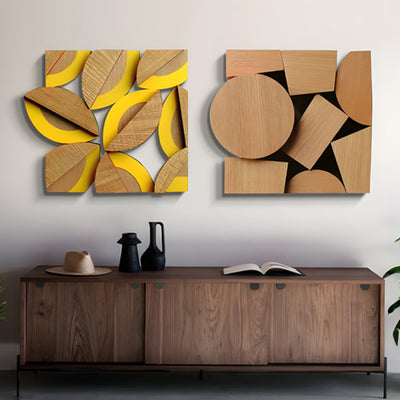
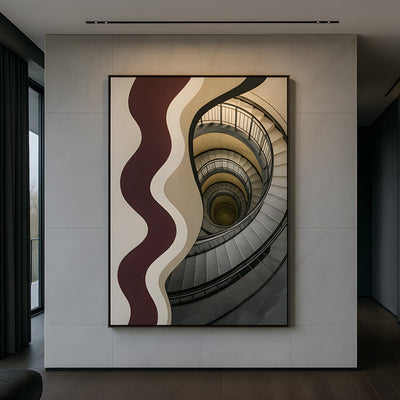
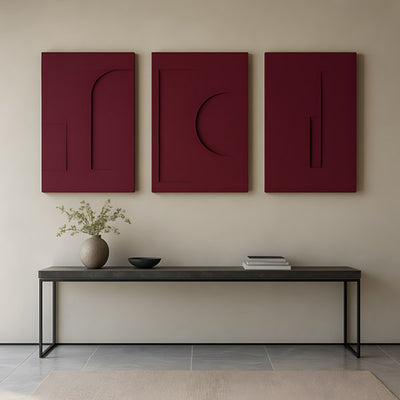
The stepped line of three frames climbing parallel to the handrail is the default solution, and more often than not it looks busy. Each frame demands its own glance, the spacing drifts as the stair changes pitch, and at walking speed the arrangement reads as clutter. A single piece of large staircase wall art gives the eye one resting point and makes the stairwell feel architectural. If you love the rhythm of multiples, look for that repetition inside a single panel instead: a carved wood relief such as Wenlock White & Burgundy Wood Relief 3D Wall Art builds its pattern from many elements within one frame, so you keep the rhythm and lose the fragmentation.
The Shoulder-Knock Test
This is where stair walls punish enthusiasm. The International Residential Code allows handrails to project up to 4.5 inches (114 mm) into the stair and asks for at least 1.5 inches (38 mm) of clear space between rail and wall. That leaves very little room for a deep relief at shoulder height, the biggest single constraint on any large wall art staircase design. A client walking the stair with a full-size mock-up will often catch an elbow on the way down, and the usual fix is a shallower carving profile below the rail line, with full depth reserved for the area above head height.
Do the test yourself. Stand on each step, turn your shoulders as you would carrying a box, and mark where you brush the wall. Anything below that line should be shallow, softly rounded at the edges, or both. Deeply sculpted 3D wall art belongs on landings and above the rail.

Keep carving shallow inside the shoulder-knock zone.
Skylight Glare Above, Dim Half-Landing Below
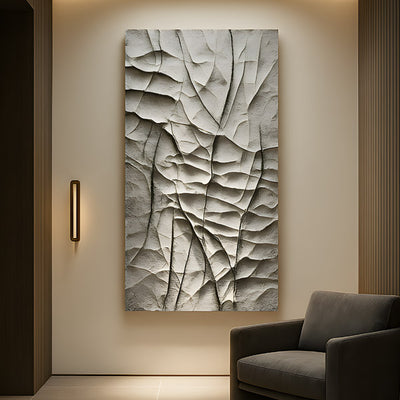
Double-height stairwells often give large staircase wall art the hardest light in the house: a skylight or tall window pouring glare down the top of the wall, and a gloomy half-landing underneath. Marble relief copes better than glazed prints because there is no glass to flash back at you, and raking daylight sharpens carved shadows. The dim zone is the real problem. A pair of adjustable ceiling spots angled at roughly 30 degrees to the wall face will pick out relief without hot spots. Stained or painted wood deserves more caution under a skylight, since direct sun shifts color over time; choose a wall with indirect light or ask us about UV-stable finishes. Brushed stainless steel from our metal wall art range solves the other half of the problem, bouncing skylight down to brighten a dark landing.
Choosing Large Wall Art for a Staircase: A Buyer Checklist
Viewing distance: can you step back from the landing at least the width of your large staircase wall art?
Height: have you measured from the pitch line, not the floor?
Relief depth: is anything deep sitting inside the shoulder-knock zone?
Fixing: is the wall solid masonry, or stud framing that needs a cleat or backing plate? Marble relief is heavy and should be installed by a professional.
Direction: does the composition move with the climb?
Light: have you looked at the wall at noon and after dark?
Access: can the crate physically get up the stair? Measure the tightest turn.

When the Wall Is Awkward, Commission It
Raking walls, curved stairwells and landings broken up by windows rarely suit an off-the-shelf rectangle. Our studio regularly adjusts proportions, grades relief depth zone by zone, or shapes a panel to follow the rake of the stair, which is often the most convincing large wall art staircase solution when the walls refuse to be square. Budget depends on material, scale, carving complexity, engineering, installation and finish, so send us photographs, wall measurements and the handrail position and we will prepare a tailored quote. Start with our wall art collection and treat every piece there as a proposal the studio can adapt.
Before you commit to any large staircase wall art, Large Metal Wall Art for a 30-foot Living Room Wall: A Studio Case Study is useful companion reading on placement, setting and sightlines.