





































































































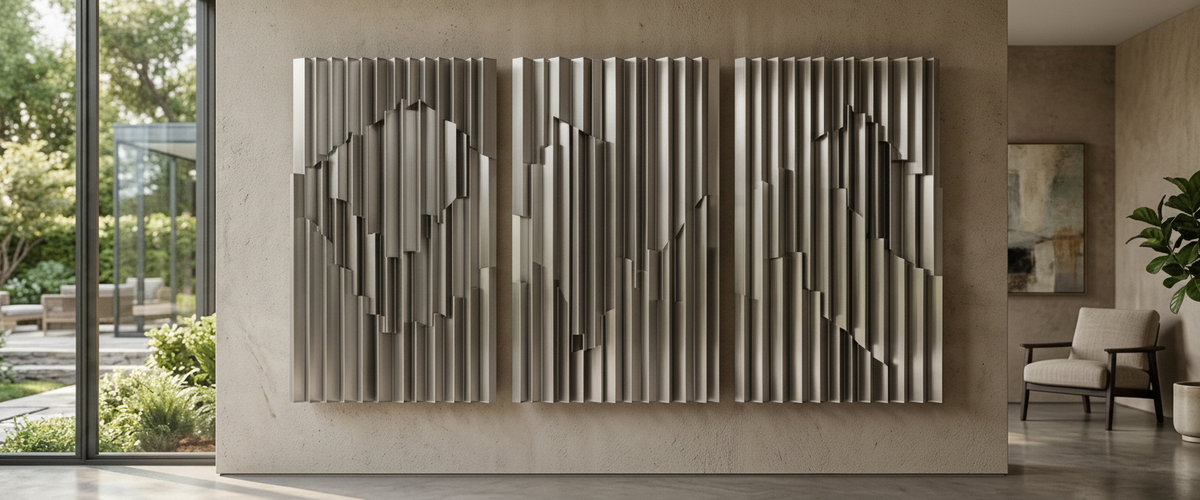

The wall ran close to 30 feet (about 9 m) along the back of an open-plan great room outside Scottsdale, and it was doing absolutely nothing. Two table lamps, a long console, acres of warm white paint. The client had already tried a pair of framed canvases and described the result, fairly, as "postage stamps." Large metal wall art was the right call. Working out what form it took ran to three weeks of back and forth, one rejected concept, and a fixing plan we redrew twice.

Quick Answer: What Large Metal Wall Art Needs on a Long Wall
Coverage: aim to fill roughly two-thirds to three-quarters of the usable wall width, measured between architectural interruptions rather than corner to corner.
Composition: on walls beyond about 16 feet (5 m), a sectional arrangement almost always reads better than one enormous panel.
Finish: brushed or hand-ground metal moves with the daylight; powder coat holds one flat color all day.
Fixings: find the real structure behind the plasterboard and spread the load across several points. Never one anchor.
Standoff depth: the shadow gap behind the work changes the piece more than most buyers expect.
Budget: driven by scale, material, fabrication complexity, finishing and installation, so ask for a tailored quote rather than guessing.
The Brief: Nothing Holding the Middle of the Room
Long walls fail in a specific way. The ends get anchored by furniture, joinery or a fireplace, and the center collapses. In this room the seating floated about 11 feet (3.4 m) off the wall, so the eye had a long run of nothing to cross before it landed on anything. The client's designer wanted mass and shadow, not pattern. That pointed us straight at metal. Large metal wall art gives you real relief depth at a weight a residential wall can actually carry, and it holds a crisp edge at a scale where timber and plaster start to look soft.
We measured the usable span at just under 24 feet (7.3 m) once we deducted the console run and the return into the kitchen. That number, not the full wall length, became the design envelope.

Why We Ruled Out One Enormous Panel
The first concept was a single continuous piece around 18 feet wide. It looked magnificent in elevation and terrible in reality, for three reasons. Freight and handling on a one-piece sculptural panel that wide get punishing; the only access route into the room included a 90-degree turn at the stair; and from the far side of the kitchen the whole thing would have flattened into wallpaper.
Three modules with 5-inch gaps read as one gesture from the sofa and hold their edges from the kitchen island.
Going sectional solved all of it. We split the composition into three modules with deliberate gaps of roughly 5 inches (13 cm) between them. Those gaps do real work: they let the wall color breathe through, they give each module its own shadow line, and they let the arrangement stretch or compress on site by an inch or two without anyone noticing. Modular thinking is also how most large metal wall art scales up. A layered orbital relief such as Aurelios Cosmic Blue Crystal Porcelain & Gold Orbit 3D Wall Art holds together as one gesture at close range, yet repeats cleanly when you group several across a wider span rather than stretching a single panel to fit.
Brushed Steel Versus Powder Coat: What the 4 PM Light Decided
Two finishes cover most large metal wall art, and we mocked up both, leaving samples on the wall for a week. Powder coat in a deep graphite looked sharper in the morning and went completely inert by late afternoon, when low desert sun rakes across that wall. Brushed stainless did the opposite. The grain caught the raking light and the panel shifted from pewter to a warmer bronze cast as the afternoon ran on. That decided it.
Neither finish is wrong. Powder coat is tough, color-stable and easy to specify across multiple modules, and the Powder Coating Institute is a sensible starting point on how the process behaves over time. Brushed and hand-ground metal, though, gives you a piece that is never quite the same twice in a day. If your wall gets directional light, brushed wins. If it sits in flat, even ambient light with no real sun path across it, powder coat or a patinated surface will hold more presence. Where a room needs warmth rather than cool reflection, cast bronze is the other honest route, and a figurative relief such as Galloping Herd Bronze Relief Wall Art, 120cm carries subject matter at a width that still sits comfortably above a low console.

Hanging 90 Pounds Without Trusting a Single Fixing
Most large metal wall art goes wrong on install day for one reason: the fixing plan was treated as an afterthought. The three modules here came in at roughly 90 pounds (about 40 kg) in total. That is not extreme, but plasterboard alone has no business carrying it. Our installer confirmed the wall build-up, located the studs, fixed a horizontal steel batten into the framing at multiple points, then hung each module off that batten. The load spreads across structure instead of hanging off drywall anchors, and it lets you slide modules laterally during alignment. Guidance from the Gypsum Association is blunt on this point: gypsum board is a surface, not a structural support.
Install Checklist for Large Metal Wall Art
Confirm wall build-up before ordering: stud and plasterboard, masonry, or plasterboard on battens over block.
Map studs, services and any recessed cabling before a single hole is drilled.
Spread weight across at least three fixing points per module, into framing or masonry.
Use a batten or rail system where you need lateral adjustment on site.
Dry-fit with paper templates at full size, taped up for 48 hours.
Check the lowest edge against sofa backs and console lamps, standing up as well as seated.
Three Sightlines We Tested Before Committing
We photographed the templates from three positions: the sofa, the kitchen island, and the doorway people actually enter through. Each one wanted something different. From the sofa the composition felt too high. From the island the gaps looked too tight. From the doorway the right-hand module clipped awkwardly against the window reveal. We dropped the whole arrangement about 4 inches (10 cm), widened the gaps, and shifted the group 7 inches (18 cm) left. Nobody who visits that house will ever know, which is the point.
Test sightlines the same way in your own room. Large metal wall art for a living room is nearly always seen from a distance and at an angle, not head-on the way gallery work is hung.

The Mistake We Caught on Install Day
Standoff depth. Our drawings had the modules sitting close to the wall, maybe half an inch. On the wall, in real light, the shadow disappeared and the metal looked stuck on. The installer packed the brackets out to roughly 1.5 inches (4 cm) and the pieces suddenly floated, each one throwing a soft band of shadow beneath it. That single adjustment did more for the room than any change to the artwork would have.
Packing the brackets out to 1.5 inches gave each module its own shadow band and lifted it off the plaster.
Carved timber behaves differently here, because the relief is cut into the face rather than lifted off the wall, so the shadow lives inside the piece instead of behind it. In a room that already has enough hard reflection, a surface like Barwick Taupe Flow Abstract 3D Carving Wall Art is closer to the right design language, and it can sit almost flush without losing depth.
If we saw the same wall tomorrow, we would add a fourth narrower module at the far end to carry the composition past the console, and we would specify the standoff depth at drawing stage rather than leaving it to the brackets. Both are lessons you may as well have for free. The full metal wall art range shows how depth reads across finishes, and 3D wall art is the place to compare relief options if you want texture with a warmer palette.
Commissioning to Fit the Wall You Actually Have
Standard sizes rarely land perfectly on a long wall. Bespoke large metal wall art at Giant Sculptures starts from your measured span, wall build-up, lighting direction and viewing distances, and the studio works back from there to material, module count and fixing strategy. Send elevations, a few photographs taken at different hours, and the sightlines that matter most. Cost depends on scale, material, engineering and installation complexity, so we quote each piece individually rather than quoting from a size chart.
For wider placement ideas, Large Abstract Wall Art for Hallways: Bold Lines Win at Walking Speed is useful companion reading before finalising the setting and sightlines.