





































































































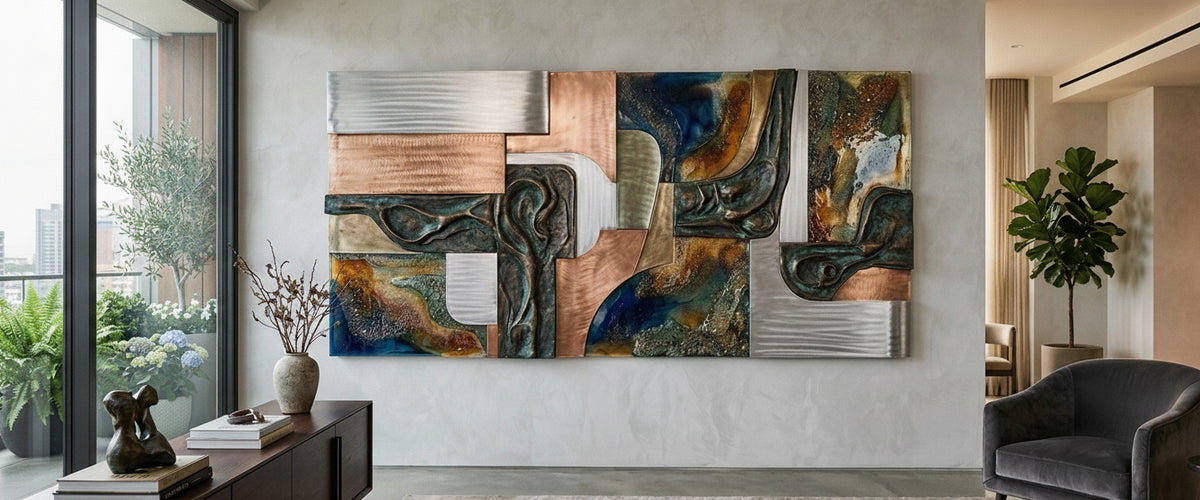

A large mixed media piece can carry an entire room, or it can vanish the moment someone hangs it too high and lights it flat. The material is not the problem. Placement is. We have shipped textured metal-and-resin panels to double-height living rooms in California and layered steel-and-stone wall works to gallery walls in NYC, and the difference between a large mixed media piece that stops people and one that people walk past almost always comes down to a handful of decisions made before installation.
This guide is about those decisions. Not the shopping, the seeing.

Key Takeaways
- Scale first. A large mixed media work needs breathing room; crowd it and the texture reads as clutter.
- Eye line rules. Center the visual weight around 57 to 60 inches (145 to 152 cm) from the floor for standing sightlines, lower for seated rooms.
- Light across, not at. Raking light reveals relief and layering; flat frontal light kills it.
- Backdrop matters more than the frame. Contrast between the piece and the wall decides how far it carries.
- Outdoor placement changes the material conversation. Weather-rated metals and stone belong outside; fragile composites do not.

What Large Mixed Media Actually Looks Like in a Room
Mixed media is a broad term, and that is part of the appeal. In practice, a large mixed media wall art piece might combine brushed or patinated metal with cast resin, weld steel elements onto a textured stone-effect ground, or layer bronze relief over a colored panel. The point is depth. Unlike a flat canvas, these works throw shadows and shift as you move past them, which is exactly why scale and light do so much of the heavy lifting.
In a home, the effect changes by room. Over a low sofa in an open-plan Texas living room, a wide horizontal mixed media art wall piece echoes the furniture line and grounds the seating. In an entrance hall with a tall ceiling, a vertical large mixed media composition pulls the eye up and gives a narrow space a sense of ambition. Commercial buyers, hotel lobbies, restaurant walls, corporate receptions, tend to go bigger still, because those rooms are read from twenty or thirty feet away and small work simply disappears.
If you are still deciding on a direction, our mixed media art collection is a useful way to see how metal, texture and color behave together at size before you commit to a bespoke commission.

Scale, Sightlines and Pedestal Height
The single most common regret we hear is "we should have gone bigger." A wall art mixed media piece competes with everything around it: window openings, furniture, architectural features. On a large blank wall, a piece that feels generous in the showroom can look stranded once it is up. A rough working rule for a feature wall is that the artwork should fill roughly two-thirds to three-quarters of the usable wall width above the furniture. Under that, it starts to read as an afterthought.
Height is where good intentions go wrong. The instinct is to hang high, and the result is a large mixed media piece floating above everyone's sightline with an awkward gap below it. For standing rooms, aim to center the visual mass around 57 to 60 inches (145 to 152 cm) from the floor, which lines up with the museum-standard eye line most galleries use. In a dining room or lounge where people are mostly seated, drop it. The eye line of a seated viewer is lower, and the piece should meet it.
For freestanding or plinth-mounted work, pedestal height changes the entire read. Put a piece on a tall plinth in a room with low seating and you force everyone to look up at it, which can feel monumental or simply uncomfortable depending on the work. Lower plinths invite closer inspection of texture and layering. We often prototype plinth height on site with temporary blocks before anything is fixed, because a few inches genuinely changes how a large mixed media work speaks to the room.

Indoor Versus Outdoor: When Each Wins
Not every large mixed media piece belongs outside, and this is where buyers get caught out. Indoor works can use fragile combinations, delicate resins, unsealed pigments, softer metals, because they never face rain, frost, or UV. Move those outdoors and they degrade fast.
Outdoor placement rewards a different palette. Weather-rated stainless steel, bronze, Corten (weathering steel), and stone hold up to decades of exposure, which is why our outdoor large mixed media commissions lean heavily on them. Corten in particular suits a layered approach outdoors: its stabilized rust surface pairs well with stone or cast elements and needs almost no upkeep once the patina settles. The US Environmental Protection Agency notes that weathering steels form a protective oxide layer that slows further corrosion, which is exactly the property that makes Corten so forgiving in a garden setting (epa.gov).
Indoors wins when you want intricate texture, color depth, or materials that would not survive a Napa winter or a coastal salt spray. Outdoors wins when you want a piece to anchor a landscape, a Hamptons garden, an Aspen terrace, a hotel courtyard, and pull sightlines across open space. If a client wants an outdoor look, we steer the specification toward materials engineered for it rather than trying to weatherproof something that was never meant to leave the house.

Light, Backdrop and Contrast
Light is the difference between texture and mud. A layered large mixed media piece needs light that grazes across its surface at an angle, called raking light, so the relief casts shadows and the material reads in three dimensions. Light it straight on and you flatten everything you paid for. Indoors, a pair of adjustable spots angled from above and slightly to the side does far more than a single ceiling downlight. The Getty's conservation guidance on displaying textured and reflective surfaces makes the same point: angle and intensity shape how the eye reads dimensional work (getty.edu).
Backdrop is the quieter decision, and often the more important one. A dark bronze-and-steel piece on a dark wall can look sophisticated up close and invisible from across the room. Contrast carries the work. Pale, textured or matte metal reads best against a mid-to-deep wall; dark, patinated work sings against a lighter ground. Before committing to a wall color, hold a large sample or a full-size paper template against it in the actual daylight the room gets, not showroom light. Daylight shifts through the day, and a north-facing NYC apartment treats a piece very differently from a sun-flooded Texas great room.

Common Placement Mistakes We See
For wider placement ideas, A Placement Guide for Large 3D Metal Wall Art Panels is useful companion reading before finalising the setting and sightlines.
After enough large mixed media commissions, the same errors repeat. Here is what to avoid.
- Hanging too high. The most frequent fix we recommend. Lower it until the visual mass meets standing or seated eye line.
- Undersizing for the wall. A piece that suited the last home rarely fits the new one. Measure the wall, then size up.
- Flat lighting. One overhead downlight flattens relief. Use raking light from an angle.
- Ignoring contrast. Matching the piece to the wall tone erases it from a distance.
- Blocking the approach. Furniture, plants or a door swing that cuts the sightline undoes the placement.
- Wrong material outdoors. Composite or unsealed work outside fails within a season or two. Specify weather-rated metal or stone.

How to Decorate a Wall With Mixed Media
If you are building a wall composition rather than hanging a single work, treat it like a layout, not a scatter. Decide on one dominant large mixed media piece and let everything else support it. Keep a consistent gap between elements, usually 2 to 3 inches (5 to 8 cm) for tightly grouped work, so the eye reads the group as one field. Anchor the arrangement to a horizontal line running through the visual centers rather than aligning tops or bottoms, which almost always looks stiff.
For a genuinely large statement wall, a single commissioned piece usually beats a gallery grid. It reads cleaner, ships as one considered composition, and lets us control scale and material against your exact wall. That is the case for a bespoke approach: we size, texture and finish the work to the room instead of asking the room to accommodate stock dimensions.
Commissioning a Piece That Fits
Giant Sculptures works as a bespoke sculpture supplier, which means a large mixed media commission does not have to be a compromise between what you want and what is in stock. Share the wall dimensions, the light the room gets, the surrounding materials and the sightlines, and we specify accordingly. Whether the large mixed media work lives indoors as a layered metal-and-resin panel or outdoors as a Corten-and-stone piece built for weather, the specification follows the placement rather than the other way round.
Budget depends on material, scale, complexity, engineering, installation and finishing, so the honest answer to "what does it cost" is that it is quoted per project. Send us the room and we will tell you what makes sense.
Start with the abstract art and mixed media art collections to sharpen your direction, then bring the wall to us and we will build your large mixed media piece to it.