










































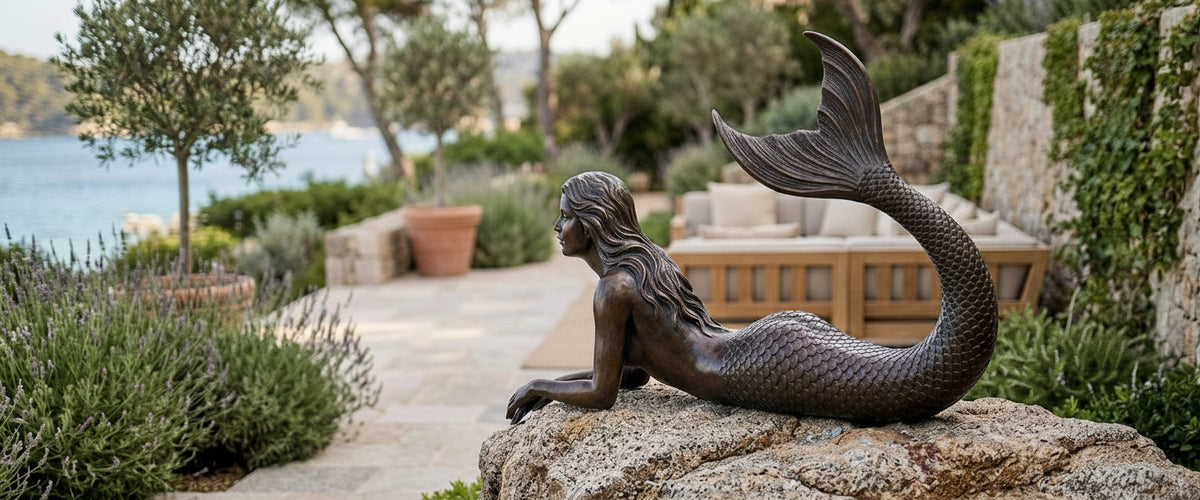

Most disappointing mermaid sculptures fail for one reason: they were bought at the wrong size. A bronze mermaid statue sitting three feet tall on a wide pool terrace looks apologetic, while the same figure at seven feet reads as the reason the terrace exists. Scale is the first decision, and it drives almost everything after it, from foundation work to how the patina will age in salt air.

Key Takeaways Before You Shop
Bronze earns its price outdoors. Cast bronze develops a protective patina rather than degrading, which is why coastal municipalities have trusted it for over a century.
Reclining poses need horizontal room; upright and arching poses need vertical sightlines. Match the pose to the space, not just your taste.
Go bigger than instinct suggests. Outdoors, a piece loses visual weight fast. A large bronze mermaid statue in the 6 to 11 ft range (roughly 180 to 350 cm) holds a garden or courtyard properly.
Water changes the brief. Fountain versions require plumbing, a reservoir and drainage planned before delivery.
Budget depends on material volume, scale, finishing, engineering and installation. Ask for a tailored quote rather than assuming a figure.
Siting at the short end of a pool gives the figure a reflection and a clear approach.
What a Bronze Mermaid Statue Signals, and Who Actually Buys One
The mermaid is one of the few figurative subjects that works in both classical and contemporary settings without looking confused. She carries maritime and mythological weight, she sits comfortably beside water, and she gives a garden a narrative rather than just an ornament. Buyers we work with tend to fall into four groups: private homeowners with pools or coastal frontage, hotels and resorts wanting a photographed focal point, marina and waterfront developers commissioning civic-scale work, and collectors building a figurative bronze group across a property.
The subject also carries a place-making function. A bronze mermaid statue at the head of a pool, at the turn of a drive, or on a jetty gives visitors an anchor point and a reason to walk toward it. That is why resorts keep asking for them, and why the piece needs to survive being photographed from every angle rather than only from the front.
How to Compare Bronze Mermaid Statue Options Before Buying
Once you look past the thumbnail, the differences between pieces are substantial. Use these criteria in order.
1. Is it solid cast bronze, or bronze-effect?
Plenty of listings describe a resin or cold-cast composite with a bronze powder surface as "bronze". They photograph well and cost far less, and they will chalk, fade and crack under UV and freeze-thaw cycles. Genuine sand-cast or lost-wax bronze is a copper alloy; the Copper Development Association documents how copper alloys form a stable surface layer that slows further corrosion instead of accelerating it. That is the entire reason bronze outlives its owners outdoors.
2. Pose and viewing angle
A reclining figure reads best when you approach it along its length. An arching or seated figure reads best head-on and from below. Compare two versions of the same subject and the difference is obvious in situ. Where there is a clear backdrop of hedge, water or sky behind the plinth, an arching treatment such as the Large Classical Reclining Mermaid Bronze Sculpture (Arching Back) - 120cm keeps the curve of the tail legible; a propped-upright version of the same figure suits a low plinth beside steps or pool coping, where the viewer looks down onto it rather than across.
3. Casting and chase quality
Look at the hands, the hair, the join between figure and rock, and the trailing edge of the tail. Sloppy chasing shows as soft detail, visible seam lines and flat scale texture. On a good cast you can read individual scales and the tension in the fingers.
Chasing quality shows first in the scales, hands and hairline, which is where you should look before buying.
4. Base, mounting and fixing points
Ask how the piece fixes down. Integral rock bases, threaded feet and pre-drilled anchor points all change installation cost. A figure that will sit near a walkway or in a public venue needs mechanical fixing into a concrete pad, not gravity alone.
5. Patina specification
Dark brown, verdigris green, and lighter golden-brown patinas each behave differently against stone, planting and water. Confirm what you are getting rather than trusting a single edited photograph.
Materials, Finishes and Scale Decisions
Bronze is the default for this subject for good reason, and the finish is where a piece either flatters your setting or fights it. Verdigris and blue-green patinas sit beautifully against limestone, gray granite and silvered teak; they can disappear against dense evergreen planting. Dark chocolate-brown patinas hold their outline against foliage and look strongest near water, where reflected light picks up the highlights on shoulders and tail. In our studio the pieces that photograph best a decade later are usually the mid-brown patinas that have been waxed regularly, because the highlights stay legible instead of flattening out.
Scale deserves more attention than most buyers give it. Indoors, in a lobby or stair hall, a 120 cm figure is generous. Outdoors, surrounded by sky and planting, the same piece can look like an accessory. A two-figure reclining group at around 220 cm (roughly 7 ft 2 in) gives you enough mass to terminate a lawn view or hold the far end of a pool. For entrance courtyards, resort arrival points and long drives, a multi-figure group at the height of the Life-Size Classical Mermaid and Merboy Bronze Sculpture - 350cm (about 11 ft 6 in) is where the sculpture becomes the address rather than a detail within it.
Weight follows scale, and it dictates access. Larger cast bronze groups run into hundreds of pounds (well over 100 kg) and often need a crane, tracked lift or extra hands over soft ground. Sort that out before you fall in love with a size.
What the Copenhagen Mermaid Teaches About Placement
For wider placement ideas, Bronze Framed Wall Art: How to Buy a Piece That Earns Its Wall is useful companion reading before finalising the setting and sightlines.
The most searched mermaid sculpture in bronze anywhere in the world is not large. Edvard Eriksen's Little Mermaid, show on the Langelinie promenade in 1913, is close to life-size and sits low on a granite boulder at the waterline, as Visit Copenhagen notes. She works because of siting, not size. Water on three sides, a low viewing angle, an approach along the quay, and nothing competing for attention.
That is the transferable lesson. A modest bronze mermaid statue placed where water, sightline and approach all cooperate will outperform a much larger piece dropped into a busy border. Before choosing a size, work out where the viewer stands, what is behind the sculpture, and whether water is involved. We have had clients halve their intended budget on scale and double the impact simply by moving the plinth eight feet closer to the pool edge.

Where to Place a Bronze Mermaid Statue for Real Impact
Pool terraces: at the short end of the pool, on axis with the main doors, so the figure reflects in still water at dawn. Popular on Naples and Palm Beach properties for exactly this reason.
Coastal frontage and jetties: low mounting on natural rock, facing the water. Expect a faster patina shift in salt air and plan waxing accordingly.
Formal gardens: at the end of a gravel walk or in a clipped niche, where the curve of the tail plays against straight lines. This works well in Hamptons and Napa gardens with strong hedging.
Hotel arrival courts and lobbies: centered in a water basin, lit from below at 30 degrees. Interior placements need lower plinths than owners expect.
Fountains: a mermaid with a water feature earns its place year-round. Where the setting needs movement and sound as well as a silhouette, a composition like the Life-Size Classical Mermaid with Dolphin and Sea Turtle Bronze Fountain - 250cm (about 8 ft 2 in) does both jobs in one piece, but it needs the pump, reservoir and power run designed in from the start.
One placement mistake we see repeatedly: putting a mermaid figure directly under a dense tree canopy. Sap, bird traffic and constant damp shade all work against the surface and rob you of the light that makes bronze worth having.
Budget, Commissioning and Delivery
Cost on a large bronze mermaid statue is driven by bronze volume, wall thickness, the number of separate castings, chasing and welding hours, patina complexity, crating, freight and installation. Two pieces of the same height can differ significantly if one is a single figure and the other is a multi-figure group with a fountain system. Rather than guess, send us the site details and we will quote against your actual conditions.
Pre-Purchase Checklist
Confirm the material is genuine cast bronze, with the alloy and casting method stated.
Measure the sightline distance from the primary viewing point, then choose scale against that number.
Check access: gate widths, turning circles, soft ground, steps, overhead cables.
Agree the patina color and finish in writing, ideally against a sample or reference photograph.
Specify the base: integral rock, separate plinth, or fixing into a poured pad.
For fountains, confirm pump specification, reservoir volume, power supply and winter drain-down.
Plan crating, offload method and who supplies lifting equipment on the day.
Book an annual wax and wash into your maintenance calendar before the piece arrives.
Delivery on large work is a logistics exercise, not a courier drop. We crate to survive ocean and road freight, and we ask for photographs of the approach route in advance. On a Gulf Coast commission a few years back, the only thing between the truck and the pool terrace was a 40 in gate; knowing that early meant we planned a crane lift over the wall rather than discovering the problem on arrival.
How Giant Sculptures Handles Bespoke Mermaid Commissions
Giant Sculptures works as a bespoke sculpture supplier at architectural scale, so a mermaid does not have to be taken off the shelf as-is. We adjust height, change the pose, split a single figure into a group, alter the base to match your stone, revise the patina, or convert a static figure into a fountain. Clay maquettes and 3D visuals come first, then casting, then finishing, so you approve the pose and patina before metal is committed.
If you are still narrowing the field, browsing the wider large bronze sculptures range is useful for calibrating what different heights actually look like, and the bronze garden statues collection shows how figurative work sits alongside planting. Buyers building a whole garden narrative often pair a mermaid with pieces from our bronze animal sculptures range so the water feature has company along the walk.
Get the scale, pose and patina right and a bronze mermaid statue stops being decoration. It becomes the piece your property is remembered for, and with a wash and wax each year it will still be doing that job for the next owner.