





































































































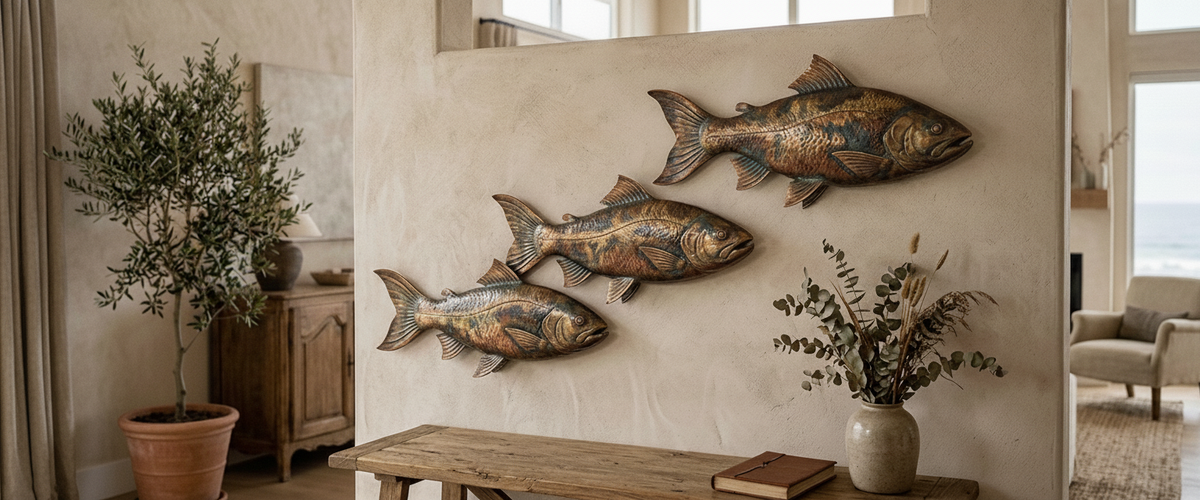

Three fish on a wall can read as a school in motion, or as three fish that got lost on the way to a frame shop. The gap between those two outcomes is not budget and it is rarely the sculpture itself. Good fish sculpture wall art lives or dies on four decisions: how many bodies you hang, which way they swim, how far they stand off the plaster, and whether the fixings can honestly carry cast metal. Get those right and a plain hallway turns into a current.

Quick Answer: What Makes Fish Sculpture Wall Art Work
Odd numbers move, even numbers pose. Three or five fish read as a shoal; one large fish reads as a portrait, and that is a legitimate choice.
Pick a swim direction and commit. Every body should travel the same way, with one rebel at most.
Relief depth sells the illusion. Roughly 2 to 4 inches (5 to 10 cm) of stand-off casts the shadow that makes a fish look alive.
Material follows environment. Hammered copper and patinated bronze handle damp air; glazed ceramic is beautiful indoors and fragile everywhere else.
Weigh before you drill. A cast panel is not picture-hook territory. Plan anchors into studs, masonry or a batten.
Cost depends on material, scale, relief complexity, finishing and installation. Ask for a tailored quote rather than guessing from a size alone.
A five-body copper shoal, staggered vertically so the group reads as one moving shape.
One Fish or a Shoal? The Numbers Change the Story
A single large fish is a statement of species and craft. Hang one well-modeled body at eye level on a broad wall and the viewer studies the gill plate, the fin ribs, the way light rolls across the flank. It behaves like a portrait. That works in a study, a stairwell landing, or above a long console where you want one clear focal point.
A group behaves completely differently. Three fish create a rhythm, five create a current, and seven starts to feel like an installation that needs a wall long enough to justify it. Most fish sculpture wall art briefs that cross our desk settle on three or five bodies for exactly that reason. The trick is that a shoal is read as one shape before it is read as individual bodies, so the outline of the whole group matters more than any single fin. Scale is what decides between the two routes: on a double-height wall, a single body only holds the space if it is genuinely vast, which is why a piece like the Gold Wire Honeycomb Fish Wall Art Sculpture - 370cm, roughly 12 feet nose to tail, works alone where a three-foot fish would not. Below about 6 feet (183 cm) on a wall that size, a single fish looks stranded and a group serves you better.
Setting the Swim Direction, Spacing and the Edge You Should Never Crowd
Fish swim into a room, not out of it. Point the noses toward the main entry sightline or toward the seating, and the group pulls the eye inward. Reverse it and the wall feels like it is leaking.
Spacing wants variation. Even gaps make a diagram; staggered gaps make a shoal. We usually offset each body vertically by a third to a half of its own height and vary the horizontal gaps so no two are identical. Then leave the group breathing room at the wall edge. Crowding the outer corner is the single most common mistake we see in photos clients send us; anything closer than about 12 inches (30 cm) to a corner, door casing or cabinet run reads as an accident. On the studio floor we cut paper templates for every fish sculpture wall art layout and shuffle them for twenty minutes before a fixing plan is signed off, and it is worth doing the same with kraft paper taped to your own wall.
Hammered Copper, Patinated Bronze and Glazed Ceramic Under Raking Light
Side light is the real collaborator here. A wall washer or a picture light set at a shallow angle drags shadow across every hammer mark, and materials respond very differently to it.
Hammered copper throws hundreds of small highlights and warms up under lamplight; the raised repoussé technique behind it has been used for sheet-metal figures for millennia, and the tool marks are part of the appeal, not a flaw. Patinated bronze is quieter and deeper, with chemical coloring that shifts from near-black to green-brown as the light moves; the Metropolitan Museum's account of Greek bronze statuary technique is a good primer on why cast bronze surfaces hold detail so well. Glazed ceramic gives you color no metal can match, plus a wet-looking gloss that suits fish beautifully, but it chips on impact and it does not forgive a bad fixing.
For most fish sculpture wall art commissions we steer buyers toward metal, and you can see the range of tones across our metal wall art and bronze wall art collections.
Raking light across a patinated bronze flank: the shadow under the belly is what reads as life.
Relief Depth Is the Whole Trick
Flat silhouettes cut from sheet look like signage. Depth is the line between decoration and fish sculpture wall art that actually swims: the moment a body has real volume, with the belly curving away from the wall and the tail lifting off it, the piece stops being a shape and starts being an animal. Shallow relief of an inch or so (about 2.5 cm) suits tight corridors where knuckles and shoulders pass close. Deeper work, standing 3 to 5 inches (8 to 13 cm) proud, belongs on walls people view from across a room.
Half-round bodies are the sweet spot for most homes: full modeling on the visible face, hollow behind, so weight stays sensible. Framed relief panels work differently again, because the border does the containing rather than the wall; a matched pair such as Artelis 2-Set Fox & Panda Animal Framed Wall Art is the format to copy when a wall already has busy joinery competing for attention.
Bathrooms, Coastal Kitchens and Covered Terraces
Humidity does not attack solid bronze or copper in any dramatic way; it attacks the fixings, the wax layer and any steel hidden inside the piece. That is the real risk for fish sculpture wall art in a shower room. Repeated wetting and drying cycles are what accelerate surface change, and conservation guidance on caring for metal objects consistently points to stable conditions and gentle waxing rather than aggressive cleaning. The American Institute for Conservation's guidance on caring for treasured objects is a sensible reference for owners.
Salt air is harsher. On a Gulf Coast terrace or a Hamptons pool house, chloride deposits sit on the surface and keep working, so specify marine-grade fixings, ask for a sealed or lacquered finish where appropriate, and rinse the piece with fresh water a few times a year. We shipped a five-body brass shoal to a covered lanai in Florida, and the owner's only maintenance routine is a hose-down each quarter and a wax coat each winter. Four years on it still reads as intended, just a shade warmer in tone.

Hanging Weight Honestly
This is where good projects go wrong. Cast fish sculpture wall art is almost always heavier than it looks: a single panel can weigh 40 to 100 pounds (18 to 45 kg) or considerably more at scale, and drywall anchors rated for a mirror will not do.
Confirm actual weight per piece with your supplier before you buy fixings.
Locate studs or masonry; if neither lines up, fit a concealed hardwood or steel batten across the wall and mount to that.
Use French cleats for heavy single bodies so load spreads along a rail rather than two points.
Add a lower stabilizer pin on deep relief pieces to stop the bottom edge kicking out.
In bathrooms and coastal rooms, specify stainless or marine-grade hardware, never plain steel.
For anything over roughly 100 pounds (45 kg), or above a bathtub or stairwell, get a professional installer.
Species Accuracy and When a Stylized Fish Wins
Literal species work has a place. A recognizable tarpon, bass or koi carries meaning for anglers, waterfront homeowners and clubhouses, and accuracy in fin count and body proportion is what makes those pieces convincing to people who know the fish. Get it wrong and every guest who fishes will notice.
Stylized forms usually win in contemporary interiors, and they are where fish sculpture wall art stops competing with taxidermy. Simplify the body, exaggerate the tail, let the surface carry the interest, and the piece reads as sculpture rather than a trophy cast in metal. It also ages better against changing decor. Where a room calls for decorative pattern instead of anatomical weight, in a nursery, a hallway or a softer coastal scheme, a piece built from stylized repeating elements, such as Blossomkin Bird 3D Floral Wall Art, is closer to the right design language than a literal cast body. If you are commissioning through Giant Sculptures, settle this early, because the modeling route, casting method and finishing all follow from that one decision. Browse the wider wall art and wall decor range to see how far the stylization can travel before a fish stops reading as a fish.
Commissioning a Bespoke Shoal
Bespoke fish sculpture wall art is straightforward to brief if you bring four things: wall dimensions with obstructions marked, a photograph taken from the main viewing position, your preferred material and finish, and whether the room is heated, humid or open to salt air. From there we can advise on body count, scale, relief depth and mounting method, then quote against the real engineering rather than a guess. Large-scale metalwork is what our studio does daily, and a shoal is one of the few subjects where making it bigger genuinely makes it better.
For wider placement ideas, Bronze Metal Wall Art: How Placement Changes What You See is useful companion reading before finalising the setting and sightlines.